

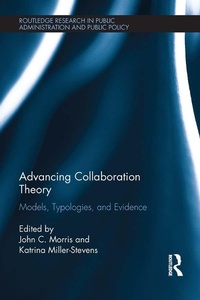
Advancing Collaboration Theory
Models, Typologies, and Evidence
Published on 7. September 2015
314 pages
978-1-317-60851-6 (ISBN)
Description

The term collaboration is widely used but not clearly understood or operationalized. However, collaboration is playing an increasingly important role between and across public, nonprofit, and for-profit sectors. Collaboration has become a hallmark in both intragovernmental and intergovernmental relationships. As collaboration scholarship rapidly emerges, it diverges into several directions, resulting in confusion about what collaboration is and what it can be used to accomplish. This book provides much needed insight into existing ideas and theories of collaboration, advancing a revised theoretical model and accompanying typologies that further our understanding of collaborative processes within the public sector.
Organized into three parts, each chapter presents a different theoretical approach to public problems, valuing the collective insights that result from honoring many individual perspectives. Case studies in collaboration, split across three levels of government, offer additional perspectives on unanswered questions in the literature. Contributions are made by authors from a variety of backgrounds, including an attorney, a career educator, a federal executive, a human resource administrator, a police officer, a self-employed entrepreneur, as well as scholars of public administration and public policy. Drawing upon the individual experiences offered by these perspectives, the book emphasizes the commonalities of collaboration. It is from this common ground, the shared experiences forged among seemingly disparate interactions that advances in collaboration theory arise.
Advancing Collaboration Theory offers a unique compilation of collaborative models and typologies that enhance the existing understanding of public sector collaboration.
Organized into three parts, each chapter presents a different theoretical approach to public problems, valuing the collective insights that result from honoring many individual perspectives. Case studies in collaboration, split across three levels of government, offer additional perspectives on unanswered questions in the literature. Contributions are made by authors from a variety of backgrounds, including an attorney, a career educator, a federal executive, a human resource administrator, a police officer, a self-employed entrepreneur, as well as scholars of public administration and public policy. Drawing upon the individual experiences offered by these perspectives, the book emphasizes the commonalities of collaboration. It is from this common ground, the shared experiences forged among seemingly disparate interactions that advances in collaboration theory arise.
Advancing Collaboration Theory offers a unique compilation of collaborative models and typologies that enhance the existing understanding of public sector collaboration.
Reviews / Votes
"In recent years, collaboration has emerged as a central component of public administration and nonprofit organization management in practice as well as in theory. Yet, it is way too tempting to simply assume that when two organizations are linked within or across sectors, they will work together - collaboratively and effectively for the public good. With Advancing Collaboration Theory, Morris and Miller-Stevens offer us a thoughtful and interesting re-examination of the what's and how's of collaboration. This is a "must read." We are indebted to them."-J. Steven Ott, University of Utah"At a time when research on collaboration in the public service has significantly grown but not yet coalesced into a clear and coherent knowledge base, Morris and Miller-Stevens' Advancing Collaboration Theory is a welcome addition that fills a critical gap in the current study of collaboration. Deeply rooted in the scholarship, this work charts the major unanswered dilemmas in collaboration research and provides five themes that structure their understanding and exploration of collaboration in the public service. This work contains conceptual and empirical chapters that explore collaboration from multiple perspectives and in multiple settings, shining a bright light on these dilemmas and capturing perspectives on both the process of collaboration and the structures that arise from collaborative endeavors. I have little doubt this book will quickly become required reading for those interested in the study and practice of collaboration in the public service." -Jessica E. Sowa, University of Colorado Denver "In recent years, collaboration has emerged as a central component of public administration and nonprofit organization management in practice as well as in theory. Yet, it is way too tempting to simply assume that when two organizations are linked within or across sectors, they will work together - collaboratively and effectively for the public good. With Advancing Collaboration Theory, Morris and Miller-Stevens offer us a thoughtful and interesting re-examination of the what's and how's of collaboration. This is a "must read." We are indebted to them."-J. Steven Ott, University of Utah
"At a time when research on collaboration in the public service has significantly grown but not yet coalesced into a clear and coherent knowledge base, Morris and Miller-Stevens' Advancing Collaboration Theory is a welcome addition that fills a critical gap in the current study of collaboration. Deeply rooted in the scholarship, this work charts the major unanswered dilemmas in collaboration research and provides five themes that structure their understanding and exploration of collaboration in the public service. This work contains conceptual and empirical chapters that explore collaboration from multiple perspectives and in multiple settings, shining a bright light on these dilemmas and capturing perspectives on both the process of collaboration and the structures that arise from collaborative endeavors. I have little doubt this book will quickly become required reading for those interested in the study and practice of collaboration in the public service." -Jessica E. Sowa, University of Colorado Denver
More details
Series
Language
English
Place of publication
London
United Kingdom
Publishing group
Taylor & Francis Ltd
Target group
College/higher education
Professional and scholarly
Illustrations
4 s/w Abbildungen, 9 s/w Tabellen, 4 s/w Zeichnungen
9 Tables, black and white; 4 Line drawings, black and white; 4 Illustrations, black and white
File size
1,24 MB
ISBN-13
978-1-317-60851-6 (9781317608516)
Copyright in bibliographic data and cover images is held by Nielsen Book Services Limited or by the publishers or by their respective licensors: all rights reserved.
Schweitzer Classification
Other editions
Additional editions
John C. Morris | Katrina Miller-Stevens
Advancing Collaboration Theory
Models, Typologies, and Evidence
Book
10/2017
1st Edition
Routledge
€73.90
Shipment within 15-20 days
John C. Morris | Katrina Miller-Stevens
Advancing Collaboration Theory
Models, Typologies, and Evidence
Book
09/2015
1st Edition
Routledge
€232.20
Shipment within 10-20 days
Persons
John C. Morris is Professor of Public Administration and Ph.D. Graduate Program Director in the School of Public Service at Old Dominion University. He has studied collaboration and public-private partnerships for more than twenty years, and has published widely in public administration and public policy.
Katrina Miller-Stevens is Assistant Professor of Public Administration in the School of Public Service at Old Dominion University. Her research interests include exploring methods of collaboration between the nonprofit and public sectors, advancing policy theory, and examining influence mechanisms of the nonprofit sector on public policy.
Katrina Miller-Stevens is Assistant Professor of Public Administration in the School of Public Service at Old Dominion University. Her research interests include exploring methods of collaboration between the nonprofit and public sectors, advancing policy theory, and examining influence mechanisms of the nonprofit sector on public policy.
Content
Part 1: Framing and Definition Chapter 1: The State of Knowledge in Collaboration John C. Morris and Katrina Miller-Stevens Chapter 2: The Development of Collaboration Theory: Typologies and Systems Approaches Andrew P. Williams Chapter 3: The Prevailing Elements of Public-Sector Collaboration Martin Mayer and Robert Kenter Chapter 4: Unraveling the Characteristics of Mandated Collaboration Madeleine W. McNamara Part 2: Advancing Theory Chapter 5: Applying Cooperative Biological Theory to Nonprofit Collaboration Nathan J. Grasse and Kevin D. Ward Chapter 6: Collaborative Management and Leadership: A Skill Set for the Entrepreneur Madeleine W. McNamara Chapter 7: Conflict in Collaborations: To Resolve or Transform? Stephanie Joannou Menefee Chapter 8: A New Model of Collaborative Federalism From a Governance Perspective Katrina Miller-Stevens, Tiffany Henley, and Luisa Diaz-Kope Chapter 9: A Life-Cycle Model of Collaboration Christopher Williams, Connie Merriman, and John C. Morris Part 3: Collaboration in Action Chapter 10: Nonprofit Collaborative Advocacy: An Exploratory Study of State Nonprofit Associations Jason S. Machado, Katrina Miller-Stevens, and Stephanie Joannou Menefee Chapter 11: Collaborating for Accountability: Implications for the Judiciary Amy M. McDowell Chapter 12: Collective Action, Social Capital, and Collaboration Christine Reed and Deniz Leuenberger Chapter 13: Exploring Interagency Collaboration in the National Security Domain: A Distinct Form of Collaboration? Brian Martinez Chapter 14: Conclusion: Future Trends in Collaboration Research Katrina Miller-Stevens and John C. Morris
