

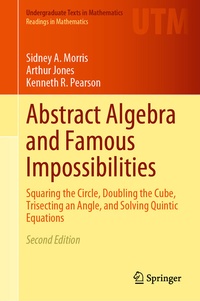
Abstract Algebra and Famous Impossibilities
Description

This textbook develops the abstract algebra necessary to prove the impossibility of four famous mathematical feats: squaring the circle, trisecting the angle, doubling the cube, and solving quintic equations. All the relevant concepts about fields are introduced concretely, with the geometrical questions providing motivation for the algebraic concepts. By focusing on problems that are as easy to approach as they were fiendishly difficult to resolve, the authors provide a uniquely accessible introduction to the power of abstraction.
Beginning with a brief account of the history of these fabled problems, the book goes on to present the theory of fields, polynomials, field extensions, and irreducible polynomials. Straightedge and compass constructions establish the standards for constructability, and offer a glimpse into why squaring, doubling, and trisecting appeared so tractable to professional and amateur mathematicians alike. However, the connection between geometry and algebra allows the reader to bypass two millennia of failed geometric attempts, arriving at the elegant algebraic conclusion that such constructions are impossible. From here, focus turns to a challenging problem within algebra itself: finding a general formula for solving a quintic polynomial. The proof of the impossibility of this task is presented using Abel's original approach.
Abstract Algebra and Famous Impossibilities illustrates the enormous power of algebraic abstraction by exploring several notable historical triumphs. This new edition adds the fourth impossibility: solving general quintic equations. Students and instructors alike will appreciate the illuminating examples, conversational commentary, and engaging exercises that accompany each section. A first course in linear algebra is assumed, along with a basic familiarity with integral calculus.
More details
Other editions
Additional editions
Persons
Sidney A. Morris is Emeritus Professor at the Federation University, Australia (formerly University of Ballarat) and Adjunct Professor at La Trobe University, Australia. His primary research is in topological groups, topology, and transcendental number theory, with broader interests including early detection of muscle wasting diseases, health informatics, and predicting the Australian stock exchange. He is the author of several books.
Arthur Jones [1934-2006] and Kenneth R. Pearson [1943-2015] were Professors in Mathematics at La Trobe University, Australia. Each had a great passion for teaching and for mathematics.
