

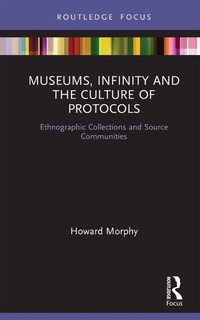
Museums, Infinity and the Culture of Protocols
Ethnographic Collections and Source Communities
1st Edition
Published on 17. October 2019
134 pages
978-1-351-33955-1 (ISBN)
Description

Museums, Infinity and the Culture of Protocols enters a dialogue about museums' responsibility for the curation of their collections into an infinite future while also tackling contentious issues of repatriation and digital access to collections.
Bringing into focus a number of key debates centred on ethnographic collections and their relationship with source communities, Morphy considers the value material objects have to different 'local' communities - the museum and the source community - and the value-creation processes with which they are entangled. The focus on values and value brings the issue of repatriation and access into a dialogue between the two locals, questioning who has access to collections and whose values are taken into consideration. Placing the museum itself firmly at the centre of the debate, Morphy posits that museums constitute a kind of 'local' embedded in a trajectory of value.
Museums, Infinity and the Culture of Protocols challenges aspects of postcolonial theory that position museums in the past by presenting an argument that places relationships with communities as central to the future of museums. This makes the book essential reading for academics and students working in the fields of museum and heritage studies, anthropology, archaeology, Indigenous studies, cultural studies, and history.
Bringing into focus a number of key debates centred on ethnographic collections and their relationship with source communities, Morphy considers the value material objects have to different 'local' communities - the museum and the source community - and the value-creation processes with which they are entangled. The focus on values and value brings the issue of repatriation and access into a dialogue between the two locals, questioning who has access to collections and whose values are taken into consideration. Placing the museum itself firmly at the centre of the debate, Morphy posits that museums constitute a kind of 'local' embedded in a trajectory of value.
Museums, Infinity and the Culture of Protocols challenges aspects of postcolonial theory that position museums in the past by presenting an argument that places relationships with communities as central to the future of museums. This makes the book essential reading for academics and students working in the fields of museum and heritage studies, anthropology, archaeology, Indigenous studies, cultural studies, and history.
More details
Series
Edition
1. Auflage
Language
English
Place of publication
London
United Kingdom
Publishing group
Taylor & Francis Ltd
Target group
College/higher education
Illustrations
4 Halftones, black and white; 4 Illustrations, black and white
ISBN-13
978-1-351-33955-1 (9781351339551)
Copyright in bibliographic data and cover images is held by Nielsen Book Services Limited or by the publishers or by their respective licensors: all rights reserved.
Schweitzer Classification
Other editions
Additional editions
Howard Morphy
Museums, Infinity and the Culture of Protocols
Ethnographic Collections and Source Communities
Book
06/2021
1st Edition
Routledge
€35.80
Shipment within 10-20 days
Howard Morphy
Museums, Infinity and the Culture of Protocols
Ethnographic Collections and Source Communities
Book
10/2019
1st Edition
Routledge
€69.70
Shipment within 10-20 days
Person
Howard Morphy is an Emeritus Professor and Head of the Centre for Digital Humanities Research at the Australian National University. In his career he has moved between museums and university departments and feels at home in collections and archives as much as in the field. He spent ten years at the Pitt Rivers Museum, Oxford University, as curator and lecturer. In 2013 he was awarded the Huxley Medal of the Royal Anthropological Institute.
Content
List of figures
Acknowledgements
1. Introduction: living with museums
2. Museums, ethnographic collections, and the creation of value
3. Different locals: reflections on Indigenous Australian collections
4. Contested values in the curation of human remains
5.Open access versus the culture of protocols
6.Conclusion: collections, time, and identity
Index
Acknowledgements
1. Introduction: living with museums
2. Museums, ethnographic collections, and the creation of value
3. Different locals: reflections on Indigenous Australian collections
4. Contested values in the curation of human remains
5.Open access versus the culture of protocols
6.Conclusion: collections, time, and identity
Index
