

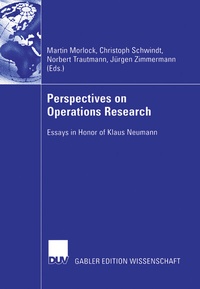
Perspectives on Operations Research
Essays in Honor of Klaus Neumann
Published on 31. October 2007
XI, 447 pages
978-3-8350-9064-4 (ISBN)
Description

This collection of essays is dedicated to Professor Klaus Neumann, Head and Chair of the Institute for Economic Theory and Operations Research WiOR at the University of Karlsruhe. On the occasion of his emeritation, disciples, colleagues, scientific companions, and friends coming from dif ferent fields have contributed their perspectives on Operations Research to form a broad view on the discipline. The papers are organized in four parts on optimization, OR in production and service management, OR in logistics, and interdisciplinary approaches. We thank all the authors for their participation in publishing this volume. Mrs. Ute Wrasmann from Deutscher Universitats-Verlag deserves credit for her interest and assis tance on this project. Finally, we would like to express our gratitude to PTV Planung Transport Verkehr AG in Karlsruhe and to numerous former WiOR colleagues for their financial support. Klaus Neumann was born in Liegnitz (Silesia) in 1937. Prom 1955 to 1961 he studied mathematics at the Technical Universities of Dresden and Munich. His first paper on analog computers and dynamic programming was published less than two years later. In 1964 he obtained a Ph. D. in mathematics under the supervision of Josef Heinhold in Munich. After a two-year stay in industry, he returned to his alma mater, working on the fields of dynamic optimization and control theory.
More details
Other editions
Additional editions
Martin Morlock | Christoph Schwindt | Norbert Trautmann
Perspectives on Operations Research
Essays in Honor of Klaus Neumann
Book
02/2006
1st Edition
Deutscher Universitätsverlag
€53.49
Shipment within 10-15 days
Persons
Dr. Martin Morlock ist Professor am Fachbereich für Wirtschaftswissenschaften der Universität Gießen.
Dr. Christoph Schwindt ist Professor am Institut für Wirtschaftswissenschaft der Technischen Universität Clausthal.
Dr. Norbert Trautmann ist Assistenzprofessor am Departement für Betriebswirtschaftslehre der Universität Bern.
Dr. Jürgen Zimmermann ist Professor am Institut für Wirtschaftswissenschaft der Technischen Universität Clausthal.
Dr. Christoph Schwindt ist Professor am Institut für Wirtschaftswissenschaft der Technischen Universität Clausthal.
Dr. Norbert Trautmann ist Assistenzprofessor am Departement für Betriebswirtschaftslehre der Universität Bern.
Dr. Jürgen Zimmermann ist Professor am Institut für Wirtschaftswissenschaft der Technischen Universität Clausthal.
Content
Overview of Klaus Neumann's Research.- Overview of Klaus Neumann's Research.- Optimization.- Matrices in Shop Scheduling Problems.- Saddle Points from the Geometric Point of View.- Nachbarschaftssuche bei mehrkriteriellen Flow Shop Problemen.- The Solution of a Generalization of a Bayesian Stopping Problem of MacKinnon.- A Remark on the Formulation of Dual Programs Based on Generalized Convexity.- Operations Research in Production and Service Management.- An Application of Markov Decision Processes to the Seat Inventory Control Problem.- Immaterielle Input-Output-Systeme.- Audit-Staff Scheduling by Column Generation.- An MILP Modelling Approach for Shelf Life Integrated Planning and Scheduling in Scalded Sausage Production.- Optimale Anpassung im Gutenberg-Produktionsmodell: Eine analytische Ermittlung der Kostenfunktion aus den Karush-Kuhn-Tucker-Bedingungen.- Just-in-Time Production of Large Assemblies Using Project Scheduling Models and Methods.- A Cyclic Approach to Large-Scale Short-Term Planning of Multipurpose Batch Plants.- Models and Methods for Workforce Scheduling: An Application to Casino Operations.- Operations Research in Logistics.- Pile Problems and Their Mathematical Treatment.- Risk and Safety Stock Management in Production Planning and Inventory Control with Stochastic Demand and Yield.- Economies of Scale in Hub & Spoke Network Design Models: We Have It All Wrong.- A Stackelberg Equilibrium Model for Supply Chain Inventory Managemen.- Das Potenzial von Operations Research in Transport und Verkehr.- Interdisciplinary Dimensions.- Evolution of Conventions in Populations with Local Interaction Structures.- Empirical Examination of Operational Loss Distributions.- Fuzzy-Nutzwertanalyse und Fuzzy-AHP.- Piecewise Linear Bertrand Oligopoly.
Overview of Klaus Neumanns Research (p. 1)
Martin Morlock
Department of Economics
University of Giefien
Christoph Schwindt and Jiirgen Zimmermann
Institute for Management and Economics
Clausthal University of Technology
Norbert Trautmann
Departement fiir Betriebswirtschaftslehre
University of Bern
1 Introduction
In this paper we give a short overview of the research conducted, initiated, and supervised by Klaus Neumann from the early sixties up to present. Of course, we do not claim exhaustiveness of our review. The major themes of research can be clustered into the three main areas sketched in Sections 2 to 4:
Control Theory and Dynamic Programming (1960s and 1970s)
GERT Networks (1970s to 1990s)
Resource-Constrained Project Scheduling (since 1990s)
In any of those fields, Klaus Neumann has significantly influenced the development of OR in Germany and beyond. Prom the very beginning, his research has combined solid mathematical foundation and applicability of theoretical results. The relevance of his achievements to the treatment of real-world problems has been reflected in many applied research and development projects. A selection of the projects that have been carried out in cooperation with different industrial partners is sketched in Section 5.
2 Control Theory and Dynamic Programming
Among the various approaches existing at the beginning of the 1970s in quantitative economic science, only linear programming has been successful on a broad front. For this simply structured class of static optimization problems, a commonly accepted and transparent model as well as efficient solution algorithms could be developed and applied due to the enormous advances in computer technology.
However, a multitude of practical problems in management and economics is not static in nature, but concern the analysis and optimal solution of time-dependent (decision) processes. Such problems are well-known as control problems (particularly in technology). To find an optimal solution to such problems, mainly two different approaches have been investigated: control theory and dynamic programming.
Control theory in continuous time is based substantially on an analytic approach referring to the Pontrjagin maximum principle and transversality conditions. Fundamental to dynamic programming is the so-called Bellman optimality principle^ which was developed in the 1950s by the American mathematician Richard Bellman (cf. Neumann 1969a). In particular Neumann contributed several publications to the spreading of those two optimization techniques and to their application. Together with Bauer (1969), he was one of the first who explained in a very lucid way these two fundamental approaches and their relationship.
For the acceptance and successful use of dynamic models, both their theoretical foundation and the development of numerical methods were essential. Major contributions to the latter topic, as well as descriptions of relevant applications, can be found for example in Neumann (1969a) and (1975a). Initial considerations were concerned with the question whether analog or digital computers should be used for the numerical solution of dynamic optimization problems, especially for dynamic optimization problems in continuous time (cf. Neumann and Neumann 1963). Rapid progress in the digital computer technology soon decided in favor of the digital computers.
Martin Morlock
Department of Economics
University of Giefien
Christoph Schwindt and Jiirgen Zimmermann
Institute for Management and Economics
Clausthal University of Technology
Norbert Trautmann
Departement fiir Betriebswirtschaftslehre
University of Bern
1 Introduction
In this paper we give a short overview of the research conducted, initiated, and supervised by Klaus Neumann from the early sixties up to present. Of course, we do not claim exhaustiveness of our review. The major themes of research can be clustered into the three main areas sketched in Sections 2 to 4:
Control Theory and Dynamic Programming (1960s and 1970s)
GERT Networks (1970s to 1990s)
Resource-Constrained Project Scheduling (since 1990s)
In any of those fields, Klaus Neumann has significantly influenced the development of OR in Germany and beyond. Prom the very beginning, his research has combined solid mathematical foundation and applicability of theoretical results. The relevance of his achievements to the treatment of real-world problems has been reflected in many applied research and development projects. A selection of the projects that have been carried out in cooperation with different industrial partners is sketched in Section 5.
2 Control Theory and Dynamic Programming
Among the various approaches existing at the beginning of the 1970s in quantitative economic science, only linear programming has been successful on a broad front. For this simply structured class of static optimization problems, a commonly accepted and transparent model as well as efficient solution algorithms could be developed and applied due to the enormous advances in computer technology.
However, a multitude of practical problems in management and economics is not static in nature, but concern the analysis and optimal solution of time-dependent (decision) processes. Such problems are well-known as control problems (particularly in technology). To find an optimal solution to such problems, mainly two different approaches have been investigated: control theory and dynamic programming.
Control theory in continuous time is based substantially on an analytic approach referring to the Pontrjagin maximum principle and transversality conditions. Fundamental to dynamic programming is the so-called Bellman optimality principle^ which was developed in the 1950s by the American mathematician Richard Bellman (cf. Neumann 1969a). In particular Neumann contributed several publications to the spreading of those two optimization techniques and to their application. Together with Bauer (1969), he was one of the first who explained in a very lucid way these two fundamental approaches and their relationship.
For the acceptance and successful use of dynamic models, both their theoretical foundation and the development of numerical methods were essential. Major contributions to the latter topic, as well as descriptions of relevant applications, can be found for example in Neumann (1969a) and (1975a). Initial considerations were concerned with the question whether analog or digital computers should be used for the numerical solution of dynamic optimization problems, especially for dynamic optimization problems in continuous time (cf. Neumann and Neumann 1963). Rapid progress in the digital computer technology soon decided in favor of the digital computers.
