

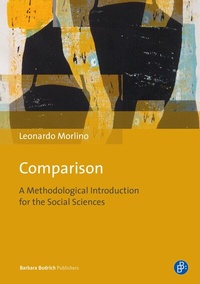
Comparison
A Methodological Introduction for the Social Sciences
1st Edition
Published on 15. January 2018
128 pages
978-3-8474-1146-8 (ISBN)
Description

Comparison is an essential research method in political science. This book helps students to understand comparison as a scientific instrument, to grasp its necessity and its effective purpose for research. For that reason, it replies to three 'simple' questions: why compare, what to compare, and how to compare. The introduction distinguishes itself by considering not only the comparative tradition but also by taking methodological innovations of the last two decades into account.
More details
Other editions
Additional editions
Book
01/2018
1st Edition
Verlag Barbara Budrich
€19.90
No shipping information available
Person
Content
- Cover
- Comparison. A Methodological Introduction for theSocial Sciences
- Table of Content
- Preface
- 1. Introduction: choosing the question?
- 1.1 Starting from the key aspect
- 1.2 Further examples
- 2. Defining Comparison
- 2.1 The key questions
- 2.2 Classic thinkers
- 2.3 Modern theorists
- 3 Why compare?
- 3.1 The goals of comparison
- 3.2 Nomothetic objectives and generalizations
- 3.3 Explanation and understanding
- 3.4 What kind of theory should be adopted in political science?
- 4. What to compare: the basic units
- 4.1 Identifying the issue
- 4.2 Concepts and classes
- 4.3 Properties and variables
- 4.4 Operationalization
- 4.5 The "many variables, small N" dilemma
- 5. What to compare: space and time
- 5.1 Dimensions of comparison
- 5.2 Deciding the space
- 5.2.1 Case study
- 5.2.2 Other strategies
- 5.3 Defining the time
- 5.4 The problem of multicollinearity
- 6. How to compare: the key mechanisms
- 6.1 The available tools
- 6.2 Ogden and Richards' triangle
- 6.3 The rules of conceptualization
- 6.4 The Tree of Porphyry
- 6.5 Classificatory strategies
- 6.6 Mill's canons
- 7. How to compare: recent developments
- 7.1 In search of new rules for conceptualization
- 7.2 Process tracing
- 7.3 The configurational comparative method and qualitative comparative analysis
- 8. Beyond comparison: other research methods
- 8.1 Data collection and relations between variables
- 8.2 More about explanation, generalization and theory
- 8.3 Experimental and non-experimental methods
- 8.4 The statistical method
- 8.4.1 The number of cases
- 8.4.2. Logic
- 8.5 The historical method
- 9. Conclusions. The limits of comparison
- Bibliographical References
- Index
