

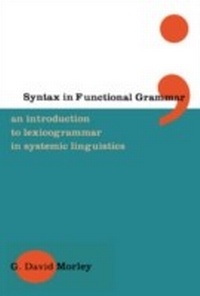
Syntax in Functional Grammar
An Introduction to Lexicogrammar in Systemic Linguistics
1st Edition
Published on 1. September 2000
256 pages
978-0-8264-3097-7 (ISBN)
Description

This well-illustrated book outlines a framework for the analysis of syntactic structure from a perspective of a systematic functional grammar. In oart, the book goes back to the grammar's "scale and category" roots, but now with the aim of presenting how a descriptive framework illustrating how the analysis of the syntactic structure can reflect the meaning structure.The contents are divided into four sections. Section one gives a brief overview of systematic grammar, including the linguistic system, context of situation, and language fractions. Developing the lexicogrammar, section two considers formal units and their classes, but the principal focus is on section three, which covers the role of units as elements of structure. Section four discusses areas of structural complexity and concludes with several refinements to the analysis format.
More details
Edition
1. Auflage
Language
English
Place of publication
New York
United States
ISBN-13
978-0-8264-3097-7 (9780826430977)
Copyright in bibliographic data and cover images is held by Nielsen Book Services Limited or by the publishers or by their respective licensors: all rights reserved.
Schweitzer Classification
Other editions
Additional editions
G. David Morley
Syntax in Functional Grammar
An Introduction to Lexicogrammar in Systemic Linguistics
Book
09/2000
Continuum International Publishing Group Ltd.
€62.30
Shipment within 15-20 days
G. David Morley
Syntax in Functional Grammar
An Introduction to Lexicogrammar in Systemic Linguistics
Book
09/2000
Continuum International Publishing Group Ltd.
€112.85
Article exhausted; check different version
Person
G. David Morley is a lecturer in modern languages at the University of Strathclyde, Scotland.
Content
- Intro
- Contents
- Introduction
- Part I: The linguistic framework
- 1 The systemic functional framework
- 1.1 The linguistic system
- 1.2 Context of situation
- 1.3 Language functions and the semantic stratum
- 1.4 The systemic orientation
- 2 The grammatical framework
- 2.1 The nature of the lexicogrammar
- 2.2 Units and the rank scale
- 2.3 Sentence, clause, phrase, word and morpheme
- 2.4 Unit complex and complex unit
- Part II: Class
- 3 Word class
- 3.1 Noun
- 3.2 Verb
- 3.3 Adjective
- 3.4 Adverb
- 3.5 Preposition
- 3.6 Conjunction
- 3.7 Interjection
- 3.8 Article
- 3.9 Pronoun
- 3.10 Determiner: a functional element
- 3.11 Labelling the word classes
- 4 Phrase class
- 4.1 Nominal phrase
- 4.2 Verbal phrase
- 4.3 Adjectival phrase
- 4.4 Adverbial phrase
- 4.5 Prepositional phrase
- 4.6 Subordinator phrase
- 4.7 Genitive phrase
- 4.8 Labelling the phrase classes
- 5 Clause class
- 5.1 Main and subordinate clauses
- 5.2 Nominal clause
- 5.3 Adjectival clause
- 5.4 Adverbial clause
- 5.5 Labelling the clause classes
- 6 Sentence class
- 6.1 Formal types of sentence
- 6.2 The sentence as clause complex
- 6.3 Labelling the sentence
- 7 Formal syntactic analysis
- Part III: Structure
- 8 Sentence structure
- 8.1 Free and bound elements
- 8.2 Traditional classification of bound elements
- 8.3 Contemporary classification of free and bound elements
- 8.4 Integral and supplementary bound elements
- 8.5 Functional analysis of sentence structure
- 9 Clause structure
- 9.1 Subject
- 9.2 Predicator and Finite
- 9.3 Complement
- 9.4 Adjunct
- 9.5 Z element
- 9.6 Functional analysis of clause structure
- 10 Elements of clause structure revised
- 10.1 Determining the elements of clause structure
- 10.2 Nominally functioning elements
- 10.3 Adjectivally functioning elements
- 10.4 Adverbially functioning elements
- 10.5 Predicator
- 10.6 Functional analysis of clause structure revised
- 11 Phrase structure
- 11.1 Nominal phrase
- 11.2 Adjectival phrase
- 11.3 Adverbial phrase
- 11.4 Prepositional phrase
- 11.5 Genitive phrase
- 11.6 Verbal phrase
- 11.7 Subordinator phrase
- 11.8 Functional analysis of phrase structure
- 12 Word structure
- 12.1 Morpheme, morph and allomorph
- 12.2 Word structure
- 13 Functional syntactic analysis
- Part IV: Complexity and complementation
- 14 Complexity (1)
- 14.1 Recursion
- 14.2 Discontinuity
- 14.3 Phase
- 15 Complexity (2)
- 15.1 Apposition
- 15.2 Thematic focusing
- 15.3 Prepositional passives
- 16 More on complementation
- 16.1 Verbal phrase complementation
- 16.2 Nominal phrase qualifiers and complements
- 16.3 Adjectival phrase complementation
- 17 Revised functional syntactic analysis
- 17.1 Clause structure elements-default modes unmarked
- 17.2 Clause structure elements-Predicator and Verbal element
- 17.3 Phrase structure-substructure analysis
- 1 7.4 Phrase structure-headword analysis
- 17.5 Phrase structure-phrasal elements
- 17.6 Postscript
- Select bibliography
- Index
- A
- B
- C
- D
- E
- F
- G
- H
- I
- K
- L
- M
- N
- O
- P
- Q
- R
- S
- T
- U
- V
- W
- X
- Y
- Z
