

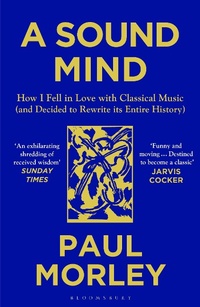
A Sound Mind
How I Fell in Love with Classical Music (and Decided to Rewrite its Entire History)
1st Edition
Published on 1. October 2020
624 pages
978-1-4088-6877-5 (ISBN)
Description

'Exhilarating' - Sunday Times
'Funny and moving' - Jarvis Cocker
Music critic and writer Paul Morley weaves together memoir and history in a spiralling tale that establishes classical music as the most rebellious genre of all.
Paul Morley had stopped being surprised by modern pop music and found himself retreating into the sounds of artists he loved when, as an emerging music journalist in the 70s, he wrote for NME. But not wishing to give in to dreary nostalgia, endlessly circling back to the bands he wrote about in the past, he went searching for something new, rare and wondrous - and found it in classical music.
A soaring polemic, a grumpy reflection on modern rock, and a fan's love note, A Sound Mind rejects the idea that classical music is establishment; old; a drag. Instead, the book reveals this genre to be the most exciting and varied in music. A Sound Mind is a multi-layered memoir of Morley's shifting musical tastes, but it is also a compelling history of classical music that reveals the genre's rich and often deviant past - and, hopefully, future.
Like a conductor, Morley weaves together timelines and timeframes in an orchestral narrative that declares the transformative and resilient power of classical music from Bach to Shostakovich, Brahms to Birtwistle, Mozart to Cage, travelling from eighteenth century salons to the modern age of Spotify.
'His passion for centuries of music - both celebrated and obscure - is infectious' - Irish Independent
More details
Edition
1. Auflage
Language
English
Place of publication
London
United Kingdom
ISBN-13
978-1-4088-6877-5 (9781408868775)
Copyright in bibliographic data and cover images is held by Nielsen Book Services Limited or by the publishers or by their respective licensors: all rights reserved.
Schweitzer Classification
Other editions
Additional editions
Paul Morley
A Sound Mind
How I Fell in Love with Classical Music (and Decided to Rewrite its Entire History)
Book
10/2021
Bloomsbury Publishing PLC
€16.50
Shipment within 10-20 days
Paul Morley
A Sound Mind
How I Fell in Love with Classical Music (and Decided to Rewrite its Entire History)
Book
10/2020
Bloomsbury Publishing PLC
€57.14
Article exhausted; check different version
Person
Paul Morley grew up in Stockport, Cheshire, and has worked as a music journalist, pop svengali and broadcaster. He is the author of a number of books on music - Ask: The Chatter of Pop, Words and Music: A History of Pop in the Shape of a City, Joy Division: Piece by Piece: Writing About Joy Division 1977-2007 and Joy Division: Fragments - as well as an acclaimed memoir of his early years, Nothing. Paul has written for a number of publications, including the New Statesman, the Sunday Telegraph, NME, the Observer and the Guardian.
Content
- Cover
- Half-title Page
- Dedication Page
- By the same author
- Title Page
- Epigraph
- Contents
- Part One The Question - Into the Unknown
- An article written about Harry Styles and Jake Bugg by someone with Anton Webern on his mind
- Part Two The Learning - What Brought Me Here
- 1. A Possible New Me
- 2. How to be a Mature Student
- an article written for the Observer Music Monthly
- Part Three The Beginning - To The Planets and Beyond
- 1. On Being a Funky Youngster
- 2. A first classical experience read out on Radio 3
- Beyond The Planets, because there is more to Holst than Mars
- 3. Further beyond: A brief history of the 'Classics for Pleasure' label that somehow leads to 'From A for Amazon to Z for Zappa'
- 4. Where the A is for aware, ardent, absurd, astonishing, analytical, alarming, atonal, apeshit, and the Z is still, but never still, for Zappa
- 5. Ten 1970s Classics for Pleasure albums that should be released as a budget box set, priced ten times the original price of ten shillings and sixpence, the equivalent now of £5.25
- Part Four The Playlist - A Few of My Favourite Things
- 1. The Age of Storage
- 2. An introduction by a rock critic to some classical music playlists
- 3. Eight Steps Beyond
- 1. Mozart - Masonic Funeral Music in C minor
- 2. Debussy - Sonata for Cello and Piano
- 3. Berio - Sequenza V
- 4. Shostakovich - Symphony No. 10
- 5. Webern - Langsamer Satz
- 6. Earle Brown - Times Five
- 7. Sofia Gubaidulina - Sonata for Double Bass and Piano
- 8. John Cage - Organ2/ASLSP
- 4. Follow-up to the above: two playlists with notes and recommendations, considering the time Ravel and Debussy spent composing more or less at the same time
- A Maurice Ravel (born 7 March 1875) playlist
- Ravel-gazing: the playlist without Boléro
- i. Piano Concerto in G major (1929-31)
- ii. Tzigane, Rhapsody for Violin and Piano (1924)
- iii. Violin Sonata No. 2 (1923-7)
- iv. La valse, a Choreographic Poem for Orchestra (1920)
- v. Folk songs, sad songs, beyond songs, sensual allure, the risk-taking of emotional exposure, and a taste for the marvellous
- vi. Introduction and Allegro for Harp, Flute, Clarinet and String Quartet (1905)
- vii. 'Oiseaux tristes' (1905)
- viii. Schéhérazade, ouverture de féerie (1899)
- ix. Sonatine pour piano (1903-5)
- x. Menuet antique (1895)
- 5. Claude and Maurice: together, for ever and never
- 6. A Debussy dozen with extras
- because the ideal French music 'generated emotion without epilepsy'
- i. Piano Trio in G major, II. Moderato con allegro (1880), performed by the Arensky Trio/ Fantaisie for Piano and Orchestra
- I, Andante ma non troppo (1889-90), performed by the Sofia Symphony Orchestra
- ii. Rêverie (1890)
- iii. String Quartet in G minor (1893), as performed by Quatuor Ébène
- iv. Prélude a l'après-midi d'un faune (1894), performed by Berlin Philharmonic conducted by Claudio Abbado/Syrinx for Flute (1913), performed by Vincent Lucas/Rapsodie pour saxophone (1901-11), performed by Nicolas Prost
- v. Pelléas et Mélisande (1902), Act I, Scene III: 'In front of the castle', performed by the orchestra and chorus of the Royal Opera House, conducted by Pierre Boulez
- vi. Danse sacrée et danse profane, version for harp and strings (1904), performed by the Los Angeles Chamber Orchestra, conducted by Gerard Schwarz, harp soloist Nancy Allen
- vii. La cathédrale engloutie (The Sunken Cathedral) (1910), Preludes Book I. No. 10, performed by Arturo Benedetti Michelangeli, as well as 'The Snow is Dancing' from Children's Corner (1908).
- viii. Images pour orchestre, I. Gigues (1909-12), performed by the Royal Concertgebouw Orchestra, conducted by Bernard Haitink
- ix. Le Martyre de saint Sébastien (Fragments Symphoniques) (1911), III. La Passion, performed by the London Symphony Orchestra, conducted by Pierre Monteux
- x. Jeux (1912-13), performed by the Vienna Philharmonic, conducted by Lorin Maazel/La Mer, trois esquisses symphoniques pour orchestre (1903-5): 2. Jeux de vagues (Play of the Waves), performed by the Berlin Philharmonic, conducted by Herbert Von Karajan
- xi. Berceuse héroïque (A Lullaby for a Hero) (1914), piano version performed by Walter Gieseking, orchestral version performed by the Royal Concertgebouw Orchestra
- xii. Sonata for Cello and Piano in D minor (1915), performed by Matt Haimovitz/Sonata for Flute, Viola and Harp: III. Finale (1915), performed by Ensemble Wien-Berlin/Sonata for Violin and Piano (1916-17)
- 7. Bonus: 'The Holy Egoism of Genius'/'La Flûte de Pan'/'Metaforce'/'Out of This World (Version 138)' (1999) by Art of Noise from The Seduction of Claude Debussy
- Part Five The Writing - Finding the Right Words
- 1. On Becoming an Insider
- 2. Crossing over with the classical TV set
- 3. The art of perseverance
- 4. The odd ones out on table 29
- My top eleven of works commissioned by or dedicated to the RPS would be:
- 5. The critic as opera diva
- 6. What plays in Huddersfield plays in Huddersfield
- 7. The critic as unlikely motivational speaker
- 8. Above and beyond: the view from Iceland
- Part Six 1973, the Year When - A Playlist With Information
- The Persistence of Memory
- A 1973 playlist with explanations
- Part Seven The String Quartet - In Four Parts
- 1. First movement: sonata form, allegro, in the tonic key
- 2. Second movement: slow, in the subdominant key
- 3. Third movement: minuet and trio, in the tonic key
- 4. Fourth movement: rondo or sonata rondo form, in the tonic key
- Part Eight The Obscure - Changing Direction
- From the sinking of the titanic as a sustaining avant-garde (classical) masterpiece
- Out of, around and under the sinking of the titanic from other directions
- Part Nine The Piano - Light and Dark
- 1. The eighty-eight
- 2. The pianist
- Selected Joanna MacGregor discography: many places to start discovering classical music
- 3. The organ
- 4. The invention
- Angela Hewitt/ Mozart Piano Concertos Nos. 17 and 27 (Hyperion)
- 5. The preparation
- 6. With Brian Eno
- On talking (1)
- On the intensity of ideas
- On listening
- On destiny
- On recording
- On being like nothing else
- On singing
- On talking (2)
- On the synthesiser (1)
- On the synthesiser (2)
- On the naming of things
- On hindsight
- On reporting in the 1990s that there was too much music being released and he was not going to add to it any more
- On the end of an era
- Part Ten The Answer - The Place Where the Story Stops
- 1. I try not to repeat myself
- A playlist through which, positively, John Adams flows
- 2. I ran away and found the future
- 3. I can't go backwards
- The Coda.
- A permanent classical music chart in no particular order
- Acknowledgements
- Index
- Copyright Page
