

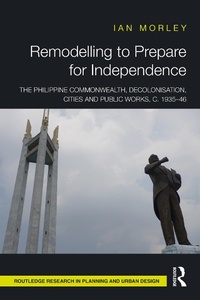
Remodelling to Prepare for Independence
The Philippine Commonwealth, Decolonisation, Cities and Public Works, c. 1935-46
1st Edition
Published on 1. December 2023
290 pages
978-1-003-81288-3 (ISBN)
Description

Remodelling to Prepare for Independence: The Philippine Commonwealth, Decolonisation, Cities and Public Works, c. 1935-46 illuminates the implications of the USA's final phase of colonial rule in the Philippine Islands. It explores the Filipino side of decolonisation and the management of the built environment in the years immediately prior to self-rule.
This book shakes off the collaboration vs. resistance paradigm that empire histories generally follow and consequently yields an original vantage point to comprehend transition within an Asian society in the years immediately prior to, during, and after World War Two. This will not only deepen insight of the American Empire, but also grants the opportunity to tie Philippine political-cultural change to the global history of urban planning's advancement. Accordingly, it opens a new window to rethink Filipino ethno-history and societal evolution, alongside the opportunity to compare the Philippines with other nations that undertook planning projects as part of their decolonisation process and early-postcolonial advancement. The book utilises theoretical frames in order to help creatively excavate the era 1935-46 for the purpose of not just revealing what public works occurred, but to also uncover what those projects meant to the Commonwealth Government, the BPW's staff, and the public who benefitted from public works projects.
The book will be relevant to students and researchers of Urban History, Asian and American (Empire) History, and Imperial and Colonial Studies. Architects, planners, and members of the public who are interested in the form and meaning of urban environments designed/constructed in the past will also find the publication to be of great interest.
This book shakes off the collaboration vs. resistance paradigm that empire histories generally follow and consequently yields an original vantage point to comprehend transition within an Asian society in the years immediately prior to, during, and after World War Two. This will not only deepen insight of the American Empire, but also grants the opportunity to tie Philippine political-cultural change to the global history of urban planning's advancement. Accordingly, it opens a new window to rethink Filipino ethno-history and societal evolution, alongside the opportunity to compare the Philippines with other nations that undertook planning projects as part of their decolonisation process and early-postcolonial advancement. The book utilises theoretical frames in order to help creatively excavate the era 1935-46 for the purpose of not just revealing what public works occurred, but to also uncover what those projects meant to the Commonwealth Government, the BPW's staff, and the public who benefitted from public works projects.
The book will be relevant to students and researchers of Urban History, Asian and American (Empire) History, and Imperial and Colonial Studies. Architects, planners, and members of the public who are interested in the form and meaning of urban environments designed/constructed in the past will also find the publication to be of great interest.
More details
Series
Edition
1. Auflage
Language
English
Place of publication
London
United Kingdom
Publishing group
Taylor & Francis Ebooks
Target group
College/higher education
Illustrations
16 Tables, black and white; 16 Line drawings, black and white; 34 Halftones, black and white; 50 Illustrations, black and white
ISBN-13
978-1-003-81288-3 (9781003812883)
Copyright in bibliographic data and cover images is held by Nielsen Book Services Limited or by the publishers or by their respective licensors: all rights reserved.
Schweitzer Classification
Other editions
Additional editions
Ian Morley
Remodelling to Prepare for Independence
The Philippine Commonwealth, Decolonisation, Cities and Public Works, c. 1935-46
Book
07/2025
1st Edition
Routledge
€67.70
Shipment within 10-20 days
Ian Morley
Remodelling to Prepare for Independence
The Philippine Commonwealth, Decolonisation, Cities and Public Works, c. 1935-46
Book
12/2023
1st Edition
Routledge
€206.70
Shipment within 10-20 days
Person
Ian Morley is an Associate Professor based in the Department of History at the Chinese University of Hong Kong. A graduate of the Centre for Urban History, Leicester University, UK, and the School of Architectural Studies, University of Sheffield, UK, he has published widely on the American colonial urban environment in the Philippines. The former book review editor for Urban Morphology: Journal of the International Seminar on Urban Form, he is currently the Vice President of the International Planning History Society. He is a Fellow of the Royal Historical Society, Royal Asiatic Society, and Royal Society of Arts.
Content
List of Illustrations
List of Tables
Acknowledgements
Chapter 1: Introduction
Reshaping the Nation and Public Works: A Precis
Social Evolution, Foreign Influences, and Modernity in Philippine Cities, 1935-46
A Political and Philosophical Watershed: The Philippine Constitution, 1935
The Evolution of the Colonial-Built Fabric in the Philippines, 1898-1935
Decolonisation
The Structure of the Book
Chapter 2: A New Capital City for a New Nation
The Constitution Convention and the Nature of the 1935 Constitution
Quezon City: A Distinct City for an Evolving Country
Planning Evolution in Quezon City: The 1941 and 1949 Plans
The Park and Road Systems, and the Creation of Neighbourhood Units
Public Buildings and Architectural Modernism
Conclusion
Chapter 3: Manila and the Provinces
Beyond Quezon City: Urban Planning During the Age of the Commonwealth
Manila's Development and Antonio Toledo's Professional Footprint
The Return to, and Advancement of, Daniel Burnham's Plan for Manila
Renewing Manila: The Built Fabric and Fire
Planning in the Provinces
Housing and Planning in the Provinces
Chapter 4: The Japanese Occupation
Japan, the Philippines, the Greater East Asian Co-Prosperity Sphere, and Pan-Asianism
The Japanese Occupation and the Evaluation of the Philippine-Built Fabric
Governing the Towns and Cities
Rebooting The Pensionados Program
Neighbourhood Associations
The Challenge and Opportunity Aligned to Post-War Rebirth
Chapter 5: National Independence, Post-War Reconstruction, Urban Betterment and Planning
A New Nation Looking Forward, Hesitantly
The Planning of Roads
Planning for New Housing Districts
New Rulings and the Problem of Their Implementation
Conclusion
References
Index
List of Tables
Acknowledgements
Chapter 1: Introduction
Reshaping the Nation and Public Works: A Precis
Social Evolution, Foreign Influences, and Modernity in Philippine Cities, 1935-46
A Political and Philosophical Watershed: The Philippine Constitution, 1935
The Evolution of the Colonial-Built Fabric in the Philippines, 1898-1935
Decolonisation
The Structure of the Book
Chapter 2: A New Capital City for a New Nation
The Constitution Convention and the Nature of the 1935 Constitution
Quezon City: A Distinct City for an Evolving Country
Planning Evolution in Quezon City: The 1941 and 1949 Plans
The Park and Road Systems, and the Creation of Neighbourhood Units
Public Buildings and Architectural Modernism
Conclusion
Chapter 3: Manila and the Provinces
Beyond Quezon City: Urban Planning During the Age of the Commonwealth
Manila's Development and Antonio Toledo's Professional Footprint
The Return to, and Advancement of, Daniel Burnham's Plan for Manila
Renewing Manila: The Built Fabric and Fire
Planning in the Provinces
Housing and Planning in the Provinces
Chapter 4: The Japanese Occupation
Japan, the Philippines, the Greater East Asian Co-Prosperity Sphere, and Pan-Asianism
The Japanese Occupation and the Evaluation of the Philippine-Built Fabric
Governing the Towns and Cities
Rebooting The Pensionados Program
Neighbourhood Associations
The Challenge and Opportunity Aligned to Post-War Rebirth
Chapter 5: National Independence, Post-War Reconstruction, Urban Betterment and Planning
A New Nation Looking Forward, Hesitantly
The Planning of Roads
Planning for New Housing Districts
New Rulings and the Problem of Their Implementation
Conclusion
References
Index
