

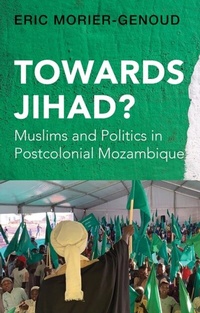
Towards Jihad?
Muslims and Politics in Postcolonial Mozambique
1st Edition
Published on 5. October 2023
240 pages
978-1-80526-322-7 (ISBN)
Description

Since 2017, Mozambique has been confronted with a jihadi insurgency. This book looks at the origins of that insurgency, and the broader and longer history of the relationship between Islam and politics in the country. Did Mozambique's Muslim politics always point towards jihad?
Eric Morier-Genoud examines the period immediately after independence, when the state engaged in anticlericalism; he then moves across the decades to the 2000s, when the ruling party and the opposition alike courted Muslims for electoral purposes, before reaching the 2010s, when tensions between 'mosque and state' returned. Along the way, he explores a wide variety of phenomena, including the rise of Wahhabism, religious competition, state mediation, secularism, the alleged growth and radicalisation of Islam, and the origins of the ongoing insurgency. What emerges is a rich history, attentive to different branches and elements of the Muslim community, looking far beyond the narrow perspective of jihad.
Taking a socio-historical perspective, 'Towards Jihad?' unpacks a complex dynamic, which the jihadi insurgency is in fact now disrupting. Understanding the long history of Muslims' engagement with politics in Mozambique sheds light on where the country has come from, where it stands now amidst violent unrest, and where it might go next.
Eric Morier-Genoud examines the period immediately after independence, when the state engaged in anticlericalism; he then moves across the decades to the 2000s, when the ruling party and the opposition alike courted Muslims for electoral purposes, before reaching the 2010s, when tensions between 'mosque and state' returned. Along the way, he explores a wide variety of phenomena, including the rise of Wahhabism, religious competition, state mediation, secularism, the alleged growth and radicalisation of Islam, and the origins of the ongoing insurgency. What emerges is a rich history, attentive to different branches and elements of the Muslim community, looking far beyond the narrow perspective of jihad.
Taking a socio-historical perspective, 'Towards Jihad?' unpacks a complex dynamic, which the jihadi insurgency is in fact now disrupting. Understanding the long history of Muslims' engagement with politics in Mozambique sheds light on where the country has come from, where it stands now amidst violent unrest, and where it might go next.
Reviews / Votes
'An excellent demonstration of how real grievances meeting an ideology can evolve into political violence. Morier-Genoud describes the evolution of the local insurgency in Mozambique into an affiliate of the Islamic State, accurately focusing on key local factors without denying the impact of IS central on the actual and future processes.' -- Wassim Nasr, journalist, France 24 'A clearly argued, intellectually honest and carefully nuanced interpretation of the relationship between Islam and the State that challenges most current readings of both the context and origins of the jihadist struggle in northern Mozambique.' -- Edward A. Alpers, Research Professor Emeritus of History, University of California, Los Angeles 'A sensitive exploration of the complex divisions within Mozambican Islam, providing welcome historical context for the insurgency.' -- William G. Clarence-Smith, Emeritus Professor of History, SOAS University of London 'Documents succinctly that the insurgency comes not so much from a continuation of Muslim politics in modern Mozambique but as a rupture with it. Business, governments and NGOs concerned by the insurgency, its roots and its future trajectory should read this.' -- Alex Vines, Director of the Africa programme, Chatham House 'A thoughtful discussion of the history of state and religion in Mozambique, shedding precious light on a pressing issue. This will be fundamental for all those trying to understand the jihadi movements in Mozambique, Africa and elsewhere.' -- Vincent Foucher, Senior Research Fellow, CNRSAll prices
More details
Other editions
Additional editions
Book
10/2023
C Hurst & Co Publishers Ltd
€69.60
Shipment within 3-4 weeks
Person
Eric Morier-Genoud is a reader in African History at Queen's University Belfast. He has published extensively on politics and religion in South Africa and Mozambique. His most recent volume is 'Catholicism and the Making of Politics in Central Mozambique, 1940-1986'.
Content
- Cover
- Halftitle
- Title
- Copyright
- Contents
- List of Figures, Tables, and Maps
- Acknowledgements
- Credits
- Glossary
- Abbreviations
- Introduction
- 1. The 'Rise' of Islam after Independence, 1974-94
- 2. The 1996 'Muslim Holidays' Affair
- 3. A Prospect of Secularization? Muslims and Political Power, 1994-2004
- 4. Growth and Radicalization? Islam and Politics after 2004
- 5. 2017: The Birth of a Jihadi Insurgency
- Conclusion
- Appendices
- I. Foundation of the Islamic Council of Mozambique (CISLAMO), 1981
- II. Letter from the Muslim World League to President Samora Machel, 1983
- III. Law Project for Two Muslim National Holidays, 1996
- IV. Final Communiqué of the First National Islamic Conference, 2003
- V. Transcript of Jihadi Insurgents' Video Messages, 2018, 2020, and 2022
- Notes
- Bibliography
- Index
- Back cover
