

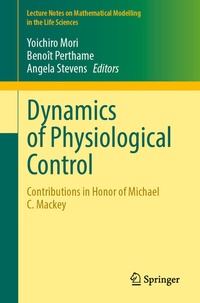
Dynamics of Physiological Control
Description

This book provides an overview of recent mathematical models for dynamics in cellular systems and offers a unique vision of the field by prominent experts.
It covers, among others, the regulatory basis of oscillations in biological systems; ergodic and chaotic properties in biological models with the example of maturity distribution of precursors of blood cells; time-delayed feedbacks; mathematical models of cell division and heterogeneous stem cell regeneration; quantitative mathematical modeling of glucose regulation; data-driven models of chemotherapy-induced neutropenia; and effects of irradiation and antioxidants in Alzheimer's disease.
This book is directed towards mathematicians interested in learning about modeling in cellular systems and is accessible also to theoreticians in biology and medicine.
More details
Other editions
Additional editions
Persons
Yoichiro Mori is the Calabi-Simons Professor of Mathematics and Biology at the University of Pennsylvania. He has worked on problems in physiology and biophysics, with a focus on electrophysiology and biofluid mechanics. His mathematical interests include numerical and applied analysis of partial differential equations and dynamical systems.
Benoît Perthame is an Emeritus Professor at Sorbonne Université in Paris. He has been successively the head of an Inria team he organized on mathematical biology, and head of the Laboratoire Jacques-Louis Lions. He is a member of the Académie des Sciences. Since the end of 1990s he turned his research area to partial differential equations in biology and medicine, including cell motion, modeling evolution, neuroscience, and more generally structured equations.
Angela Stevens is Full Professor at the University of Münster and Honorary Professor at Leipzig University. Together with Michael C. Mackey she is founding editor of Springer's Lecture Notes on Mathematical Modelling in the Life Sciences (LMML). She is working on mathematical models in biology and medicine, including cell motility and chemotaxis, the cellular cytoskeleton, epidemiology, pattern formation in microbial colonies, and tissue regeneration. Mathematically her focus is on partial- and integro-differential equations with further interests in stochastic interacting many-particle systems.
Content
- 1. Mike and Me Since 1973: A Review of a Long Friendship and Research Relationship.- 2. Michael Mackey and Data-Driven Models of Chemotherapy-Induced Neutropenia.- 3. Biological rhythms: Mechanisms, functions, and associated disorders.- 4. Mathematical Modeling of Heterogeneous Stem Cell Regeneration: From Cell Division to Waddington's Epigenetic Landscape.- 5. A Mathematical Model to Describe the Formation of Perinuclear ATM Crown and the Effect of Irradiation and Antioxidants in Cells Affected by Alzheimer's Disease.- 6. Ergodic and Chaotic Properties of Some Biological Models.- 7. Quantitative Insights into Glucose Regulation: A Review of Mathematical Modeling Efforts.- 8. Why does a Stick Balanced on the Fingertip fall?.
