

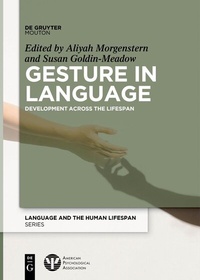
Gesture in Language
Description

Through constant exposure to adult input in interaction, children's language gradually develops into rich linguistic constructions containing multiple cross-modal elements subtly used together for communicative functions. Sensorimotor schemas provide the "grounding" of language in experience and lead to children's access to the symbolic function. With the emergence of vocal or signed productions, gestures do not disappear but remain functional and diversify in form and function as children become skilled adult multimodal conversationalists.
This volume examines the role of gesture over the human lifespan in its complex interaction with speech and sign. Gesture is explored in the different stages before, during, and after language has fully developed and a special focus is placed on the role of gesture in language learning and cognitive development. Specific chapters are devoted to the use of gesture in atypical populations.
CONTENTS
Contributors
Aliyah Morgenstern and Susan Goldin-Meadow
1 Introduction to Gesture in Language
Part I: An Emblematic Gesture: Pointing
Kensy Cooperrider and Kate Mesh
2 Pointing in Gesture and Sign
Aliyah Morgenstern
3 Early Pointing Gestures
Part II: Gesture Before Speech
Meredith L. Rowe, Ran Wei, and Virginia C. Salo
4 Early Gesture Predicts Later Language Development
Olga Capirci, Maria Cristina Caselli, and Virginia Volterra
5 Interaction Among Modalities and Within Development
Part III: Gesture With Speech During Language Learning
Eve V. Clark and Barbara F. Kelly
6 Constructing a System of Communication With Gestures and Words
Pauline Beaupoil-Hourdel
7 Embodying Language Complexity: Co-Speech Gestures Between Age 3 and 4
Casey Hall, Elizabeth Wakefield, and Susan Goldin-Meadow
8 Gesture Can Facilitate Children's Learning and Generalization of Verbs
Part IV: Gesture After Speech Is Mastered
Jean-Marc Colletta
9 On the Codevelopment of Gesture and Monologic Discourse in Children
Susan Wagner Cook
10 Understanding How Gestures Are Produced and Perceived
Tilbe Göksun, Demet Özer, and Seda AkbIyık
11 Gesture in the Aging Brain
Part V: Gesture With More Than One Language
Elena Nicoladis and Lisa Smithson
12 Gesture in Bilingual Language Acquisition
Marianne Gullberg
13 Bimodal Convergence: How Languages Interact in Multicompetent Language Users' Speech and Gestures
Gale Stam and Marion Tellier
14 Gesture Helps Second and Foreign Language Learning and Teaching
Aliyah Morgenstern and Susan Goldin-Meadow
Afterword: Gesture as Part of Language or Partner to Language Across the Lifespan
Index
About the Editors
More details
Other editions
Additional editions
Persons
Aliyah Morgenstern , University Sorbonne, France; Susan Goldin-Meadow , University of Chicago, USA.
Content
- Intro
- Contents
- Contributors
- 1 Introduction to Gesture in Language
- I An Emblematic Gesture: Pointing
- 2 Pointing in Gesture and Sign
- 3 Early Pointing Gestures
- II Gesture Before Speech
- 4 Early Gesture Predicts Later Language Development
- 5 Interaction Among Modalities and Within Development
- III Gesture With Speech During Language Learning
- 6 Constructing a System of Communication With Gestures and Words
- 7 Embodying Language Complexity: Co-Speech Gestures Between Age 3 and 4
- 8 Gesture Can Facilitate Children's Learning and Generalization of Verbs
- IV Gesture After Speech Is Mastered
- 9 On the Codevelopment of Gesture and Monologic Discourse in Children
- 10 Understanding How Gestures Are Produced and Perceived
- 11 Gesture in the Aging Brain
- V Gesture With More Than One Language
- 12 Gesture in Bilingual Language Acquisition
- 13 Bimodal Convergence: How Languages Interact in Multicompetent Language Users' Speech and Gestures
- 14 Gesture Helps Second and Foreign Language Learning and Teaching
- Afterword: Gesture as Part of Language or Partner to Language Across the Lifespan
- Index
- About the Editors
