

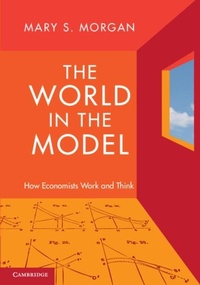
The World in the Model
How Economists Work and Think
1st Edition
Published on 15. August 2012
978-1-139-55796-2 (ISBN)
Description

During the last two centuries, the way economic science is done has changed radically: it has become a social science based on mathematical models in place of words. This book describes and analyses that change - both historically and philosophically - using a series of case studies to illuminate the nature and the implications of these changes. It is not a technical book; it is written for the intelligent person who wants to understand how economics works from the inside out. This book will be of interest to economists and science studies scholars (historians, sociologists and philosophers of science). But it also aims at a wider readership in the public intellectual sphere, building on the current interest in all things economic and on the recent failure of the so-called economic model, which has shaped our beliefs and the world we live in.
Reviews / Votes
'This well-informed and beautifully written series of case studies offers the best analysis to date of how economists work with models. It should help all economists think more deeply about what they do and give others insights into the way economic reasoning works.' Roger Backhouse, University of Birmingham 'Mary Morgan has developed a distinctive approach to economic methodology, relying on a great variety of examples - each one analysed and dissected in-depth like a careful entomologist. Her main message is that modelling should be kept distinct from formalism and mathematization: when we model, we use a specific entity both as an object of enquiry and as an instrument to study economic reality. Historians and philosophers of economics have been waiting for this book for years, and it will not fail to impress.' Francesco Guala, University of Milan 'Modern economics is about models - they are the 'working objects' of economic science - and yet we have traditionally had so little understanding of exactly what models are and how they work. This book provides us with that understanding. It is the culmination of Mary Morgan's many years of research on economic models and as such it is the definitive treatment of the subject. She gives us a complex historical investigation - not 3-by-5 card economic methodology - and such a detailed case studies-based history is exactly what is needed to understand the diversity of ways that models work, and have worked, in economic science. It will be an instant classic in the history and philosophy of modern economics.' D. Wade Hands, University of Puget Sound 'The Nobel laureate James Heckman has written that, just as the Jews are 'the people of the book', economists are 'the people of the model'. Mary Morgan in her The World in the Model provides an anthropological account of economists as model-makers and model-users - a mixture of their stories, their practices, and their languages. In Morgan's case studies, history provides an insightful window on methodology and philosophy, which, in turn, enlightens and enlivens a complex and previously untold history.' Kevin D. Hoover, Duke University 'In this superb book, models appear as little, artificial worlds, and Mary Morgan is the perfect guide to their structures and mysteries. Never content with generalizations, she joins the reader in exploring a series of rich and intriguing cases and shows how much the modern role of economics depends on the ambiguous relationships of these models to real economic institutions and behaviors.' Ted Porter, University of California, Los Angeles 'The World in the Model argues that economic models are not merely or mainly representations of phenomena; they are flexible tools that configure the domain, constitute its objects, and display salient features, thereby facilitating thinking about economics. Through a series of carefully crafted case studies, Mary S. Morgan shows how economic modeling and thinking about economic matters evolved in tandem. Anyone interested in scientific models or in economic understanding will find this book rewarding.' Catherine Z. Elgin, Harvard University 'Morgan's book constitutes a substantial contribution to the history of economics and a crucial one on the practice of modelling. Nearly, all the chapters of the long book are adapted from papers published in journals and books in the previous years. They can be read independently of each other, although there are great benefits in going through the whole book to appraise all the evidence for the claims made in the first chapter. This book has been, since 2012, and will be, for some years, of interest to multiple audiences.' Maxime Desmarais-Tremblay, The European Journal of the History of Economic ThoughtMore details
Language
English
Place of publication
Cambridge
United Kingdom
Publishing group
Cambridge University Press
Target group
College/higher education
Professional and scholarly
Illustrations
6 Tables, unspecified; 4 Plates, color; 1 Halftones, unspecified; 70 Line drawings, unspecified
File size
11,53 MB
ISBN-13
978-1-139-55796-2 (9781139557962)
Copyright in bibliographic data and cover images is held by Nielsen Book Services Limited or by the publishers or by their respective licensors: all rights reserved.
Schweitzer Classification
Other editions
Additional editions
Book
09/2012
Cambridge University Press
€93.80
Shipment within 15-20 days
Book
09/2012
Cambridge University Press
€214.90
Shipment within 15-20 days
Person
Mary S. Morgan, Fellow of the British Academy and Overseas Fellow of the Royal Dutch Academy of Arts and Sciences, is Professor of History and Philosophy of Economics at the London School of Economics and University of Amsterdam. She has published on a range of topics in the history and philosophy of economics: from statistics to experiments to narrative, and from nineteenth-century Social Darwinism to game theory in the Cold War. Her previous books include The History of Econometric Ideas (Cambridge University Press, 1990) and Models as Mediators (Cambridge University Press, 1999, co-edited with Margaret Morrison). She has also edited collections on measurement, policy making with models and the development of probability thinking. In the broader sphere, the collection of essays How Well Do Facts Travel? (Cambridge University Press, 2011, co-edited with Peter Howlett) marks the conclusion of a major interdisciplinary team project on evidence in the sciences and humanities. Professor Morgan is currently engaged in the project 'Re-thinking Case Studies Across the Social Sciences' as a British Academy-Wolfson Research Professor, this year as a Davis Center Fellow at Princeton University.
Content
1. Modelling as a method of enquiry; 2. Model building: new recipes, ingredients and integration; 3. Imagining and imaging: creating a new model world; 4. Character making: ideal types, idealization and the art of caricature; 5. Metaphors and analogies: choosing the world of the model; 6. Questions and stories: capturing the heart of matters; 7. Model experiments?; 8. Simulating: taking a microscope to economics; 9. Model situations, typical cases and exemplary narratives; 10. From the world in the model to the model in the world.
