

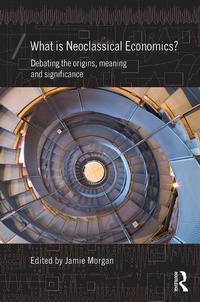
What is Neoclassical Economics?
Debating the origins, meaning and significance
Published on 19. November 2015
336 pages
978-1-317-33452-1 (ISBN)
Description

Despite some diversification modern economics still attracts a great deal of criticism. This is largely due to highly unrealistic assumptions underpinning economic theory, explanatory failure, poor policy framing, and a dubious focus on prediction. Many argue that flaws continue to owe much of their shortcomings to neoclassical economics. As a result, what we mean by neoclassical economics remains a significant issue. This collection addresses the issue from a new perspective, taking as its point of departure Tony Lawson's essay 'What is this 'school' called neoclassical economics?'.
Few terms are as controversial for pluralist and heterodox economists as neoclassical economics. This controversy has many aspects because the term itself has different specifications and connotations. Within this multiplicity what we mean by neoclassical matters to pluralist and heterodox economists for two primary reasons. First, because it informs how we view and critique the mainstream; second, because the relationship between heterodox and mainstream economics influences how heterodox economists model, apply methods and construct theory. The chapters in this collection each have different things to say about these matters, with contributions ranging across the work of key thinkers, such as Thorstein Veblen and Kenneth Arrow, applied issues of non-linear modelling of dynamic systems, and key events in the history of economics.
This book will be of use to those interested in methodology, political economy, heterodoxy, and the history of economic thought.
Few terms are as controversial for pluralist and heterodox economists as neoclassical economics. This controversy has many aspects because the term itself has different specifications and connotations. Within this multiplicity what we mean by neoclassical matters to pluralist and heterodox economists for two primary reasons. First, because it informs how we view and critique the mainstream; second, because the relationship between heterodox and mainstream economics influences how heterodox economists model, apply methods and construct theory. The chapters in this collection each have different things to say about these matters, with contributions ranging across the work of key thinkers, such as Thorstein Veblen and Kenneth Arrow, applied issues of non-linear modelling of dynamic systems, and key events in the history of economics.
This book will be of use to those interested in methodology, political economy, heterodoxy, and the history of economic thought.
Reviews / Votes
'What is neo-classical economics? Does the term pick out a coherent body of economic thought, a specific methodological stance or some more general distinctive position? Tony Lawson in a startlingly original contribution not only considers the origins of the term but shows how reflection on its meaning might be deployed to clarify the confused state of the contemporary academic discipline. In this excellent new collection a number of prominent economists and/or philosophers engage Lawson's analysis. The result is essential reading for all those seeking to understand the nature of modern economics and/or wanting something better.' - Dr. Stephen Pratten, King's College London, UK'Coming to terms with the concept of neoclassical economics is essential in understanding the continuing evolution of modern economics. Drawing on the traditions of political economy, economic methodology and the history of economic thought, this important and innovative volume is an excercise in pluralism. No consensus emerges, but the reader is left better equipped to compehend the different meanings of, and different perspectives on, this elusive concept.' - Professor Dimitris Milonakis, University of Crete, Greece
More details
Series
Language
English
Place of publication
London
United Kingdom
Publishing group
Taylor & Francis Ltd
Target group
College/higher education
Illustrations
6 s/w Abbildungen, 6 s/w Zeichnungen
6 Line drawings, black and white; 6 Illustrations, black and white
File size
1,77 MB
ISBN-13
978-1-317-33452-1 (9781317334521)
Copyright in bibliographic data and cover images is held by Nielsen Book Services Limited or by the publishers or by their respective licensors: all rights reserved.
Schweitzer Classification
Other editions
Additional editions
Book
12/2015
1st Edition
Routledge
€232.40
Shipment within 10-20 days
Book
11/2015
1st Edition
Routledge
€73.10
Shipment within 10-20 days
Person
Jamie Morgan is Reader at the School of Accounting, Finance and Economics, Leeds Beckett University, UK.
Content
1. What is this school called neoclassical economics? 2. From neoclassical theory to mainstream modelling: fifty years of moral hazard in perspective 3. Neo-classicism, critical realism and the Cambridge methodological tradition 4. Lawson, Veblen and Marshall: How to read modern Neoclassicalism 5. Lawson on Veblen on social ontology 6. Why is this school called neoclassical economics? Classicism and neoclassicism in historical context 7. Ten Propositions on 'Neoclassical' Economics 8. Neoclassical Economics: An Elephant is not a Chimera But is a Chimera Real? 9. The State of Nature and Natural States - ideology and formalism in the critique of neoclassical economics 10. Heterodox economics, social ontology, and the use of mathematics 11. Is Neoclassical Economics mathematical? Is there a non-Neoclassical mathematical economics? 12. Neoclacissism forever 13. Reflections upon Neoclassical Labour Economics
