

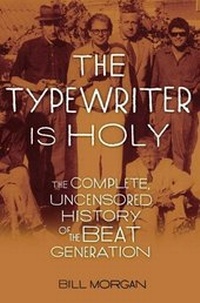
The Typewriter Is Holy
The Complete, Uncensored History of the Beat Generation
1st Edition
Published on 11. May 2010
320 pages
978-1-4165-9720-9 (ISBN)
Description

2014 ACKER AWARD WINNER
Anyone who cares to understand the literary and cultural ferment of America in the later twentieth century must be familiar with the writings and lives of those scruffy bohemians known as the Beat Generation.
In this highly entertaining work, Bill Morgan, the country's leading authority on the movement and a man who personally knew most of the Beats, narrates the history of these writers as primarily a social group of friends, tracing their origins together during the World War II years to the full blossoming of their notoriety in the late 1950s to their profound influence on the social upheaval of the 1960s. Indeed, it is impossible to comprehend the sixties without first grasping the importance of the social ripples set in motion by the Beats a decade earlier.
Although their prose and poetry varied in style and for the most part did not represent a genuine literary movement, the Beats, through their words and nonconformist lives, collectively posed a challenge to the staid and complacent America of the postwar years. They believed in free expression, opposing all censorship; they dabbled in free love; they practiced Eastern philosophy, leading to an embrace in America of alternative forms of spirituality; sooner than others, they watched with dismay the increasingly heavy hand of military and corporate culture in our national life; they embraced the aspirations, as well as the lingo, of urbanized black Americans. They believed in the liberating influence of hallucinogenic drugs.
In short, the Beats were thoroughly American in their love of individual freedom. Perhaps it should come as no surprise that J. Edgar Hoover described them in 1960 as one of the three greatest threats to American security (after communism and intellectual "eggheads").
The story that Bill Morgan tells has less to do with sociology than with social mingling. He traces the closely knit friendships of the Beat luminaries Allen Ginsberg, Jack Kerouac, William S. Burroughs, and the small army of other names. Although Kerouac, author of the much loved novel On the Road, was the most famous of the Beat writers, it was Ginsberg, Morgan contends, who resided at the center of the group and for more than two decades provided it with cohesion and a sense of direction.
The Beats were not saints. They were sexually irresponsible, undependable in marriage (the movement could in fact fairly be described as misogynistic); they did too many drugs and consumed too much booze; the very quality that characterized their lives and writings?a fervent belief in spontaneity?destroyed some friendships. Indeed, Morgan's story begins with a murder in New York's Riverside Park in 1944.
Bill Morgan has provided a sweeping, indispensable story about these discontented free spirits. We watch their peripatetic lives, their sexual misadventures, their ambivalent response to fame. We are reminded above all that while their personal lives may have not have been holy, their typewriters and their lasting words very much were.
Anyone who cares to understand the literary and cultural ferment of America in the later twentieth century must be familiar with the writings and lives of those scruffy bohemians known as the Beat Generation.
In this highly entertaining work, Bill Morgan, the country's leading authority on the movement and a man who personally knew most of the Beats, narrates the history of these writers as primarily a social group of friends, tracing their origins together during the World War II years to the full blossoming of their notoriety in the late 1950s to their profound influence on the social upheaval of the 1960s. Indeed, it is impossible to comprehend the sixties without first grasping the importance of the social ripples set in motion by the Beats a decade earlier.
Although their prose and poetry varied in style and for the most part did not represent a genuine literary movement, the Beats, through their words and nonconformist lives, collectively posed a challenge to the staid and complacent America of the postwar years. They believed in free expression, opposing all censorship; they dabbled in free love; they practiced Eastern philosophy, leading to an embrace in America of alternative forms of spirituality; sooner than others, they watched with dismay the increasingly heavy hand of military and corporate culture in our national life; they embraced the aspirations, as well as the lingo, of urbanized black Americans. They believed in the liberating influence of hallucinogenic drugs.
In short, the Beats were thoroughly American in their love of individual freedom. Perhaps it should come as no surprise that J. Edgar Hoover described them in 1960 as one of the three greatest threats to American security (after communism and intellectual "eggheads").
The story that Bill Morgan tells has less to do with sociology than with social mingling. He traces the closely knit friendships of the Beat luminaries Allen Ginsberg, Jack Kerouac, William S. Burroughs, and the small army of other names. Although Kerouac, author of the much loved novel On the Road, was the most famous of the Beat writers, it was Ginsberg, Morgan contends, who resided at the center of the group and for more than two decades provided it with cohesion and a sense of direction.
The Beats were not saints. They were sexually irresponsible, undependable in marriage (the movement could in fact fairly be described as misogynistic); they did too many drugs and consumed too much booze; the very quality that characterized their lives and writings?a fervent belief in spontaneity?destroyed some friendships. Indeed, Morgan's story begins with a murder in New York's Riverside Park in 1944.
Bill Morgan has provided a sweeping, indispensable story about these discontented free spirits. We watch their peripatetic lives, their sexual misadventures, their ambivalent response to fame. We are reminded above all that while their personal lives may have not have been holy, their typewriters and their lasting words very much were.
More details
Other editions
Additional editions
Book
09/2010
Atria Books
€44.80
No shipping information available
Person
Bill Morgan is the author and editor of more than a dozen books about the Beat writers, including the acclaimed biography, I Celebrate Myself: The Somewhat Private Life of Allen Ginsberg. For nearly forty years he has worked as an editor and archival consultant for nearly every member of the Beat Generation including Allen Ginsberg, Lawrence Ferlinghetti, Jack Kerouac, Gary Snyder, Michael McClure, Diane Di Prima, Gregory Corso, William S. Burroughs, and Edie Kerouac. He lives in Vermont.
Content
- Cover Page
- Title Page
- Copyright Page
- Dedication
- Contents
- Acknowledgments
- Introduction
- chapter 1 Friendship and Murder
- chapter 2 The Lumpen World
- chapter 3 The Adonis of Denver
- chapter 4 Insanity
- chapter 5 The Subterraneans
- chapter 6 Literary Lives
- chapter 7 The Name of a Generation
- chapter 8 To the West Coast
- chapter 9 Nightmare of Moloch
- chapter 10 The Six Gallery
- chapter 11 Desolation and Loneliness
- chapter 12 Censorship and Vindication
- chapter 13 Fame
- chapter 14 The Threads Loosen
- chapter 15 The Circle Widens
- chapter 16 Cut-ups
- chapter 17 Bitter Fruits
- chapter 18 Setting the Global Stage
- chapter 19 A Culture Turned Upside Down
- chapter 20 The Sixties
- chapter 21 The End of the Road
- chapter 22 Aftermath
- chapter 23 Respectability
- chapter 24 Acceptance
- chapter 25 Postscript
- Source Notes
- Selected Bibliography
- Index
- About the Author
- Photo Page
