

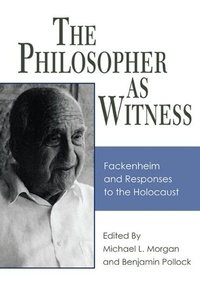
The Philosopher as Witness
Description

Emil Fackenheim (1916-2003), one of the most important Jewish philosophers of the twentieth century, called on the world at large not only to bear witness to the Holocaust as an unprecedented assault on Judaism and on humanity, but also to recognize that the question of what it means to philosophize-indeed, what it means to be human-must be raised anew in its wake. The Philosopher as Witness begins with two recent essays written by Fackenheim himself and includes responses to the questions that Fackenheim posed to philosophy, Judaism, and humanity after the Holocaust. The contributors to this book dare to extend that questioning through a critical examination of Fackenheim's own thought and through an exploration of some of the ramifications of his work for fields of study and realms of religious life that transcend his own.
Michael L. Morgan is Chancellor's Professor of Philosophy and Jewish Studies at Indiana University. He is the author and editor of many books, including A Holocaust Reader: Responses to the Nazi Extermination and Beyond Auschwitz: Post-Holocaust Jewish Thought in America. Benjamin Pollock is Assistant Professor of Religious Studies at Michigan State University.
More details
Other editions
Additional editions
Persons
Michael L. Morgan is Chancellor's Professor of Philosophy and Jewish Studies at Indiana University. He is the author and editor of many books, including A Holocaust Reader: Responses to the Nazi Extermination and Beyond Auschwitz: Post-Holocaust Jewish Thought in America. Benjamin Pollock is Assistant Professor of Religious Studies at Michigan State University.
Content
Preface
Part 1. Reflections
1. In Memory of Leo Baeck and Other Jewish Thinkers in "Dark Times": Once More, "After Auschwitz, Jerusalem"
Emil Fackenheim
2. Hegel and "The Jewish Problem"
Emil Fackenheim
Part 2. Critique
3. Hegel's Ghost: "Witness" and "Testimony" in the Post-Holocaust Philosophy of Emil Fackenheim
Susan E. Shapiro
4. Fackenheim on Passover after the Holocaust
Warren Zev Harvey
5. Of Systems and the Systematic Labor of Thought: Fackenheim as Philosopher of His Time
Benjamin Pollock
6. Fackenheim and Levinas: Living and Thinking after Auschwitz
Michael L. Morgan
7. The Holocaust and the Foundations of Future Philosophy: Fackenheim and Strauss
Sol Goldberg
8. Fackenheim and Strauss
Catherine H. Zuckert
Part 3. Response
9. Emil Fackenheim: Theodicy, and the Tikkun of Protest
David R. Blumenthal
10. The Holocaust Is a Christian Issue: Christology Revisited
Richard A. Cohen
11. The Holocaust-Tragedy for the Jewish People, Credibility Crisis for Christendom
Franklin H. Littell
12. Man or Muselmann?: Fackenheim's Elaboration on Levi's Question
David Patterson
13. Emil Fackenheim, Irving Howe, and the Fate of Secular Jewishness
Edward Alexander
14. She'erith Hapleitah: Reflections of a Historian
Zeev Mankowitz
15. Willful Murder in the Lublin District of Poland
David Silberklang
16. Metahistory, Redemption, and the Shofar of Emil Fackenheim
Gershon Greenberg
List of Contributors
Index
