

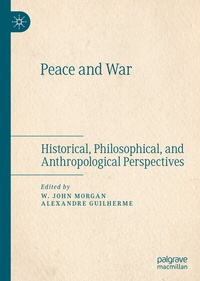
Peace and War
Description

Peace and War: Historical, Philosophical, and Anthropological Perspectives is an accessible, higher-level critical discussion of philosophical commentaries on the nature of peace and war. It introduces and analyses various philosophies of peace and war, and their continuing theoretical and practical relevance for peace studies and conflict resolution. Using a combination of both historical and contemporary philosophical perspectives, the book is at once eclectic in its approach and broad in its inquiry of these enduring phenomena of human existence.
Reviews / Votes
"Interdisciplinary yet uncompromisingly philosophical, this collection takes the reader on a global journey of peace and conflict. From Bartolome de Las Casas and the atrocities of colonization to the
Tao Te Ching
and living a life of goodness, we are reminded of who we have been and who we might yet become. A timely, sobering reminder of the potentiality of violence and the necessity of education for peace."
-
John E. Petrovic
, Professor of Educational Foundations and Policy Studies, The University of Alabama, USA
"This edited volume is impressively historically and contextually sensitive, and includes a number of chapters on underserved, forgotten, or otherwise neglected theorists and works. Thus, it is valuable for anyone who is concerned to have a truly global understanding of war and peace."
-
Jennifer Kling
, Assistant Professor of Philosophy and Director of the Center for Legal Studies, University of Colorado, USA
More details
Other editions
Additional editions
Persons
W. John Morgan is Professor Emeritus and formerly UNESCO Chair of the Political Economy of Education at the University of Nottingham. He is also Honorary Professor in the School of Social Sciences and Leverhulme Emeritus Fellow of the Wales Institute of Social and Economic Research, Data, and Methods at Cardiff University, Wales, U.K.
Alexandre Guilherme is Adjunct Professor in the School of Humanities at the Pontificia Universidade Catolica do Rio Grande do Sul, PUCRS, Brazil. He is the Coordinator of the Research Group on Education and Violence (CNPq, Brazilian Ministry of Education), and Reader at the UNESCO Chair of Youth, Education and Society, Brasilia.
Content
Introduction.- Chapter One: Bartolomé de las Casas' Critique of War and Vision of Peace.- Chapter Two: The Heart of the Daodejing: Non-violent Personhood.- Chapter Three: The Augustinian Legacy of Divine Peace and Earthly War.- Chapter Four: Pacifism or Bourgeois Pacifism? Huxley, Orwell, and Caudwell.- Chapter Five: Julien Freund on War and Peace: Mitigated Realism .- Chapter Six: Revolutionary War and Peace.- Chapter Seven: Catastrophe and Conversion: Culture, Conflict, and Violence in the Hermeneutics of René Girard.- Chapter Eight: Learning for Peace: The Montessori Way.- Chapter Nine: Peace and Violence in Poor Rural Schools in Post-Apartheid South Africa.
