

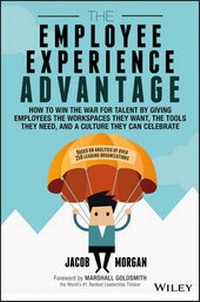
The Employee Experience Advantage
Description

Recently a new type of organization has emerged, one that focuses on employee experiences as a way to drive innovation, increase customer satisfaction, find and hire the best people, make work more engaging, and improve overall performance. The Employee Experience Advantage is the first book of its kind to tackle this emerging topic that is becoming the #1 priority for business leaders around the world. Although everyone talks about employee experience nobody has really been able to explain concretely what it is and how to go about designing for it...until now.
How can organizations truly create a place where employees want to show up to work versus need to show up to work? For decades the business world has focused on measuring employee engagement meanwhile global engagement scores remain at an all time low despite all the surveys and institutes that been springing up tackle this problem. Clearly something is not working. Employee engagement has become the short-term adrenaline shot that organizations turn to when they need to increase their engagement scores. Instead, we have to focus on designing employee experiences which is the long term organizational design that leads to engaged employees. This is the only long-term solution. Organizations have been stuck focusing on the cause instead of the effect. The cause is employee experience; the effect is an engaged workforce.
Backed by an extensive research project that looked at over 150 studies and articles, featured extensive interviews with over 150 executives, and analyzed over 250 global organizations, this book clearly breaks down the three environments that make up every single employee experience at every organization around the world and how to design for them. These are the cultural, technological, and physical environments. This book explores the attributes that organizations need to focus on in each one of these environments to create COOL spaces, ACE technology, and a CELEBRATED culture. Featuring exclusive case studies, unique frameworks, and never before seen research, The Employee Experience Advantage guides readers on a journey of creating a place where people actually want to show up to work.
Readers will learn:
* The trends shaping employee experience
* How to evaluate their own employee experience using the Employee Experience Score
* What the world's leading organizations are doing around employee experience
* How to design for technology, culture, and physical spaces
* The role people analytics place in employee experience
* Frameworks for how to actually create employee experiences
* The role of the gig economy
* The future of employee experience
* Nine types of organizations that focus on employee experience
* And much more!
There is no question that engaged employees perform better, aspire higher, and achieve more, but you can't create employee engagement without designing employee experiences first. It's time to rethink your strategy and implement a real-world framework that focuses on how to create an organization where people want to show up to work. The Employee Experience Advantage shows you how to do just that.
More details
Other editions
Additional editions
Persons
Content
Foreword xiii
Acknowledgments xvii
We All Care about Experience (Introduction) xix
Part I The Evolution of Employee Experience 1
1 Defining Employee Experience 3
Utility 3
Productivity 3
Engagement 5
Employee Experience 6
2 Research on Employee Experience 11
A Note about the Research Sponsors 15
3 Employee Experience Drivers 17
Poor Success with Engagement 18
Engagement Measures Downward 18
Engagement Has Become the New Annual Review 20
Engagement Tends to Look at the Effect but Not the Cause 21
Engagement Surveys Are Exhaustingly Long 22
Engagement Acts as an Adrenaline Shot 22
The War for Talent 26
Skills Gap and Talent Shortage 26
Changing Demographics 27
Changing Face of Talent Competition 28
Psychology (and Sociology) 29
Business Turbulence 29
Technology 30
Alternative Work Arrangements and the Gig Economy 32
Growing Fast but Not Dominating 33
The Effect on Employee Tenure 35
People Analytics 38
People Analytics in Action 40
The Future of People Analytics 43
Transparency 45
Part II The Reason for Being and the Three Employee Experience Environments 49
4 Reason for Being 51
Statements from Leading Organizations 52
The Three Employee Experience Environments 56
5 The Physical Environment 59
Chooses to Bring in Friends or Visitors 61
Offers Flexibility 64
Organization's Values Are Reflected 67
Leverage Multiple Workspace Options 70
How Organizations Scored 74
6 The Technological Environment 77
Availability to Everyone 78
Consumer Grade Technology 82
Employee Needs versus Business Requirements 84
How Organizations Scored 86
7 The Cultural Environment 89
Company Is Viewed Positively 90
Everyone Feels Valued 95
Compensation and Benefits 96
Having Employee's Voices Heard 97
Organization Doesn't Ask 97
Organization Asks but Does Nothing 98
Organization Asks and Acknowledges 98
Organization Asks, Acknowledges, and Acts 98
Employees Are Recognized for the Work That They Do 98
Legitimate Sense of Purpose 100
Employees Feel like They're Part of a Team 107
Believes in Diversity and Inclusion 109
Referrals Come from Employees 112
Ability to Learn New Things and Given the Resources to Do So and Advance 114
Learning and Development 115
Advancement 118
Treats Employees Fairly 120
Executives and Managers Are Coaches and Mentors 122
Dedicated to Employee Health and Wellness 124
How Organizations Scored 126
8 The Employee Experience Equation 131
Part III Why Invest in Employee Experience? 133
9 The Nine Types of Organizations 135
inExperienced 136
Emerging 137
Engaged 139
Empowered 140
Enabled 140
preExperiential 141
Experiential 141
10 Employee Experience Distribution 145
11 The Business Value of Employee Experience 149
Customer Service 151
Innovation 153
Employer Attractiveness 153
Admiration and Respect 154
Brand Value 154
Other Lists 155
12 Business Metrics and Financial Performance 157
13 The Cost of Employee Experience 167
Part IV Building the Experiential Organization 171
14 System 1 versus System 2 Experiences 173
15 The Employee Experience Design Loop 177
Respond 178
Analyze 180
Scenario 1 Analysis Reveals 180
Scenario 1 Insight for Your Organization 180
Scenario 2 Analysis Reveals 181
Scenario 2 Insight for Your Organization 181
Scenario 3 Analysis Reveals 181
Scenario 3 Insight for Your Organization 181
Analysis Enablers 181
Design 182
Launch 183
Participate 183
Example: General Electric 184
Respond 184
Analyze 185
Design 185
Launch 186
Participate 187
Example: Airbnb 189
Respond 189
Analyze 189
Design 190
Launch 191
Participate 191
16 The Starbucks Model of Transparency 193
17 The Employee Life Cycle 197
18 Moments That Matter or Moments of Impact 201
Specific Moments That Matter 201
Ongoing Moments That Matter 202
Created Moments That Matter 203
Moments That Matter at Cisco 203
19 Moments That Matter and Employee Experience 205
20 The Employee Experience Pyramid 209
21 What about the Actual Work? 213
22 Who Owns the Employee Experience? 217
Initiated by the CEO and Executive Team 217
Owned by the People Team 219
Driven by Managers 220
Championed by Everyone 222
23 A Lesson from Airbnb 223
24 The Role of Employees 227
25 Where to Start 229
You Have to Care, Really Care 229
Define a Reason for Being 231
Build a People Analytics Function 232
Start Small 232
Identify the Required Skills 234
Have Executive Support, Typically the Chief People Officer 236
Train the Organization 236
Tell Stories 237
Build or Improve the Experience Team 237
Deploy Feedback Tools/Mechanisms 239
In-Person Feedback 239
Feedback via Technology 241
Implement COOL Spaces, ACE Technology, and CELEBRATED Culture 242
Example: Adobe 244
Technological Environment 244
Physical Environment 245
Cultural Environment 246
Identify and Create Moments That Matter (or Moments of Impact) 250
Think of Your Organization like a Lab Instead of a Factory 253
26 Focus on What Makes Your Company Unique 257
27 Size, Industry, and Location Don't Matter 261
Always Improve 262
Think like a Laboratory 262
Move beyond Checklists 263
Put People at the Center and Know Them 264
Design with, Not For 264
Care 264
Focus on What Makes You Unique 265
28 A Futurist's Perspective 267
Appendix 269
Index 271
CHAPTER 1
Defining Employee Experience
UTILITY
Decades ago the relationship we had with our employers was pretty straightforward. Employers had jobs they needed to fill; we had bills to pay, things we wanted to buy, and certain skills we could offer, so we tried to get that open job. This basic relationship also meant that work was always about utility, that is, the bare-bones, essential tools and resources that an employer can provide employees to get their jobs done (see Figure 1.1). Today that is typically a computer, desk, cubicle, and phone. In the past this may have been a desk, pen, notepad, and phone, or perhaps just a hammer and nails. That was it. Can you imagine if someone were to bring up health and wellness programs, catered meals, bringing dogs to the office, or flexible work efforts in the past? Give me a break! They would be laughed at and the employee most likely fired on the spot! These things are all relatively new phenomena that are now only starting to gain global attention and investment. Granted, there are still plenty of organizations out there that are still stuck in the utility world.
Figure 1.1 Evolution of Employee Experience
PRODUCTIVITY
After the utility era came the productivity era. This is where folks like Frederick Winslow Taylor and Henri Fayol pioneered methods and approaches to optimize how employees worked. Managers literally used stopwatches to time how long it would take employees to complete a task to shave off a few seconds here and there. It was analogous to trying to get a sprinter or swimmer to improve his or her lap time. All of this was designed to improve productivity and output while emphasizing repeatable processes, such as the famous factory assembly line. Unfortunately at the time, we didn't have robots and automation to do these jobs (which they would have been perfect for), so instead we used humans. Today, we finally have the technology capable to do the jobs they were designed for, and the humans who were simply acting as placeholders are now in trouble. Robots aren't taking jobs away from humans; it's the humans who took the jobs away from robots. As with the utility era, there also wasn't much focus on creating an organization where the employee truly wanted to be. Productivity was simply utility on steroids!
ENGAGEMENT
Next came engagement, a radically new concept where we saw the collective business world say, "Hey, maybe we should pay more attention to employees and what they care about and value instead of just trying to extract more from them." And thus, the era of engagement (or enlightenment) was born. This was actually quite a revolutionary approach that shifted some of the focus away from how the organization can benefit and extract more value from employees to focusing on what the organization can do to benefit the employees and understand how and why they work. The more engaged an employee is, the better! This is where we stopped and where we have been for the past two or three decades. There have been all sorts of studies that have shown engaged employees are more productive, stay at the company longer, and are generally healthier and happier.
I'll admit that when I first started writing this book, I was convinced that employee experience and engagement were at odds with each other. I mistakenly believed that experience must replace engagement. In fact there were thousands of words originally devoted to that very rationale that I had to scrap from this book. I've since changed my tune. Employee experience doesn't need to replace engagement. The two can actually work together, and in fact, they have to. Instead I view employee experience as something that creates engaged employees but focuses on the cultural, technological, and physical design of the organization to do that. Still, our current definitions and understanding of employee engagement need to evolve before that can happen. Many of the questions and frameworks used to explore engagement haven't changed since they were first introduced into the business world, which creates some challenges.
EMPLOYEE EXPERIENCE
Let's say you buy an old car at a junkyard and then spend thousands of dollars on new paint, upholstery, rims, and interior upgrades. Even though the car will look beautiful, it will still drive like the same car you brought home from the junkyard. If you want to improve how the car performs, then you need to replace the engine. Organizations around the world are investing considerable resources into things such as corporate culture programs, office redesigns, employee engagement initiatives, and well-being strategies. Unfortunately these things make the organization look better but have little impact on how it actually performs.
Many organizations today use employee engagement and employee experience interchangeably without any distinguishable difference, which is incorrect. Employee engagement has been all about short-term cosmetic changes that organizations have been trying to make to improve how they work. If this approach doesn't work for a car, then it certainly won't work for an organization.
If employee engagement is the short-term adrenaline shot, then employee experience is the long-term redesign of the organization. It's the focus on the engine instead of on the paint and upholstery. Chances are you've heard of the term customer experience, which is typically defined as "the relationship that a customer has with a brand." Most people reading that would say, "Well, of course that's what it is. Isn't that obvious?" Yes it is, which is why I think it's really a meaningless definition that provides no context or direction for what that actually looks like. This is why I wanted to avoid simply defining employee experience as "the relationship between an employee and the organization." That doesn't help anyone or provide any value, and as with the customer experience, it's rather obvious. So then what is employee experience?
There are a few ways we must look at this. The first is through the eyes of the employee, the second is through the eyes of the organization, and the third is the overlap between the two. When reading through these you may decide to lean toward the side of the employee or the organization, but since two parties are involved, it is in both the employee's and the organization's best interest if we view employee experience as something that is created and affected by both.
For the people who are a part of your organization, their experience is simply the reality of what it's like to work there. From the perspective of the organization, employee experience is what is designed and created for employees, or put another way, it's what the organization believes the employee reality should be like. This, of course, is a challenge and one we see in our everyday lives. Have you ever said or done something to a loved one or friend that was well intentioned yet was perceived as being rude or disrespectful? This is the same scenario we see play out between organizations and employees all the time. Just because the organization does something doesn't mean the employees perceive it in the intended way. Naturally this causes problems not just in our personal lives but also at work.
You may have seen The Truman Show, a film about a man who is living in a world that was designed for him by an organization. His entire perceived world was constructed from a massive stage, and although he didn't realize it, every action and event that took place was planned. Regardless of how hard the organization tried to keep Truman from leaving the world that was created for him, he eventually did break free. In some ways this is how our organizations operate. They tell us when we can work, what tools we should use, what to wear, when we can get promoted or learn something new, whom we can talk to, and when we can eat or take breaks. Not only that but they also control the environments we work in and pretty much anything and everything else that happens within the walls of the organization. As an employee you have virtually no say in what happens for around 8 to 10 hours of your day. Although our organizations aren't exactly Truman-izing our lives, there are parallels that can be drawn here. So where does that leave us?
The ideal scenario is the overlap between the employee's reality and the organization's design of that employee reality. In other words, the organization designs or does something, and the employees perceive it in the intended way. This is possible because as you will see in the following chapters, employees actually help shape their experiences instead of simply having them designed by the organization (aka the Truman approach).
Taking that viewpoint, one can define employee experience as "the intersection of employee expectations, needs, and wants and the organizational design of those expectations, needs, and wants." You can see this in Figure 1.2 below.
Figure 1.2 Employee Experience Design
However, what resonates more with people is saying "designing an organization where people want to show up by focusing on the cultural, technological, and physical environments." Phrasing it this way essentially encapsulates the entire relationship and journey that an employee experiences while interacting with an...
