

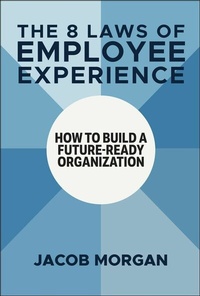
The 8 Laws of Employee Experience
Description

Organizations around the world have lost their way. It's time to get back to basics and focus on what really drives people and performance.
In chasing talent, organizations have turned employee experience into an entitlement culture - lavishing perks without accountability, lowering standards in the name of empathy, and confusing short-term fixes with long-term solutions. The result? Performance suffers, leaders are scared to lead, and culture drifts.
The 8 Laws of Employee Experience is a reset, a new framework to build a future-ready organization in an AI driven world. Best-selling author and professionally trained futurist Jacob Morgan shows that employee experience must return to its core: a value exchange where employees contribute, grow, and lead, and where organizations enable them to thrive. Based on over 100 CHRO interviews at companies like Verizon, Delta, Hilton, IBM,and LVMH, Morgan lays out eight unshakeable laws that form the new operating system for the future of work.
This book isn't just about where we are today - it's about where employee experience is going over the next decade, and how leaders can design the future instead of being dragged into it.
After reading this book you'll learn how to:
- Separate signal from noise in an era of trend-chasing with the STEEPLE methodology
- Discover the eight laws required to build a future-ready organization and how to implement them
- Use futurist frameworks like the Cone of Possibilities to map out multiple employee experience scenarios
- Conduct a future-ready audit to see where your company stands today and where it must go next
- Explore the five potential futures of employee experience and how to steer your organization towards the right one
- Challenge the myth that employee experience is about making people happy
Combining insights from CHROs who are collectively leading millions of people around the world with a futurist framework, The 8 Laws of Employee Experience: How to Build a Future-Ready Organization offers a blueprint to design organizations that don't just adapt to the future but build it. You'll see what works, what fails, and what the future demands.
More details
Other editions
Additional editions
Person
JACOB MORGAN is one of the world's leading authorities on the future of work, employee experience and leadership. He's a bestselling author, professionally trained futurist and sought-after keynote speaker. He has worked with organizations including Microsoft, Disney, PwC, PepsiCo, MasterCard, IBM, and many others. He hosts a popular podcast called Future-Ready Leadership and runs an exclusive CHRO group called Future of Work Leaders.
Content
Introduction xi
Chapter 1 The STEEPLE Framework for Employee Experience Trends 1
Chapter 2 Trends Are Not Truths 13
Chapter 3 Law #1: Decode the Human Signal 21
Chapter 4 Law #2: Act with Empathetic Excellence 35
Chapter 5 Law #3: Grow or Go 57
Chapter 6 Law #4: Design for Flexibility 81
Chapter 7 Law #5: Make People the First Principle 97
Chapter 8 Law #6: Lead Like the Experience Starts with You 117
Chapter 9 Law #7: Use Technology to Amplify Humanity 135
Chapter 10 Law #8: Run Culture Like an Operating System 159
Chapter 11 The Future-Ready EX Diagnostic Tool 181
Chapter 12 The Cone of Possibilities 189
Chapter 13 The Future- Ready Audit: Turning Possibilities into Action 205
Notes 211
Acknowledgments 217
About the Author 219
Index 221
INTRODUCTION
In 2015 I started doing research for The Employee Experience Advantage, which was published in 2017. At the time, organizations were just coming to understand that a great employee experience wasn't just about surveys, perks, or free food. That book highlighted that most organizations around the world weren't actually making meaningful changes as far as how work got done. Instead, they were obsessed with the idea of employee engagement, an idea that had good intentions but became a type of temporary solution to distract employees from the sad reality of working for their respective organizations.
In my research for that book, I found that even though organizations have never spent more money on employee engagement programs, our scores have never been lower. How is that possible? It's because instead of changing core workplace practices, we invested in perks like free food, hot yoga, and unlimited vacation days. In my book, I laid out a specific and structured approach to employee experience that focused on three environments that organizations can design for: culture, technology, and space.
That book has gone on to become the number-one best-selling employee experience book, and it still is used by many of the world's top organizations to shape their employee experience strategies. It's hard to believe that book came out almost a decade ago. A lot has changed since 2017, and many of the chief human resources and people officers (CHROs and CPOs) and executives whose organizations I have spoken at, advised, and interviewed started asking me if I had plans to write a new employee experience book for 2026 and beyond. I didn't want to write a sequel or make just a few updates; I wanted something new and different. This time I approached the employee experience with a futurist lens, looking not just at where we are today but where we are going and where we must go in the future.
Although employee experience is still the number-one talent and even business imperative for organizations around the world, many have lost sight of what employee experience is and what really matters. During and after the pandemic, organizations around the world were so desperate to keep and attract talent that they resorted to giving anything and everything to anyone who would come through their doors and stay there. One CHRO I interviewed told me that her company effectively created a Pinocchio's island where employees were getting salary raises regardless of performance; learning stipends of thousands of dollars were paid out to everyone; employees could work when, where, and how they wanted; and standards of any kind were basically suspended. The company, with thousands of employees, has since had to claw back many of these programs to cut costs.
This approach is not practical, scalable, or sustainable. In fact, it has caused far more harm than good.
We've lost sight of the purpose of work. At its core, work is a value exchange; people are paid to contribute, perform, and make a positive impact. Of course, as employees and leaders we want to feel respected, supported, and inspired, but that doesn't mean abandoning standards, accountability, or the pursuit of excellence. Humanity at work doesn't mean lowering the bar; it's about challenging and pushing people to rise to meet it. The goal of employee experience isn't to make work effortless; it's to unlock the potential of people, to enable them to perform at their best, and to drive meaningful results.
Employees should feel challenged; they should make occasional sacrifices; they should work hard; they should have some amazing days and some tough days; they should get frustrated at times; they should wrestle with difficult problems; and they should experience the satisfaction of overcoming an obstacle. They should feel the weight of accountability but also the thrill of achievement when they rise to meet a challenge. Sometimes they should get offended and argue with a peer. They should know they are trusted to handle complexity while empowered to make decisions and expected to grow as leaders. All of these things make work and life meaningful.
Work has weight, impact, and consequences.
Employee experience will always be the number-one talent imperative for organizations because people are the number-one asset for any organization. Trends may change, new technologies will emerge, expectations will evolve, and new generations will be born. But organizations will still need the very best and brightest people to solve complex problems, build relationships, mitigate threats, and identify new opportunities.
Maud Alvarez-Pereyre is the CHRO of LVMH, which has 215,000 employees globally. Here's what she shared with me.
We need to remember that people are the business-not a cost, not an expense, but the true engine of growth and value. And yet, in HR, we haven't always been bold enough to demonstrate that. Too often, we're seen as business partners, but we're not just partners-we are the business. When you create an exceptional employee experience, where does that show up on the P&L? It doesn't. When you build a culture that retains top talent, multiplies skills, and produces better leaders-where does that get recognized in the numbers? It doesn't. Because we still think of people as a cost to be managed, not as value to be created. That has to change. It's time to flip the script and show that investing in people is the most efficient business strategy-and the greatest opportunity for growth. This is what employee experience is all about and why talents are the most precious asset any business should focus on.
As I wrote this book, I kept coming back to a series of questions that companies and the leaders I was working with were asking me. The same questions were being asked in my Future of Work Leaders CHRO group. (You can learn more at FutureOfWorkLeaders.com.) Here are the questions:
- What will an exceptional employee experience look like in the next 5+ years-and how can organizations reverse-engineer that future today?
- What are the nonnegotiable pillars of employee experience that every organization must build on to attract, engage, and retain top talent?
- How can futurist thinking and frameworks be used to design employee experiences that are not only resilient but future-ready?
- Which trends are truly reshaping employee experience-and how can leaders separate the signal from the noise?
- What does it really mean to be a future-ready organization-and what practical steps can leaders take to make it a reality?
The laws outlined in this book are the collective answer to these questions.
Many of the fringe concepts I explored in The Employee Experience Advantage, such as internal talent marketplaces, skills-based mobility, flexible work, and the impact of AI, are now being fully embraced and implemented in organizations around the world. However, a lot has also changed over the past few years in terms of geopolitics, the economy, technology, the political climate, the aftermath of the pandemic, the massive DEI backlash, and a whole lot more.
I interviewed over 100 CHROs at companies around the world including Verizon, BAT, Delta, Panasonic, UPS, Mastercard, IBM, LVMH, and dozens of others. I specifically focused on some of the world's top and most recognized brands, which collectively are responsible for millions of employees around the world. All of these interviews were hourlong virtual discussions with many follow-ups and additional email exchanges. A handful of the interviews were done via email responses and in-person discussions.
I asked all the CHROs not just what they were doing but where they wanted to go in the future, what was working and what wasn't, and what they saw on the horizon. We talked about trends, strategies, challenges, and a host of other topics. After all of these conversations, I looked for common trends, themes, strategies, areas of success, and interesting and compelling examples and stories that I can share with you here.
A LEADERSHIP BOOK, NOT AN HR BOOK
I have always believed that employee experience is not something that is owned by HR. It's owned by everyone at the company, although HR can help be the guiding strategic force to move things forward.
Jyoti Chopra is the chief people officer at MGM Resorts International with over 61,000 employees. At all of the organization's properties and corporate offices, everyone owns the employee experience. Here is a highlight of our discussion:
Our frontline managers are employee experience advocates. They lead onboarding through a program we call "Show Time"-a two-day orientation for all new hires. They're involved in training, recognition, and engagement. And they set the tone every day. Our culture isn't a top-down message, it's lived in the back-of-house dining rooms, on the casino floor, and in the break rooms. That's where it comes to life. At MGM, we view human capital on par with financial capital. Our philosophy is that people are an asset on the balance sheet. That means we expect our leaders to look at their people data with the same discipline as their P&L, including turnover trends, hiring metrics, promotions, and even tenure data by department and job type.
This is the mindset that future-ready organizations need. That's why this book is anchored around the Eight laws of employee experience...
