

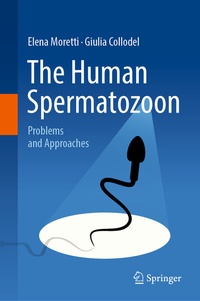
The Human Spermatozoon
Description

This textbook provides a comprehensive overview of the human spermatozoon, tracing its journey from historical discovery to contemporary scientific understanding.
The chapters cover the complexities of sperm morphology and function, providing a thorough examination that is both technical and accessible. The volume opens with the history of sperm research, and subsequent chapters focus on human spermatogenesis and the detailed structure and motility of sperm cells. Readers will gain critical insight into the factors that influence spermatogenesis, including oxidative stress, genetic influences, and lifestyle factors. The book also provides an in-depth examination of various sperm defects and their impact on fertility.
Written by leading experts in the field, this work invites the reader to reflect on critical issues in male fertility and reproductive health. It provides a complete summary of the sophisticated machinery of the human spermatozoon, making it essential reading for students, researchers and technicians in reproductive biology and medicine.
More details
Other editions
Additional editions
Persons
Dr. Elena Moretti obtained the Master degree in Biological Sciences at the University of Siena in 1991 and her Ph.D. in the Biology of Germ Cells at the University of Siena in 1999, with a focus on human and animal spermatozoa, and spermatogenesis.
In 1996 she spent a year as a research fellow at the Department of Genetic and Molecular Biophysics and Biochemistry, Yale University (New Haven, CT, USA), under the supervision of Prof. Gabor Huszar and Prof. David Ward.
From 2004 to 2019, Dr. Moretti has had a role as Researcher in Applied Biology and currently she is an Associate Professor in Applied Biology at the Department of Molecular and Developmental Medicine, University of Siena (Siena, Italy).
Dr. Moretti is a member of the Board of the Doctoral School in Molecular Medicine (University of Siena, Siena, Italy) and a member of the Teaching Committee of the Master Degree in "Biotechnologies of Human Reproduction", Department of Molecular and Developmental Medicine, University of Siena (Italy).
Her research interests are focused in the field of reproduction. In particular, she is interested in the morphological and molecular study of human and animal spermatogenesis in normal and pathological conditions and in the study of oxidative stress in seminal plasma and spermatozoa.
She has authored more than 170 publications in international peer-reviewed journals and has an h-index of 36 (Scopus).
Dr. Giulia Collodel is Associate Professor of Applied Biology at the Department of Molecular and Developmental Medicine of the University of Siena.
She received a Master's degree in Biological Sciences in 1987 and a Ph.D. in 1994 in the Biology of Germ Cells. In 1997-1998 she was a guest in the laboratory of Prof. Jordi Benet (Universitat Autonoma de Barcelona, Spain). From 2006-2012 she was Director of the Interdepartmental Center for the Study and Treatment of Male Infertility (University of Siena, Italy). Currently she is a member of the Accademia dei Fisiocritici, member of the Board of the Doctoral School in Molecular Medicine (University of Siena, Italy) and Deputy for Research (Department of Molecular and Developmental Medicine, University of Siena, Italy).
Her scientific interests are in the field of animal and human male reproduction, in particular the study of sperm morphology and physiology in normal and pathological conditions. A line of research concerns the role of fatty acid oxidation in male infertility.
She is author and co-author more than 200 publications in international peer-reviewed journals and has an h-index of 39 (Scopus).
Content
Chapter 1: The history of the spermatozoon: from discovery to today.- Chapter 2 Human spermatogenesis.- Chapter 3 The human spermatozoon: structure and motility.- Chapter 4: Factors affecting human spermatogenesis.- Chapter 5: Non-systematic and systematic defects of human spermatozoon.- Chapter 6: Post-testicular sperm maturation: the epididymis and the seminal plasma.- Chapter 7: The Human Spermatozoon: conclusion and future directions.
