

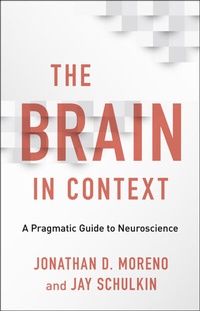
The Brain in Context
A Pragmatic Guide to Neuroscience
1st Edition
Published on 16. December 2019
280 pages
978-0-231-54710-9 (ISBN)
Description

The human brain is the most complex object in the known universe. The field of neuroscience has made remarkable strides in recent years in understanding aspects of the brain, yet we still struggle with seemingly fundamental questions about how the brain works. What lessons can we learn from neuroscience's successes and failures? What kinds of questions can neuroscience answer, and what will remain out of reach?
In The Brain in Context, the bioethicist Jonathan D. Moreno and the neuroscientist Jay Schulkin provide an accessible and thought-provoking account of the evolution of neuroscience and the neuroscience of evolution. They emphasize that the brain is not an isolated organ-it extends into every part of the body and every aspect of human life. Understanding the brain requires studying the environmental, biological, chemical, genetic, and social factors that continue to shape it. Moreno and Schulkin describe today's transformative devices, theories, and methods, including technologies like fMRI and optogenetics as well as massive whole-brain activity maps and the attempt to create a digital simulation of the brain. They show how theorizing about the brain and experimenting with it often go hand in hand, and they raise cautions about unintended consequences of technological interventions. The Brain in Context is a stimulating and even-handed assessment of the scope and limits of what we know about how we think.
In The Brain in Context, the bioethicist Jonathan D. Moreno and the neuroscientist Jay Schulkin provide an accessible and thought-provoking account of the evolution of neuroscience and the neuroscience of evolution. They emphasize that the brain is not an isolated organ-it extends into every part of the body and every aspect of human life. Understanding the brain requires studying the environmental, biological, chemical, genetic, and social factors that continue to shape it. Moreno and Schulkin describe today's transformative devices, theories, and methods, including technologies like fMRI and optogenetics as well as massive whole-brain activity maps and the attempt to create a digital simulation of the brain. They show how theorizing about the brain and experimenting with it often go hand in hand, and they raise cautions about unintended consequences of technological interventions. The Brain in Context is a stimulating and even-handed assessment of the scope and limits of what we know about how we think.
More details
Other editions
Additional editions
Book
11/2019
Columbia University Press
€31.00
Article not available at the moment
Persons
Jonathan D. Moreno is David and Lyn Silfen University Professor and a Penn Integrates Knowledge professor at the University of Pennsylvania, where he is also a professor of medical ethics and health policy, history and sociology of science, and philosophy. His books include Mind Wars: Brain Science and the Military in the 21st Century (2012) and Impromptu Man: J. L. Moreno and the Origins of Psychodrama, Encounter Culture, and the Social Network (2014).
Jay Schulkin is a research professor in the Department of Neuroscience at Georgetown University. He is the author of numerous books, including Reflections on the Musical Mind: An Evolutionary Perspective (2013) and Sport: A Biological, Philosophical, and Cultural Perspective (Columbia, 2016).
Jay Schulkin is a research professor in the Department of Neuroscience at Georgetown University. He is the author of numerous books, including Reflections on the Musical Mind: An Evolutionary Perspective (2013) and Sport: A Biological, Philosophical, and Cultural Perspective (Columbia, 2016).
Content
Introduction
1. Electrifying
2. Constructing
3. Evolving
4. Imaging
5. Engineering
6. Securing
7. Healing
8. Socializing
Not the Last Word
Acknowledgments
Notes
References
Index
1. Electrifying
2. Constructing
3. Evolving
4. Imaging
5. Engineering
6. Securing
7. Healing
8. Socializing
Not the Last Word
Acknowledgments
Notes
References
Index
