

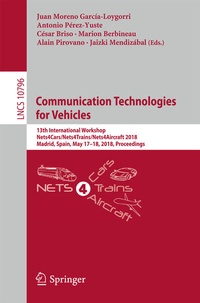
Communication Technologies for Vehicles
Description

This book constitutes the proceedings of the 13th International Workshop on Communication Technologies for Vehicles, Nets4Cars/Nets4Trains/Nets4Aircraft 2018, held in Madrid, Spain, in May 2018.
The 17 full papers presented together with 2 demo papers in this volume were carefully reviewed and selected from numerous submissions.
The volume features contributions in the theory or practice of intelligent transportation systems (ITS) and communication technologies for:
- Air: e.g. aircraft and unmanned aerial vehicles; and
- Rail: e.g. trains, metros and trams.
More details
Other editions
Additional editions
Persons
Content
- Intro
- Preface
- Organization
- Contents
- Nets4Aircrafts and UAV
- 3D Air-X UAV Communications: Challenges and Channel Modeling
- Abstract
- 1 Introduction
- 2 UAV Communications and Networking
- 2.1 Fundamentals and Challenges
- 2.2 Example Recent Work
- 3 Channel Modeling for UAVs
- 3.1 AG Channel Model Framework
- 3.2 Modeling Considerations
- 4 Future Work
- 5 Summary
- Acknowledgment
- References
- IP Mobility in Aeronautical Communications
- Abstract
- 1 Introduction
- 2 Aeronautical Air Ground Communications and Data Link
- 2.1 From Analog Voice to Data Link
- 2.2 Future Trends
- 3 IP Mobility
- 3.1 Mobility Main Principles and MIPv6 Protocol
- 3.2 MIPv6 Enhancements
- 4 MIPv6 Performances Assessment in an Aeronautical Context
- 4.1 Simulation Scenario, Parameters and Hypothesis
- 4.2 Results and Analysis
- 5 Conclusions and Further Work
- References
- Routing in Wireless Sensor Networks for Surveillance of Airport Surface Area
- Abstract
- 1 Introduction
- 2 Airport Surface Area Surveillance (ASAS)
- 2.1 Overview and Principles
- 2.2 Interviews with Airport Managers and Air Traffic Controllers
- 2.3 Environment and Network Properties
- 3 Routing Protocols in WSN
- 3.1 Overview of Popular Routing Protocols for WSN
- 3.2 Classification of Routing Protocols for WSN
- 4 Suitable Routing Protocols for WSN Dedicated to Airport Surface Area Surveillance
- 5 Conclusions and Further Works
- References
- Reverberation Time in Vehicular Cabins
- Abstract
- 1 Introduction
- 2 Reverberation Time
- 3 Measurement Set-Up
- 4 Results
- 5 Conclusions
- References
- A Deterministic Two-Ray Model for Wideband Air Ground Channel Characterization
- Abstract
- 1 Introduction
- 2 Wideband Model
- 3 Setup
- 4 Results
- 5 Ground Station Antenna
- 6 Conclusions
- References
- Nets4Trains
- Defining an Adaptable Communications System for All Railways
- 1 Adaptable Communication System in the X2Rail-1 Project of the European Shift2Rail Joint Undertaking
- References
- Survey of Environmental Effects in Railway Communications
- Abstract
- 1 Introduction
- 2 Applications in Railway Environment
- 3 Main Environments and Phenomena in Railway Communications
- 3.1 Weather Conditions
- 3.2 Environment Scenarios
- 3.3 Speed of the Train
- 3.4 Electromagnetic Disturbances
- 3.5 Summary
- 4 Possible Solutions
- 5 Conclusions
- References
- LTE-Based Wireless Broadband Train to Ground Network Performance in Metro Deployments
- Abstract
- 1 Introduction
- 2 Network
- 3 Test Description
- 4 Test Results
- 4.1 Coverage Measurements Results
- 4.2 Throughput Results
- 4.3 Network Latency
- 5 Conclusions
- References
- Technologies Evaluation for Freight Train's Wireless Backbone
- Abstract
- 1 Introduction
- 2 Railway Freight Needs
- 2.1 Operation and Traffic Management Subsystem
- 2.2 Characteristics of Loading Units
- 2.3 Characteristics of Rolling Stock
- 2.4 Transports Systems in the European Union
- 2.5 Freight Wagons
- 3 Scope of the Wireless Communication Technologies
- 4 Evaluation of the Wireless Communication Technologies
- 5 Successful Implementation Cases in Railway Environment
- 5.1 802.11 Family
- 5.2 802.15 Family
- 5.3 WiMAX
- 5.4 Satellite Technologies
- 5.5 TETRA
- 6 Conclusions
- References
- Characterization of a Wireless Train Backbone for TCMS
- Abstract
- 1 Introduction
- 2 Environment and Setup
- 2.1 Environment
- 2.2 Experimental Setup
- 3 Results
- 3.1 Narrowband
- 3.2 Wideband
- 4 Conclusions
- References
- Narrowband Characterization of a Train-to-Train Wireless Link at 2.6 GHz in Metro Environments
- Abstract
- 1 Introduction
- 2 Measurement Setup
- 3 Measurement Results
- 3.1 Instantaneous and Average Attenuations
- 3.2 Path Loss Models
- 3.3 Statistical Analysis
- 4 Conclusions
- Acknowledgments
- References
- Evaluating TCMS Train-to-Ground Communication Performances Based on the LTE Technology and Discreet Event Simulations
- Abstract
- 1 Introduction
- 2 Pure Simulation Platform
- 2.1 Simulation Topology and Parameters
- 2.2 Performance Evaluation
- 3 Hardware and Software Evaluation Platform for LTE-Based Train-to-Ground Communication in the Context of TCMS
- 3.1 HW and SW Co-simulation Using System-in-the-Loop (SITL)
- 3.2 Co-simulation Platform: Architecture, Components and Configurations
- 4 Test Cases and Results
- 4.1 Testbed Setup
- 5 Conclusion
- References
- Nets4Cars
- A Vehicle Recognition Method Based on Adaptive Segmentation
- Abstract
- 1 Introduction
- 2 Vehicle Target Segment Based on Improved Selective Search
- 2.1 Vehicle Segmenting Based on Selective Search Algorithm
- 2.2 Improved Vehicle Target Segmentation Based on Selective Search Algorithm
- 2.3 Evaluate the Improvement Method
- 3 Vehicle Recognition Based on Multi-class Classifier
- 3.1 Sparse Autoencoder Neural Network
- 3.2 The Test Result of Sparse Autoencoder Neural Network Under Different Parameters
- 4 Conclusion
- Acknowledgment
- References
- Traffic Signal Recognition with a Priori Analysis of Signal Position
- Abstract
- 1 Introduction
- 2 Traffic Light Recognition System
- 2.1 Overall Structure
- 2.2 Priori Analysis Based on Location Information
- 2.3 The Detection of Lights
- 2.4 Traffic Lights Recognition
- 3 Experiment and Analysis
- 3.1 Traffic Light Recognition
- 3.2 Traffic Light Tracking
- 3.3 Experimental Analysis
- 4 Conclusion
- Acknowledgement
- References
- Standardizing IT Systems on Public Transport: An Eco-Driving Assistance System Case Study
- Abstract
- 1 Introduction
- 2 ITxPT
- 3 Architecture and Standards
- 4 Physical and Logical Implementations
- 5 Use Case: Retrofitting an Eco-Driving Assistance System
- 6 Conclusions
- Acknowledgements
- References
- Fading Characterization of 73 GHz Millimeter-Wave V2V Channel Based on Real Measurements
- Abstract
- 1 Introduction
- 2 Measurement Equipment and Scenarios
- 3 Measurement Results
- 3.1 Large-Scale Fading
- 3.2 Small-Scale Fading
- 4 Conclusions
- Acknowledgment
- References
- A Flexible TDMA Overlay Protocol for Vehicles Platooning
- Abstract
- 1 Introduction
- 2 Related Work
- 3 Simulation Framework
- 4 RA-TDMAp for Vehicle Platoons
- 5 Evaluation of the Protocol
- 5.1 Simulation Setup
- 5.2 Validating RA-TDMAp Adaptation to Interference Delays
- 5.3 Comparison of Protocols
- 6 Conclusion
- Acknowledgement
- References
- Abstract of Invited Talks
- Demo for Channel Sounding in the Air-to-Ground Link
- Software Demonstration for Millimeter-Wave Railway Communications
- Author Index
