

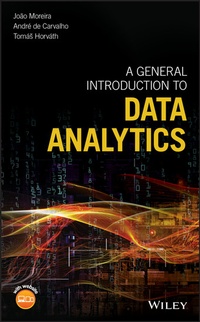
A General Introduction to Data Analytics
Description

A General Introduction to Data Analytics is an essential guide to understand and use data analytics. This book is written using easy-to-understand terms and does not require familiarity with statistics or programming. The authors--noted experts in the field--highlight an explanation of the intuition behind the basic data analytics techniques. The text also contains exercises and illustrative examples.
Thought to be easily accessible to non-experts, the book provides motivation to the necessity of analyzing data. It explains how to visualize and summarize data, and how to find natural groups and frequent patterns in a dataset. The book also explores predictive tasks, be them classification or regression. Finally, the book discusses popular data analytic applications, like mining the web, information retrieval, social network analysis, working with text, and recommender systems. The learning resources offer:
* A guide to the reasoning behind data mining techniques
* A unique illustrative example that extends throughout all the chapters
* Exercises at the end of each chapter and larger projects at the end of each of the text's two main parts
Together with these learning resources, the book can be used in a 13-week course guide, one chapter per course topic.
The book was written in a format that allows the understanding of the main data analytics concepts by non-mathematicians, non-statisticians and non-computer scientists interested in getting an introduction to data science. A General Introduction to Data Analytics is a basic guide to data analytics written in highly accessible terms.
More details
Other editions
Additional editions
Content
1
What Can We Do With Data?
Until recently, researchers working with data analysis were struggling to obtain data for their experiments. Recent advances in the technology of data processing, data storage and data transmission, associated with advanced and intelligent computer software, reducing costs and increasing capacity, have changed this scenario. It is the time of the Internet of Things, where the aim is to have everything or almost everything connected. Data previously produced on paper are now on-line. Each day, a larger quantity of data is generated and consumed. Whenever you place a comment in your social network, upload a photograph, some music or a video, navigate through the Internet, or add a comment to an e-commerce web site, you are contributing to the data increase. Additionally, machines, financial transactions and sensors such as security cameras, are increasingly gathering data from very diverse and widespread sources.
In 2012, it was estimated that, each year, the amount of data available in the world doubles [1]. Another estimate, from 2014, predicted that by 2020 all information will be digitized, eliminated or reinvented in 80% of processes and products of the previous decade [2]. In a third report, from 2015, it was predicted that mobile data traffic will be almost 10 times larger in 2020 [3]. The result of all these rapid increases of data is named by some the "data explosion".
Despite the impression that this can give - that we are drowning in data - there are several benefits from having access to all these data. These data provide a rich source of information that can be transformed into new, useful, valid and human-understandable knowledge. Thus, there is a growing interest in exploring these data to extract this knowledge, using it to support decision making in a wide variety of fields: agriculture, commerce, education, environment, finance, government, industry, medicine, transport and social care. Several companies around the world are realizing the gold mine they have and the potential of these data to support their work, reduce waste and dangerous and tedious work activities, and increase the value of their products and their profits.
The analysis of these data to extract such knowledge is the subject of a vibrant area known as data analytics, or simply "analytics". You can find several definitions of analytics in the literature. The definition adopted here is:
Analytics
- The science that analyze crude data to extract useful knowledge (patterns) from them.
This process can also include data collection, organization, pre-processing, transformation, modeling and interpretation.
Analytics as a knowledge area involves input from many different areas. The idea of generalizing knowledge from a data sample comes from a branch of statistics known as inductive learning, an area of research with a long history. With the advances of personal computers, the use of computational resources to solve problems of inductive learning become more and more popular. Computational capacity has been used to develop new methods. At the same time, new problems have appeared requiring a good knowledge of computer sciences. For instance, the ability to perform a given task with more computational efficiency has become a subject of study for people working in computational statistics.
In parallel, several researchers have dreamed of being able to reproduce human behavior using computers. These were people from the area of artificial intelligence. They also used statistics for their research but the idea of reproducing human and biological behavior in computers was an important source of motivation. For instance, reproducing how the human brain works with artificial neural networks has been studied since the 1940s; reproducing how ants work with ant colony optimization algorithm since the 1990s. The term machine learning (ML) appeared in this context as the "field of study that gives computers the ability to learn without being explicitly programmed," according to Arthur Samuel in 1959 [4].
In the 1990s, a new term appeared with a different slight meaning: data mining (DM). The 1990s was the decade of the appearance of business intelligence tools as consequence of the data facilities having larger and cheaper capacity. Companies start to collect more and more data, aiming to either solve or improve business operations, for example by detecting frauds with credit cards, by advising the public of road network constraints in cities, or by improving relations with clients using more efficient techniques of relational marketing. The question was of being able to mine the data in order to extract the knowledge necessary for a given task. This is the goal of data mining.
1.1 Big Data and Data Science
In the first years of the 20th century, the term big data has appeared. Big data, a technology for data processing, was initially defined by the "three Vs", although some more Vs have been proposed since. The first three Vs allow us to define a taxonomy of big data. They are: volume, variety and velocity. Volume is concerned with how to store big data: data repositories for large amounts of data. Variety is concerned with how to put together data from different sources. Velocity concerns the ability to deal with data arriving very fast, in streams known as data streams. Analytics is also about discovering knowledge from data streams, going beyond the velocity component of big data.
Another term that has appeared and is sometimes used as a synonym for big data is data science. According to Provost and Fawcett [5], big data are data sets that are too large to be managed by conventional data-processing technologies, requiring the development of new techniques and tools for data storage, processing and transmission. These tools include, for example, MapReduce, Hadoop, Spark and Storm. But data volume is not the only characterization of big data. The word "big" can refer to the number of data sources, to the importance of the data, to the need for new processing techniques, to how fast data arrive, to the combination of different sets of data so they can be analyzed in real time, and its ubiquity, since any company, nonprofit organization or individual has access to data now.
Thus big data is more concerned with technology. It provides a computing environment, not only for analytics, but also for other data processing tasks. These tasks include finance transaction processing, web data processing and georeferenced data processing.
Data science is concerned with the creation of models able to extract patterns from complex data and the use of these models in real-life problems. Data science extracts meaningful and useful knowledge from data, with the support of suitable technologies. It has a close relationship to analytics and data mining. Data science goes beyond data mining by providing a knowledge extraction framework, including statistics and visualization.
Therefore, while big data gives support to data collection and management, data science applies techniques to these data to discover new and useful knowledge: big data collects and data science discovers. Other terms such as knowledge discovery or extraction, pattern recognition, data analysis, data engineering, and several others are also used. The definition we use of data analytics covers all these areas that are used to extract knowledge from data.
1.2 Big Data Architectures
As data increase in size, velocity and variety, new computer technologies become necessary. These new technologies, which include hardware and software, must be easily expanded as more data are processed. This property is known as scalability. One way to obtain scalability is by distributing the data processing tasks into several computers, which can be combined into clusters of computers. The reader should not confuse clusters of computers with clusters produced by clustering techniques, which are techniques from analytics in which a data set is partitioned to find groups within it.
Even if processing power is expanded by combining several computers in a cluster, creating a distributed system, conventional software for distributed systems usually cannot cope with big data. One of the limitations is the efficient distribution of data among the different processing and storage units. To deal with these requirements, new software tools and techniques have been developed.
One of the first techniques developed for big data processing using clusters was MapReduce. MapReduce is a programming model that has two steps: map and reduce. The most famous implementation of MapReduce is called Hadoop.
MapReduce divides the data set into parts - chunks - and stores in the memory of each cluster computer the chunk of the data set needed by this computer to accomplish its processing task. As an example, suppose that you need to calculate the average salary of 1 billion people and you have a cluster with 1000 computers, each with a processing unit and a storage memory. The people can be divided into 1000 chunks - subsets - with data from 1 million people each. Each chunk can be processed independently by one of the computers. The results produced by each these computers (the average salary of 1 million people) can be averaged, returning the final salary average.
To efficiently solve a big data problem, a distributed system must attend the following requirements:
- Make sure that no chunk of data is lost and the...
