

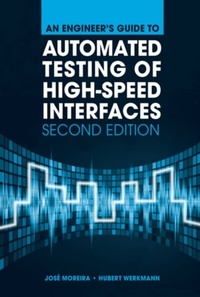
Engineer's Guide to Automated Testing of High-Speed Interfaces, Second Edition
1st Edition
Published on 1. January 2016
706 pages
978-1-60807-986-5 (ISBN)
Description

This second edition of An Engineer's Guide to Automated Testing of High-Speed Interfaces provides updates to reflect current state-of-the-art high-speed digital testing with automated test equipment technology (ATE). Featuring clear examples, this one-stop reference covers all critical aspects of automated testing, including an introduction to high-speed digital basics, a discussion of industry standards, ATE and bench instrumentation for digital applications, and test and measurement techniques for characterization and production environment. Engineers learn how to apply automated test equipment for testing high-speed digital I/O interfaces and gain a better understanding of PCI-Express 4, 100Gb Ethernet, and MIPI while exploring the correlation between phase noise and jitter. This updated resource provides expanded material on 28/32 Gbps NRZ testing and wireless testing that are becoming increasingly more pertinent for future applications. This book explores the current trend of merging high-speed digital testing within the fields of photonic and wireless testing.
More details
Other editions
Additional editions
Jose Moreira | Hubert Werkmann
An Engineer's Guide to Automated Testing of High-Speed Interfaces, Second Edition
Book
04/2016
Artech House Publishers
€126.50
Shipment within 10-20 days
Content
- Intro
- Contents
- Preface to the Second Edition
- Preface to the First Edition
- 1 Introduction
- 1.1 Characterization and Design Verification
- 1.2 Production Testing
- 1.3 Accuracy and Correlation
- 1.4 The ATE Test Fixture
- 1.5 The Future
- 2 High-Speed Digital Basics
- 2.1 High-Speed Digital Signaling
- 2.2 Time and Frequency-Domains
- 2.3 Bit Error Rate
- 2.4 Jitter
- 2.5 Classification of High-Speed I/O Interfaces
- 2.6 Hardware Building Blocks and Concepts
- 2.7 Multilevel Signaling
- 3 High-Speed Interface Standards
- 3.1 PCI Express
- 3.2 XDR DRAM
- 3.3 GDDR SDRAM
- 3.4 MIPI Standards
- 3.5 Other High-Speed Digital Interface Standards
- 4 ATE Instrumentation for Digital Applications
- 4.1 ATE Timing Architectures
- 4.2 Digital Pin Electronics ATE Card
- 4.3 Sampler/Digitizer ATE Card
- 4.4 Parametric Measurements with Sampled Data
- 4.5 Power Supplies
- 5 Tests and Measurements
- 5.1 Bit and Pattern Alignment
- 5.2 Functional Test
- 5.3 Shmoo Tests
- 5.4 Fundamental Driver Tests
- 5.5 Driver Jitter Tests
- 5.6 Fundamental Receiver Tests
- 5.7 Receiver Jitter Tolerance
- 5.8 PLL Characterization
- 5.9 Other Tests
- 5.10 Power Consumption During IC Testing
- 5.11 Measurement Errors
- 6 Production Testing
- 6.1 Golden Device
- 6.2 System-Level Test
- 6.3 Instrument-Based Testing: At-Speed ATE
- 6.4 Instrument-Based Testing: Low-Speed ATE
- 6.5 Instrument-Based Testing: Bench Instrumentation
- 6.6 Active Test Fixture
- 6.7 Multi-site Testing
- 7 Support Instrumentation
- 7.1 Oscilloscopes
- 7.2 Bit Error Rate Tester
- 7.3 Time Interval Analyzer
- 7.4 Time-Domain Reflectrometry/Transmission(TDR/TDT)
- 7.5 Spectrum Analyzer
- 7.6 Signal Source Analyzer
- 7.7 Vector Network Analyzer
- 7.8 Arbitrary Waveform and Function Generators
- 7.9 Noise Generators
- 7.10 Sinusoidal Clock Sources
- 7.11 Clock and Data Recovery
- 7.12 Protocol Analyzer
- 7.13 Switch Matrix
- 7.14 Isolation Transformer
- 7.15 Connecting Bench Instrumentation to an ATESystem
- 7.16 Coaxial Cables and Connectors
- 7.17 Accessories
- 8 Test Fixture Design
- 8.1 Test Fixtures
- 8.2 High-Speed Design Effects
- 8.3 Impedance Controlled Routing
- 8.4 Stack-Up
- 8.5 Via Transitions
- 8.6 Coaxial Connector Footprint Design
- 8.7 DUT BGA Ballout
- 8.8 Relays
- 8.9 Bidirectional Layout
- 8.10 Sockets
- 8.11 Power Distribution Network Design
- 8.12 HIFIX
- 8.13 Wafer Probing
- 9 Advanced ATE Topics
- 9.1 ATE Specifications and Calibration
- 9.2 Multiplexing of ATE Channels
- 9.3 Focus Calibration
- 9.4 Testing of High-Speed Bidirectional Interfaceswith a Dual Transmission Line Approach
- 9.5 Including the DUT Receiver Data Recovery inDriver Tests
- 9.6 DUT Reference Clock Jitter AttenuationApproaches
- 9.7 Protocol-Awareness and Protocol-Based Testing
- 9.8 Testing Multilevel Interfaces with Standard DigitalATE Pin Electronics
- 9.9 Signal Path Characterization and Compensation
- 9.10 Test Fixture and ATE Pin Electronics Co-Simulation
- 9.11 ATE DC Level Adjustments
- A Introduction to the Gaussian Distribution and Analytical Computation of the BER
- A.1 The Gaussian Distribution
- A.2 Computation of the BER for a System with OnlyGaussian Random Jitter
- A.3 Computation of the a(BER) Value
- A.4 Properties of the Error Function erf(x) andComplementary Error Function erfc(x)
- B The Dual Dirac Model and RJ/DJ Separation
- B.1 The Dual Dirac Jitter Model
- B.2 RJ/DJ Separation with the Q-Factor Algorithm
- C Pseudo-Random Bit Sequences and Other Data Patterns
- C.1 Pseudo-Random Bit Sequences
- C.2 Pseudo-Random Word Sequences
- C.3 Other Important Patterns
- D Coding, Scrambling, Disparity, and CRC
- D.1 Disparity
- D.2 8B/10B Coding
- D.3 128B/130B Coding
- D.4 Scrambling
- D.5 Error Detection
- E Time-Domain Reflectometry and Time-Domain Transmission (TDR/TDT)
- E.1 TDR
- E.2 TDT
- E.3 Differential TDR/TDT Measurements
- F S-Parameters
- F.1 Simulating and Synthesizing Time-DomainResponses from S-ParametersAs mentioned
- F.2 S-Parameters of Coupled Differential Pairs andStructures
- F.3 S-Parameters: Calibration and De-Embedding
- G Engineering CAD Tools
- G.1 Circuit Simulators
- G.2 3D EM Field Solvers
- G.3 2D Planar Field Solvers
- G.4 Power Integrity
- G.5 Model Generation
- G.6 Other Tools
- H Test Fixture Evaluation and Characterization
- H.1 Measuring the Test Fixture Signal Performance
- H.2 Measuring the Test Fixture Power DistributionNetwork
- I Jitter Injection Calibration
- I.1 Sinusoidal Jitter Injection Calibration
- I.2 Random Jitter Injection Calibration
- I.3 ISI Jitter Injection Calibration
- J Phase Noise, RMS Jitter, and Random Jitter
- About the Authors
- Index
