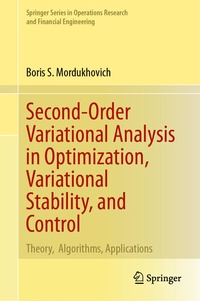
Second-Order Variational Analysis in Optimization, Variational Stability, and Control
Description

Results presented are useful tools for characterizations of fundamental notions of variational stability of solutions for diverse classes of problems in optimization and optimal control, the study of variational convexity of extended-real-valued functions and their specifications and variational sufficiency in optimization. Explicit calculations and important applications of second-order subdifferentials associated with the achieved characterizations of variational stability and related concepts, to the design and justification of second-order numerical algorithms for solving various classes of optimization problems, nonsmooth equations, and subgradient systems, are included. Generalized Newtonian algorithms are presented that show local and global convergence with linear, superlinear, and quadratic convergence rates. Algorithms are implemented to address interesting practical problems from the fields of machine learning, statistics, imaging, and other areas.
Reviews / Votes
"This book is a valuable resource to a wide range of readers including researchers in the areas of nonlinear, variational, and convex analysis, optimization and systems control, as well as graduate students." (Ilya A. Shvartsman, Mathematical Reviews, June, 2025)
"This self-contained book, authored by a well-known expert in non-smooth analysis and optimization, is the first comprehensive work on second-order variational analysis, including both numerical algorithms and practical applications. . Each chapter includes historical context, key definitions, theorems, and examples/exercises for readers to complete. This structure makes the book a useful resource for both lecturers and students and offers inspiration for PhD students. . the book is a valuable resource that can be recommended to scientific researchers, students . ." (Wieslaw Kotarski, zbMATH 1551.49001, 2025)
More details
Other editions
Additional editions