

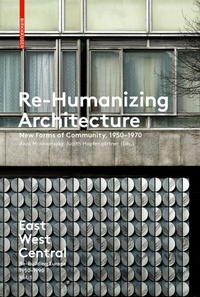
Re-Humanizing Architecture
Description

Das geteilte Europa war nach dem Ende des zweiten Weltkriegs durch die Phase des Wiederaufbaus geprägt. Diese wurde durch die unterschiedlichen politischen Systeme beeinflusst: im sozialistischen Osten wie auch im kapitalistischen Westen ging es um den Zusammenhalt der Gesellschaft sowie um deren kulturellen und baulichen Ausdruck. Parallel zur schnell einsetzenden Industrialisierung des Bauwesens wurden auf beiden Seiten intensive Debatten über die Humanisierung der gebauten Umwelt geführt. Der Band zeigt, wie vor dem Hintergrund von Existentialismus, New Monumentality und sozialistischem Realismus durchaus ähnliche Konzepte und Strategien entwickelt wurden, um Antworten auf die Frage nach adäquaten Strukturen für neue Formen von Gemeinschaft und Identität zu geben.
More details
Other editions
Additional editions
Persons
Content
- Intro
- Contents
- Foreword. East West Central: Re-Building Europe
- Introduction
- I. Discourses on Humanism
- Re-Humanizing Architecture: The Search for a Common Ground in the Postwar Years, 1950-1970
- CIAM: From "Spirit of the Age" to the "Spiritual Needs" of People
- Was Humanized Socialist Modernism Possible After All? The Promise and Failure of Mass Housing in Hungary
- Mieczyslaw Porebski: Man and Architecture in the Iconosphere
- II. Building New Societies
- Continuity or Discontinuity? Narratives on Modern Architecture in East and West Germany during the Cold War
- Building Together: Construction Sites in a Divided Europe During the 1950s
- Building a New Warsaw, Building a Social Warsaw: The First Reconstruction Plans and Their International Review
- Building a New Community - A Comparison Between the Netherlands and Czechoslovakia
- "Social Efficiency" and "Humanistic Specificity": A Double Discourse in Romanian Architecture in the 1960s
- Sociological and Environmental- Psychology Research in Estonia during the 1960s and 1970s: A Critique of Soviet Mass-Housing
- III. The Urban Context
- Bogdan Bogdanovic and the Search for a Meaningful City
- From "New Units of Settlement" to the Old Arbat: The Soviet NER Group's Search for Spaces of Community
- Theories and Practices of Re-Humanizing Postwar Italian Architecture: Ernesto Nathan Rogers and Giancarlo De Carlo
- Urban Planning and Christian Humanism: The Institut Supérieur d'Urbanisme Appliqué in Brussels under Gaston Bardet
- The Monumentality of the Matchbox: On "Slabs" and Politics in the Cold War
- Between City and University: New Monumentality in the Student Center of the Campus of Coimbra
- IV. The Inhabited Nature
- Socialist Pastoral: The Role of Folklore in Socialist Architectural Culture, 1950s and 1960s
- Dwelling in the Middle Landscape: Rethinking the Architecture of Rural Communities at CIAM 10
- A Desire for Innocence? Community and Recreational Architecture around Lake Balaton
- Unexpected Side Effects: Indirect Benefits of International Mass Tourism on Croatia's Adriatic Coast
- Appendix
- Notes on Contributors
- Index
