

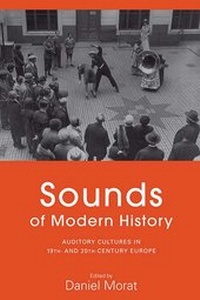
Sounds of Modern History
Auditory Cultures in 19th- and 20th-Century Europe
1st Edition
Published on 1. September 2014
352 pages
978-1-78238-422-9 (ISBN)
Description

Long ignored by scholars in the humanities, sound has just begun to take its place as an important object of study in the last few years. Since the late 19th century, there has been a paradigmatic shift in auditory cultures and practices in European societies. This change was brought about by modern phenomena such as urbanization, industrialization and mechanization, the rise of modern sciences, and of course the emergence of new sound recording and transmission media. This book contributes to our understanding of modern European history through the lens of sound by examining diverse subjects such as performed and recorded music, auditory technologies like the telephone and stethoscope, and the ambient noise of the city.
Reviews / Votes
"The decentring of music from the privileged site at which questions about listening are asked makes room for broader questions about the relationship between sound and culture. By thinking about sonic practices as a means of answering larger historical and cultural questions the volume challenges the narrower theoretical approaches to sound often taken in the field of sound studies." ? Contemporary European History"...this highly readable and well-sequenced text synthesises key research on the history of sound, bringing the work of the burgeoning field's seminal figures into dialogue with that of emerging scholars of the history of European sound cultures." ? Melbourne Historical Journal
"As a whole, this collection provides a fine introduction to Sound Studies for historians of modern Europe and, at the same time, contributes new material to the growing body of work in this field. The collective work on World War I is perhaps the most original and compelling, but there is excellent scholarship throughout." ? German History
"...presents an excellent contribution to the social studies of sound...In contrast to the more common ocular-centricity of the history of the senses, this book explores the social dimensions of sound as an independent and new area of research." ? Sounds of Modern History
"...represents a significant contribution to the ongoing process of defining the comparatively young field of 'Sound History'. As the editor notes in his introduction, the field is still characterized by a multitude of different perspectives, and a corresponding range of approaches such that even a stable set of terminologies have yet to be settled upon... This book does an excellent job of show-casing the variety of possibilities and potentials present in the field, and is to be thoroughly recommended on those grounds alone." ? Sehepunkte
"Sound has to be recognized as another, co-modifying factor of the multi-sensory world. Thanks to the publisher, the editor, and all the contributors to Sounds of Modern History, sound now receives this long-missed recognition. I have to congratulate everyone involved in this project, as it opens up new perspectives and adds great depth and variety to contemporary soundscape studies." ? CritCom. Journal of Reviews & Critical Commentar
"This is a timely intervention in sound studies, one of the most innovative fields to have emerged in the past 10 years. It brings together work by some established figures in the field (e.g. Mark Smith), but also essays by emerging scholars... One of the key aspects of the collection is the focus on aurality as part of a wider history of modernity." ? Veit Erlmann, University of Texas at Austin
"Sounds of Modern History offers a strong collection of essays, by younger as well as established scholars, bringing the vanguard of European sound studies scholarship in direct dialogue with... scholarship focused on North America." ? Art Blake, Ryerson University
All prices
More details
Language
English
Place of publication
Oxford
United Kingdom
Target group
Professional and scholarly
Illustrations
Bibliography; Index; 17 Illustrations
ISBN-13
978-1-78238-422-9 (9781782384229)
DOI
10.3167/9781782384212
Copyright in bibliographic data and cover images is held by Nielsen Book Services Limited or by the publishers or by their respective licensors: all rights reserved.
Schweitzer Classification
Other editions
Additional editions
Book
11/2016
1st Edition
Berghahn Books
€42.30
Shipment within 3-4 weeks
Book
09/2014
1st Edition
Berghahn Books
€147.70
Shipment within 3-4 weeks
Person
Daniel Morat is a Research Fellow and Lecturer in the History Department of the Free University Berlin. He currently holds a Dilthey Fellowship from the Fritz Thyssen Foundation, and since 2012 has directed the international research network "Auditory Knowledge in Transition: An Epistemic History of Listening in Modernity." His publications include Von der Tat zur Gelassenheit. Konservatives Denken bei Martin Heidegger, Ernst Juenger und Friedrich Georg Juenger 1920-1960 (Goettingen 2007).
Content
List of Figures
Introduction
Daniel Morat
Part I: Sound History in Perspective
Chapter 1. Futures of Hearing Pasts
Mark M. Smith
Part II: Literature, Science, and Sound Technologies in the 19th Century
Chapter 2. English Beat: The Stethoscopic Era's Sonic Traces
John M. Picker
Chapter 3. The Human Telephone: Physiology, Neurology, and Sound Technologies
Anthony Enns
Part III: Sound Objects as Artifacts of Attraction
Chapter 4. Listening to the Horn: On the Cultural History of the Phonograph and the Gramophone
Stefan Gauss
Chapter 5. Phones, Horns, and "Audio Hoods" as Media of Attraction: Early Sound Histories in Vienna between 1883 and 1933
Christine Ehardt
Part IV: Music Listening in the Laboratory and in the Concert Hall
Chapter 6. From the Piano Pestilence to the Phonograph Solo: Four Case Studies of Musical Expertise in the Laboratory and on the City Street
Alexandra E. Hui
Chapter 7. The Invention of Silence: Audience Behavior in Berlin and London in the Nineteenth Century
Sven Oliver Mueller
Part V: The Sounds of World War I
Chapter 8. Cheers, Songs, and Marching Sounds: Acoustic Mobilization and Collective Affects at the Beginning of World War I
Daniel Morat
Chapter 9. Listening on the Home Front: Music and the Production of Social Meaning in German Concert Halls
during World War I
Hansjakob Ziemer
Part VI: Auditory Cultures in the Interwar Period
Chapter 10. In Storms of Steel: The Soundscape of World War I and its Impact on Auditory Media Culture During the Weimar Period
Axel Volmar
Chapter 11. Sound Aesthetics and the Global Imagination in German Media Culture around 1930
Carolyn Birdsall
Chapter 12. Neurasthenia, Civilization and the Sounds of Modern Life: Narratives of Nervous Illness in the Interwar Campaign against Noise
James Mansell
Part VII: The Sounds of World War II
Chapter 13. The Silence of Amsterdam before and during World War II: Ecology, Semiotics and Politics of Urban Sound
Annelies Jacobs
Notes on Contributors
Index
Introduction
Daniel Morat
Part I: Sound History in Perspective
Chapter 1. Futures of Hearing Pasts
Mark M. Smith
Part II: Literature, Science, and Sound Technologies in the 19th Century
Chapter 2. English Beat: The Stethoscopic Era's Sonic Traces
John M. Picker
Chapter 3. The Human Telephone: Physiology, Neurology, and Sound Technologies
Anthony Enns
Part III: Sound Objects as Artifacts of Attraction
Chapter 4. Listening to the Horn: On the Cultural History of the Phonograph and the Gramophone
Stefan Gauss
Chapter 5. Phones, Horns, and "Audio Hoods" as Media of Attraction: Early Sound Histories in Vienna between 1883 and 1933
Christine Ehardt
Part IV: Music Listening in the Laboratory and in the Concert Hall
Chapter 6. From the Piano Pestilence to the Phonograph Solo: Four Case Studies of Musical Expertise in the Laboratory and on the City Street
Alexandra E. Hui
Chapter 7. The Invention of Silence: Audience Behavior in Berlin and London in the Nineteenth Century
Sven Oliver Mueller
Part V: The Sounds of World War I
Chapter 8. Cheers, Songs, and Marching Sounds: Acoustic Mobilization and Collective Affects at the Beginning of World War I
Daniel Morat
Chapter 9. Listening on the Home Front: Music and the Production of Social Meaning in German Concert Halls
during World War I
Hansjakob Ziemer
Part VI: Auditory Cultures in the Interwar Period
Chapter 10. In Storms of Steel: The Soundscape of World War I and its Impact on Auditory Media Culture During the Weimar Period
Axel Volmar
Chapter 11. Sound Aesthetics and the Global Imagination in German Media Culture around 1930
Carolyn Birdsall
Chapter 12. Neurasthenia, Civilization and the Sounds of Modern Life: Narratives of Nervous Illness in the Interwar Campaign against Noise
James Mansell
Part VII: The Sounds of World War II
Chapter 13. The Silence of Amsterdam before and during World War II: Ecology, Semiotics and Politics of Urban Sound
Annelies Jacobs
Notes on Contributors
Index

