

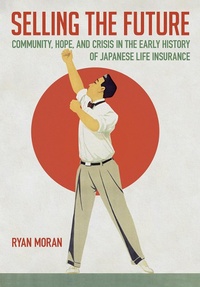
Selling the Future
Description

In Selling the Future, Ryan Moran explains how the life insurance industry in Japan exploited its association with mutuality and community to commodify and govern lives. Covering the years from the start of the industry in 1881 through the end of World War II, Moran describes insurance companies and government officials working together to create a picture of the future as precarious and dangerous. Since it was impossible for individual consumers to deal with every contingency on their own, insurance industry administrators argued that their usage of statistical data enabled them to chart the predictable future for the aggregate. Through insurance, companies and the state thus offered consumers a means to a perfectible future in an era filled with repeated crises.
Life insurance functioned as an important modernist technology within Japan and its colonies to instantiate expectations for responsibility, to reconfigure meanings of mutuality, and to normalize new social formations (such as the nuclear family) as essential to life. Life insurance thus offers an important vehicle for examining the confluence of modes of mobilizing and organizing bodies, the expropriation of financial resources, and the action of disciplining workers into a capitalist system.
More details
Other editions
Additional editions
Person
Ryan Moran is Assistant Professor of History at the University of Utah.
