

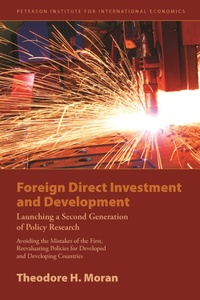
Foreign Direct Investment and Development
Description

This volume is the culmination of Institute investigations on the relationship between foreign direct investment (FDI) and development. Today, more than one-third of world trade takes place in the form of intrafirm transactions-that is, trade among the various parts of the same corporate network spread across borders-and the bulk of technology is transferred within the confines of integrated international production systems. This means that FDI and the operations of multinational corporations have become central to the world economy at large. Nowhere is this more important than for developing countries.
But as Theodore Moran argues in this new volume, FDI is not a single phenomenon. FDI has such different impacts in the extractive sector, infrastructure, manufacturing and assembly, and services-and presents such distinctive policy challenges-that each broad category of FDI must be treated on its own terms. Indeed, past studies that have aggregated all FDI flows together to try to find some unique relationship to host-country growth or welfare have led to unreliable substantive findings and, sometimes, mistaken policy conclusions. Moran examines each of the principal forms of FDI, extracts the best from previous analysis, and offers new findings and perspectives about how benefits from FDI in each sector can be enhanced and potential damages limited or eliminated.
More details
Other editions
Additional editions
Person
Content
- Cover
- Contents
- Preface
- Ch 1 Introduction
- Ch 2 FDI in Extractive Industries
- The Resource Curse and Dutch Disease
- Combating Corruption and Ensuring Transparent Revenue Flows
- Promoting FDI, Ensuring Contract Stability, and Assisting Host Tax Collection
- Advancing Environmental Standards and Sustainable Development Goals
- Ch 3 FDI in Infrastructure
- Distinctive Public Policy Concerns
- Blurring of Commercial and Political Risk and the Need to Reform Investor-State Arbitration
- Mediation, Work-Outs, and Avoiding Moral Hazard
- Ch 4 FDI in Manufacturing and Assembly
- Impact on Developing-Country Hosts: Early Evidence
- Search for Spillovers and Externalities
- Painting a New Portrait of Manufacturing Multinationals: Level of Wages, Kinds of Activities, and Types of Jobs
- Implications for Developing-Country Policy: The Real versus False Debate about Using Manufacturing FDI for Development
- Ch 5 A First Look at the Impact of FDI in Services
- New Investigations
- Ch 6 Reconsidering the Debate on FDI "Crowding Out" or "Crowding In" Domestic Investment
- Aggregate Analysis
- Three Prominent Case Studies
- Conclusions
- Ch 7 FDI, Host-Country Growth, and Structural Transformation
- Fundamentals in the Debate
- Discovery that "What You Export Matters"
- Magnitude of Benefits from FDI and the Question of Incentives for Foreign Manufacturing Investors: Observations from Costa Rica
- Contribution of Trade and FDI Liberalization
- Trade-and-FDI Modeling: Dynamic Effects, Extensive plus Intensive Margins, New Varieties of Intermediates, and Continuous Real-Time Technology Upgrades
- Ch 8 Globalization of Industry via FDI: Consequences for Developed-Country Home Economies
- Rekindling an Old Debate about US MNCs and US Economic Interests
- Outward FDI and Abandonment of the Home Economy?
- Outward FDI, Runaway Plants, Lost Capital?
- Outward FDI, Strategic Trade Theory, and the Capture of Rents Abroad?
- How Is FDI Transforming the Chinese Economy?
- Maintaining the Home Economy as a Competitive Base for MNC Investment
- Ch 9 Policy Implications
- Developing Countries
- Developed Countries
- Multilateral Financial Institutions
- Other Organizations and Groups
- Ch 10 Lessons and Conclusions: The Second-Generation Research Agenda
- References
- Abbreviations
- Index
