

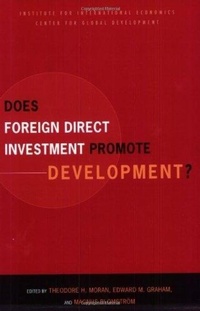
Does Foreign Direct Investment Promote Development?
Description

More details
Other editions
Additional editions
Persons
Theodore H. Moran, nonresident senior fellow, has been associated with the Peterson Institute since 1998. He holds the Marcus Wallenberg Chair at the School of Foreign Service in Georgetown University. He is the founder of the Landegger Program in International Business Diplomacy at the university and serves as director there. He also serves as a member of Huawei's International Advisory Council. From 2007 to 2013 he served as Associate to the US National Intelligence Council on international business issues.
Edward M. Graham (1944-2007) was a senior fellow at the Peterson Institute from 1990 to 2007. He also taught concurrently as adjunct professor at Columbia University in New York. Previously he was an economist at the US Treasury and taught full-time in the business schools of several US universities (MIT, University of North Carolina Chapel Hill, Duke University, among others). While serving at the Treasury, he was seconded for two years to the Organization for Economic Cooperation and Development (OECD) in Paris. He also served as visiting or adjunct faculty at the University of Virginia, Charlottesville; Stanford University (Washington Program); The Johns Hopkins University; Seoul National University; Harvard University (John F. Kennedy School of Government); INSEAD (European Institute of Administration, Fontainebleau, France); and the University of Paris I (Pantheon/La Sorbonne). His research interests have included foreign direct investment, international competition policy, and the industrial organization of major Asian economies.
Magnus Blomström has been a professor of economics at the Stockholm School of Economics since 1990 and president of the European Institute of Japanese Studies, Stockholm School of Economics since 1997. He was an assistant professor in the department of economics, University of Gothenburg (1985-87) and a research fellow at the Institute for International Economic Studies, University of Stockholm (1982-84). He is a research associate at the National Bureau of Economic Research and research fellow at the Centre of Economic Policy Research.
Content
- Cover
- Contents
- Preface
- Chapter 1 Introduction and Overview
- Finding an Empirical Framework for Policy Analysis
- New Methodologies and New Results in Measuring FDI's Impact on Development: Searching for Externalities and Spillovers
- Aggregate Assessment of FDI's Impact on Host Country Growth
- Designing Policies to Capture Beneficial (and Avoid Harmful) Economic Impacts of FDI
- Chapter 2 The Impact of Inward FDI on Host Countries: Why Such Different Answers?
- Wage Spillovers
- Productivity Spillovers
- Productivity Spillovers in Indonesia
- Conclusions
- Chapter 3 Disentangling FDI Spillover Effects: What Do Firm Perceptions Tell Us?
- A Tale of Two Countries and Two Spillover Patterns
- Dissecting Horizontal Spillovers
- How Do Vertical Spillovers Work?
- Further Complications-Do Characteristics of FDI Projects Affect Spillovers?
- Conclusions
- Chapter 4 Foreign Direct Investment and Externalities: The Case for Public Intervention
- Technology Spillover from FDI
- Liquidity Insurance from FDI
- Conceptual Framework of Technology Transfer from FDI
- Conceptual Framework for FDI and Liquidity Insurance
- Theories
- Indonesian Manufacturing and Foreign Investment Policy
- Data
- Productivity Effects of FDI
- Market and Welfare Effects
- Liquidity Insurance from FDI
- Summary and Implications
- Chapter 5 R&D Activities of Foreign and National Establishments in Turkish Manufacturing
- Background and Literature Review
- Turkey's R&D Trends and Policies
- Data
- Research Questions
- Methodology, Model, and Hypotheses
- Empirical Results
- Summary and Conclusions
- Linkages
- Chapter 6 Foreign Direct Investment and Local Economic Development: Beyond Productivity Spillovers
- Productivity Spillovers
- Multinational Effect on Domestic Plant Entry
- Plant Survival
- Multinational Effect on Plant Growth
- Conclusions
- Chapter 7 Multinational Firms and Backward Linkages: A Critical Survey and a Simple Model
- Existing Analytical Work on Linkages
- A Research Agenda
- Model
- Autarky
- Multinational's Entry into the Market
- Multinational's Effect on Backward Linkages
- Vertical Technology Transfer
- Conclusion
- Comment: Gordon H. Hanson
- Comment: Michael P. Keane
- Chapter 8 Does Foreign Direct Investment Accelerate Economic Growth?
- Econometric Framework
- Data
- Results
- Conclusion
- Chapter 9 Inappropriate Pooling of Wealthy and Poor Countries in Empirical FDI Studies
- Descriptive Differences in FDI Patterns for DCs Versus LDCs
- Estimating Determinants of FDI
- FDI and Growth
- FDI and Domestic Investment: Crowding In or Out?
- Conclusion
- Chapter 10 Intrafirm Trade of US MNCs: Findings and Implications for Models and Policies Toward Trade and Investment
- Data
- Empirical Results
- Discussion of Results
- Conclusion
- Comment: Marc J. Melitz
- Chapter 11 How Does FDI Affect Host Country Development? Using Industry Case Studies to Make Reliable Generalizations
- Initial Answers from a Limited Number of Case Studies
- Avoiding Selection Bias and Allowing Generalization from Country and Industry Case Studies
- Why Have Other Studies Not Come to the Same Conclusions?
- Implications for Further Research
- Chapter 12 China's Policies on FDI: Review and Evaluation
- The Evolution of FDI in China
- China's FDI Policies
- Export Performance Requirement Policies' Influence on FDI
- FDI's Contribution to Advancing China's Technological Capability
- Conclusion
- Chapter 13 Is Africa's Skepticism of Foreign Capital Justified? Evidence from East African Firm Survey Data
- Foreign Investment in Sub-Saharan Africa
- African Barriers to FDI
- Background: Foreign Investment in East Africa
- African Skepticism Toward Foreign Investment
- Foreign Investment in East Africa: New Results from Firm Surveys
- Factors Determining Foreign Ownership: A Simple Econometric Test
- Conclusion
- Comment: Robert Z. Lawrence
- Chapter 14 Conclusions and Implications for FDI Policy in Developing Countries, New Methods of Research, and a Future Research Agenda
- Implications for Policy Toward FDI
- Implications for Future Research Methodology
- Priority Areas for Further Research
- About the Contributors
- Index
