

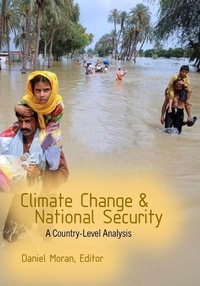
Climate Change and National Security
Description

In this unique and innovative contribution to environmental security, an international team of scholars explore and estimate the intermediate-term security risks that climate change may pose for the United States, its allies and partners, and for regional and global order through the year 2030. In profiles of forty-two key countries and regions, each contributor considers the problems that climate change will pose for existing institutions and practices. By focusing on the conduct of individual states or groups of nations, the results add new precision to our understanding of the way environmental stress may be translated into political, social, economic, and military challenges in the future.
Countries and regions covered in the book include China, Vietnam, The Philippines, Indonesia, India, Pakistan, Bangladesh, Central Asia, the European Union, the Persian Gulf, Egypt, Turkey, the Maghreb, West Africa, Southern Africa, the Northern Andes, and Brazil.
More details
Other editions
Additional editions
Person
Daniel Moran is a professor of national security affairs at the Naval Postgraduate School in Monterey, California. He is coeditor of Energy Security and Global Politics: The Militarization of Resource Management.
Content
1. Introduction: Climate Science and Climate Politics
Daniel Moran
2. China
Joanna I. Lewis
3. Vietnam
Carlyle A. Thayer
4. The Philippines
Paul D. Hutchcroft
5. Indonesia
Michael S. Malley
6. India
T.V. Paul
7. Pakistan
Daniel Markey
8. Bangladesh
Ali Riaz
9. Russia
Celeste A. Wallander
10. Central Asia: Kazakhstan, Kyrgyzstan, Tajikistan, Turkmenistan, and Uzbekistan
Edward Schatz
11. The European Union
Chad M. Briggs and Stacy D. VanDeveer
12. Turkey
Ibrahim Al-Marashi
13. The Persian Gulf: Bahrain, Iran, Kuwait, Qatar, Saudi Arabia, the United Arab Emirates, and Oman
James A. Russell
14. Egypt
Ibrahim Al-Marashi
15. The Maghreb: Algeria, Libya, Morocco, and Tunisia
Gregory W. White
16. West Africa I: Cote d'Ivoire, Nigeria, and Senegal
Linda J. Beck and E. Mark Pires
17. West Africa II, The Mano River Union: Guinea, Liberia, and Sierra Leone
Dennis Galvan and Brian Guy
18. Southern Africa: Lesotho, South Africa, Swaziland, and Zimbabwe
Ngonidzashe Munemo
19. The Northern Andes: Bolivia, Colombia, Ecuador, and Peru
Kent Eaton
20. Brazil
Jeffrey Cason
21. Conclusion: The Politics of Uncertainty
Daniel Moran
Appendixes
List of Contributors
Index
