

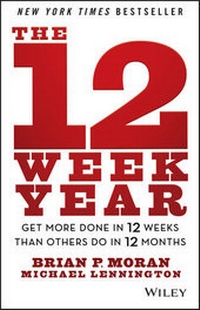
The 12 Week Year
Description

More details
Other editions
Additional editions
Persons
Content
Chapter 2
Redefining the Year
Most people, and most organizations for that matter, don't lack ideas. Whether they're effective marketing techniques, sales ideas, cost-cutting measures, or customer service enhancements, there are always more ideas than you can effectively implement. The breakdown is not in knowing, but in applying.
"You can't build a reputation on what you're going to do." -Henry FordOne of the things that gets in the way of individuals and organizations achieving their best is the annual planning process. As strange as this is going to sound, annual goals and plans are often a barrier to high performance. I'm not saying that annual goals and plans don't have a positive impact; they do. There is no question you will do better with annual goals and plans than without any goals or plans; however, we have found that this annual process inherently limits performance.
As we worked with clients over the years, we noticed an interesting pattern emerging. Most of them believed, either consciously or unconsciously, that their success and failure was determined by what they had achieved over the course of a year. They set annual goals, created annual plans, and in many cases broke the goals down into quarterly, monthly, and sometimes even weekly plans. But in the end, they evaluated their success annually. The trap is what we call annualized thinking.
Discard Annualized Thinking
At the heart of annualized thinking is an unspoken belief that there is plenty of time in the year to make things happen. In January, December looks a long way off.
Think about it; we begin the year with big goals but by the end of January we usually find ourselves slightly behind where we need to be. While we're certainly not pleased, we're not too worried, either, because we think to ourselves: "I've got plenty of time. I've got 11 more months to catch up." At the end of March we're still a bit behind, but again we're not too worried. Why? Because we still think we've got plenty of time to catch up. And this thought pattern prevails late into the year.
We mistakenly believe that there is a lot of time left in the year, and we act accordingly. We lack a sense of urgency, not realizing that every week is important, every day is important, every moment is important. Ultimately, effective execution happens daily and weekly!
Another flawed premise with annualized thinking is the notion that, sometime later in the year, we will experience a significant improvement in results. It's as if something magical will happen in late September or October that will result in a substantial increase. If we can't produce a substantial increase this week, why do we think we can do it for the entire year?
The fact is every week counts! Every day counts! Every moment counts! We need to be conscious of the reality that execution happens daily and weekly, not monthly or quarterly.
Annualized thinking and planning more often than not leads to less than optimal performance. In order to perform at your best you will need to get out of the annual mode and scrub your annualized thinking. Stop thinking in terms of a year; instead focus on shorter time frames.
The annual execution cycle blinds people to the reality that life is lived in the moment and that ultimately success is created in the moment. It lulls people into believing that they can put things off-critical activity-and still accomplish what they desire, still achieve their goals.
At this point, you might argue that almost every organization operates this way and many of them hit their goals and make plan. I would argue back that making plan does not mean that they are accomplishing what they are capable of.
We've had successful organizations increase their results by 50 percent in just 12 short weeks. In one example, we helped a billion dollar brokerage operation double its sales productivity in six months. That is just not possible operating in an annual execution cycle. However organizations or individuals are performing, they will perform better in a nonannualized environment.
Discard annualized thinking and watch what happens.
Great Things Happen at Year-End
You've probably seen advertisements or heard the pitches proclaiming "unbeatable deals" as the end of the year approaches. The fact is, these end-of-year pushes get results and are standard practice in many industries.
If you've ever been part of a year-end push, you know that everyone is focused on getting business in and completing important tasks. The difference between success and failure for the whole year can hang in the balance during the last 60 days. More often than not, results spike upward as the days left in the year dwindle toward zero.
"There's nothing like a deadline to get you motivated."It happens all the time in the insurance and financial services industries. For many agents and firms December is traditionally the best month of the year, and the fourth quarter often represents 30 to 40 percent of the annual sales. It is amazing what happens when people have a goal and a deadline.
Year-end is certainly a rousing time in most industries. Activity is up and people are focused. With little time to waste and with clear objectives to meet, workers focus on the critical projects and opportunities. Tasks that are not directly related to driving results are pushed aside for what really matters in the short-term.
At this time of year there also seems to be an increase in performance-related conversations. Management, focused on achieving their own performance goals, spends more time with associates reviewing results and encouraging them more than at any other time of the year.
What is it about year-end? Why do people behave differently in November and December than they do in July and August? Inevitably, it is because there is a deadline, which for most people is December 31.
The end of the year represents a line in the sand, a point at which we measure our success or failure. Never mind that it's an arbitrary deadline; everyone buys into it. It is the deadline that creates the urgency.
Whether self-imposed or company-driven, November and December is crunch time. People procrastinate less at this time of year. Recognizing that time is running out, people address barriers and tasks that they had been avoiding earlier in the year. In these remaining days, a strong sense of urgency replaces diffusion and downtime. People pull out all the stops to get business placed before the year ends and there is a strong surge to cross the finish line before time runs out.
In addition, there is a feeling of excitement that comes with the anticipation of a new year. Regardless of how you performed this year, you're hopeful that next year will be better. If you had a tough year, the coming year provides you an opportunity to start fresh. If you've had a great year, you get a chance to build off of that. Either way, a new year holds lots of hope and high expectations of good things to come.
Year-end is an exciting and productive time. The final five or six weeks of the year are the most fascinating time of the entire year. During this period there is a frantic rush to end the year strong and to kick off the new one with gusto. The problem is that this urgency exists for just a handful of weeks. Wouldn't it be great if you could create that energy, focus, and commitment every week throughout the year? Well, you can! The 12 Week Year and the concept of periodization will show you how.
Periodization
Periodization began as an athletic training technique designed to dramatically improve performance. Its principles are focus, concentration, and overload on a specific skill or discipline. Periodization in sports is a focused training regimen that concentrates on one skill at a time for a limited period, usually four to six weeks. After each four- to six-week period, the athlete then moves to the next skill in sequence. In this way, capacity in each skill is maximized. Eastern European athletes were the first to apply this technique in their Olympic training in the 1970s. Periodization is still widely used today in various training regimens.
"We are what we repeatedly do. Excellence then is not an act, but a habit." -AristotleWe realized how periodization could be powerful for our clients and in our own practice, so we adapted the technique for business and personal success. We have developed a 12 week approach to periodization that moves beyond just training to focus on the critical factors that drive income and life balance. The 12 Week Year defines what's important for you to do today so that your long-term objectives can be attained.
The 12 Week Year is a structured approach that fundamentally changes the way you think and act. It's important to understand that the results you achieve are a direct byproduct of the actions you take. Your actions, in turn, are manifestations of your underlying thinking. Ultimately, it is your thinking that drives your results; it is your thinking that creates your experiences in life. (See Figure 2.1.)
Figure 2.1 Your results are ultimately a manifestation of your thinking.
In the long run, your actions are always congruent with your underlying thinking. When you focus on changing your actions, you experience incremental improvements; however, when your thinking...
