

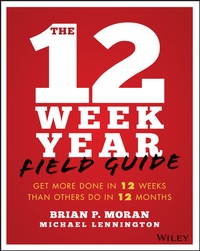
The 12 Week Year Field Guide
Description

Are you ready to change your life? This hands-on template for implementing advice from the game-changing book The 12 Week Year is a study guide that makes it easy for anyone to apply the 12 week year to their own lives. Instead of getting bogged down in annualized thinking that produces pitfalls and saps productivity, follow along with this guide to redefine your "year" to be just 12 weeks long. By doing so, you'll avoid complacency, begin to focus on what matters most, create better clarity, and develop a sense of urgency so that "now" is always the right time to act.
Applicable to business growth, career goals, and life in general, the 12 week plan will help you improve in any--or every--area. By closing the "knowing-doing gap," you'll discover how to execute on what you already know and greatly expand the boundaries of your capabilities. Learn to:
* Create your personal and business visions with step-by-step tips
* Develop your own 12 week plan by applying what you know to what you do
* Put over 10 years of field-tested content, exercises, and templates to work for you
* Build a 12 week commitment and apply the system to your own life and business
Take back your life, improve your thinking, and advance your business or career by implementing real-world, hands-on methods in The 12 Week Year Study Guide.
More details
Other editions
Additional editions
Content
- Intro
- Title Page
- Copyright
- Preface
- Overview of the 12 Week YearTM
- The 12 Week Year
- The 12WY Principles
- The 12WY Disciplines
- Chapter 1. Becoming a Visionary
- Exercise #1: Have-Do-Be
- Exercise #2: Long-Term Vision
- Exercise #3A: Three-Year Personal Vision
- Exercise #3B: Three-Year Business Vision
- Exercise #4: 12-Month Vision (Optional)
- Chapter 2. Establishing Your Goals and Building Your Plan
- Starting with the End in Mind
- Writing Effective Goals
- 12 Week Plan Tactics
- Chapter 3. Making and Keeping 12 Week Commitments
- Benefits of Keeping Commitments
- Chapter 4. Installing Process Control
- Weekly Plan
- Weekly Accountability Meeting (WAM)
- Daily Huddles
- 12 Week Theme
- 12 Week Year Celebrations
- Chapter 5. Scorekeeping
- The Four Weekly Execution Scenarios
- Great Week after Great Week: The Weekly Execution Routine
- Chapter 6. Using Your Time Intentionally
- Constructive Belief #1: Your Time Is at Least as Valuable as the Time of Others
- Constructive Belief #2: You Can't Get Everything Done
- Constructive Belief #3: Work on the High Priority, Money-Making, Results-Generating Activity First
- Constructive Belief #4: Breakthrough Requires Breakout from Your Old "Systems"
- Constructive Action: Create a Model Workweek and Implement It
- Chapter 7. 12 Week Year Review and Planning
- 12 Week Year Review and Planning
- Quality of Life
- Success Disciplines
- Breakthroughs
- Chapter 8. Confront the Truth (Optional Section)
- Confronting the Truth Example-12 Week Execution Data
- Confronting the Truth
- Chapter 9. 12 Week Year Game Plan
- Conclusion
- About the Authors
- End User License Agreement
CHAPTER 1
Becoming a Visionary
The 12 Week Year journey begins with the first of the five disciplines-Vision.
Your compelling vision provides the focus, direction, and energy needed for you to achieve extraordinary results. The best visions stretch you-they require your best work. Your "same-old, same-old" just won't do if you strive to become great at anything.
You will have to stretch yourself and when you stretch, you encounter resistance. Your old habits, thoughts, and systems will all push back at you.
Most change fails because the price required is too high. The ultimate price of change? Your comfort. That's why your vision is so important. It is your emotional and intellectual "why." It is the reason why you are willing to pay the price of change. If you have a vision that you are unwilling to abandon in the face of discomfort, you will become what you are capable of becoming.
The first step in creating your powerful vision is to imagine where you find yourself in 5, 10, 15, or even more years into the future. When you do this, something amazing happens. Neurons deep within your prefrontal cortex begin to fire. These neurons are the same ones that fire when you act on your vision. In a very real sense, when you imagine your future, you are training your brain to act on it as well.
SUCCESS TIP
Create a big vision. The larger your vision, the greater your results will be-big thinking always precedes big achievements. A big vision will call on you to deliver your very best. A big vision will give you permission to become more of what you are capable of.
On pages 79-81 of The 12 Week Year, we show how your thinking can often get in the way as you work on creating a big vision for yourself. If you have your copy of the book handy, take a look at these pages and learn what kinds of questions drive a big vision, and what kinds of questions get in the way. Then as you work through this chapter of the field guide, be aware of your thinking so that your vision is big enough to tap into what you are capable of in life.
In Exercise #1, which follows, you will do some initial vision work. While it may sound simple enough, vision work can require a fair amount of effort. In formulating your vision, let your mind stretch to imagine, and even embrace, the possibilities before you. These possibilities may be ones that you push aside in your daily life as being not immediate enough to command your attention, impractical, or even too audacious to even consider! There are no right or wrong answers in vision work. Please get comfortable, remove distractions, and let's get started.
EXERCISE #1: HAVE-DO-BE
This first exercise is designed to "prime the pump" and to get you thinking about the possibilities for your life. Make it fun. Dream about the things that truly excite you.
Vision is the first place where you either expand, or limit, your results in life. Your goal is to create a stretch vision that is emotionally compelling for you, one that incorporates and strikes a balance between both your personal and professional aspirations.
As we begin, remember that you will have to push back against your limiting thinking. You may consider some big and challenging elements to your vision that will cause you to bump into what you believe are your current limits. You may even feel some fear or anxiety as you contemplate what it will take to reach your vision. Don't give in to that fear. It arises from your current thinking.
Anxiety creeps in when you begin to think that you don't know how to do something that is needed to reach your vision. That not knowing can make you feel uncomfortable. That discomfort can turn into anxiety and can ultimately even keep you from trying. Let go of your "How will I do this?" thoughts for a while! The question of "how" gets tackled in Chapter 2 of this field guide-the 12 Week Year Planning section.
For now, just focus on the question "What if?" What if you could accomplish your big vision? What would be different for you? For your family, friends, co-workers, team, community, family, place of worship, and so on.
To get started on your vision journey, you will work through an exercise called "Have-Do-Be." It will take about 20 minutes to complete, and it is a lot of fun!
Below is a table to capture your work. Start with the first column: "Have." Brainstorm all the things you would like to have in life, both material and nonmaterial. Perhaps you wish to have things like a cottage or second home, a great family, or financial security. Then stretch your thinking even further to include things that are well beyond your comfort zone-things like a private jet, or an island, or even a home in space!
In the end, some of the things will matter, make the final cut, and be part of your vision, and some won't. For now, just stretch. Work to fill the entire space provided.
Once the Have column is completed, repeat the same process with the Do and the Be columns. Ready? Let's get started.
Note that the output of the Have-Do-Be exercise is not your vison. It is simply a list of things that you want in your life; you are not committing to anything just yet. However, if some things show up in more than one column, they are likely to end up in your final vision. Keep this completed exercise handy-you will come back to it in the next exercise, your Long-Term Vision.
EXERCISE #2: LONG-TERM VISION
It's time to commit and to construct a vision of your life 5, 10, 15, or more years into the future. As you do this, pull from your Have-Do-Be lists. As other things occur to you as important, include them as well. Be bold, be courageous; create a life vision that inspires you and fulfills your purpose. There are no right or wrong answers. This is the life you deeply desire. Build your long-term vision below:
Long-Term Vision
The next step is to craft your three-year vision-in two parts-one part for your personal objectives, and one part for your professional objectives. Your three-year vision represents a stake in the ground for you. It is time-bound, and more specific than your longer-term vision. It represents progress toward your long-term vision, and it defines what greatness looks like for you three years from today. It may include elements of your long-term vision, and it may have elements that are not fleshed-out there.
EXERCISE #3A: THREE-YEAR PERSONAL VISION
Now that you have started thinking about the possibilities in your life, let's get specific. In the box below, first enter your age-three years from today. Time is passing!
Next, determine what you want your personal life to be like in three years. Consider the following areas, and any others that may come to mind:
- Spouse ~ Family ~ Health ~ Spiritual ~ Social ~ Financial ~ Intellectual ~ Emotional ~ Life Style
Three-Year Personal Vision Age: ___________
EXERCISE #3B: THREE-YEAR BUSINESS VISION
Now that you have some clarity on what you want your personal life to look like in three years, let's take a look at your professional vision. Your career/business vision should align and enable your life vision. Your professional vision should financially fund your life vision, and it should provide the desired amount of free time. Further, your career should be enjoyable and rewarding in itself. The areas you focus on, and the work you choose to do, should be chosen to best support your life vision.
Consider the following questions:
What is your ideal profession?
What areas do you excel in?
What value do you create, and what difference do you make?
Where will you feel most fulfilled?
What will your income be?
How much time off will you have?
What position/role will you be playing?
Will you lead others?
What will your team look like?
If you are an entrepreneur:
What space will you operate out of?
Will you have multiple locations?
What is your target market?
What is your ideal client profile?
What is your value offer?
How many clients will you have in profile?
What is your service model?
How will you market?
Will you be referral based?
Three-Year Business Vision
For those of you in annualized organizations, or those with important annual personal objectives, an additional helpful step is to determine your 12-month vision. It often helps to view your annual objectives as your vision four 12 Week Years from today. Your 12-month vision should define the progress needed to be on-track with your three-year vision, and it should describe what greatness looks like for you 12 months from today.
EXERCISE #4: 12-MONTH VISION (OPTIONAL)
What will your personal and professional life look like at the end of the next 12...
