

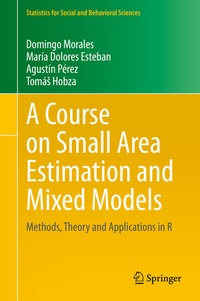
A Course on Small Area Estimation and Mixed Models
Description

This advanced textbook explores small area estimation techniques, covers the underlying mathematical and statistical theory and offers hands-on support with their implementation. It presents the theory in a rigorous way and compares and contrasts various statistical methodologies, helping readers understand how to develop new methodologies for small area estimation. It also includes numerous sample applications of small area estimation techniques. The underlying R code is provided in the text and applied to four datasets that mimic data from labor markets and living conditions surveys, where the socioeconomic indicators include the small area estimation of total unemployment, unemployment rates, average annual household incomes and poverty indicators. Given its scope, the book will be useful for master and PhD students, and for official and other applied statisticians.
More details
Other editions
Additional editions
Persons
Domingo Morales is a Professor of Statistics at the Miguel Hernández University of Elche, Spain. He has participated in two projects on Small Area Estimation (SAE) funded by the European Commission. Moreover, he has developed SAE methodologies and software for the Statistical Offices of Spain and Valencia. He has published more than 140 papers in statistics journals and taught courses on survey methodology and SAE at statistical institutes and universities. He has developed the R packages saery and mme .
María Dolores Esteban is a Professor of Statistics at the Miguel Hernández University of Elche, Spain. She has participated in two projects on Small Area Estimation (SAE) funded by the European Commission, and developed SAE methodologies and software for the Statistical Offices of Spain and Valencia. She has published more than 40 papers in statistics journals and taught courses on statistics and R at hospitals and universities. She has developed the R package saery .
Agustín Pérez is a Professor of Finance at the Miguel Hernández University of Elche, Spain. He has participated in one project on Small Area Estimation (SAE) funded by the European Commission. In addition, he has developed SAE methodologies and software for the Statistical Offices of Spain and Valencia. He has published more than 20 papers in statistics journals and taught courses on statistics and R at hospitals and universities. He has developed the R package saery .
T omás Hobza is an Associate Professor of Statistics at the Czech Technical University in Prague, Czech Republic, where he works in the fields of Information Theory and Small Area Estimation (SAE). He has developed SAE methodologies and software with applications to labor market and living conditions survey data. He has published more than 20 papers in statistics journals and taught courses on statistics at universities and clinical research companies.
