

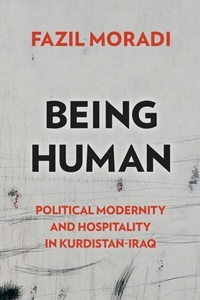
Being Human
Political Modernity and Hospitality in Kurdistan-Iraq
1st Edition
Published on 12. January 2024
193 pages
978-1-9788-3173-5 (ISBN)
Description

The Iraqi Ba?th state's Anfa?l operations (1987-1991) is one of the twentieth century's ultimate acts of destruction of the possibility of being human. It remains the first and only crime of state in the Middle East to be tried under the 1948 UN Genocide Convention, the 1950 Nuremberg Principles, and the 1969 Iraqi Penal Code and to be recognized as genocide, crimes against humanity, and war crimes in Baghdad between 2006 and 2007. Being Human: Political Modernity and Hospitality in Kurdistan-Iraq offers an unprecedented pathway to the study of political violence. It is a sweeping work of anthropological hospitality, returning to the Anfa?l operations as the violence of political modernity only to turn to the human survivors' hospitality and acts of translation-testimonial narratives, law, politics, archive, poetry, artworks, museums, memorials, symbolic cemeteries, and infinite pursuit of justice in the Kurdistan Region of Iraq. Being Human gathers together social sciences, humanities, and the arts to understand modernity's violence and its living on.
Reviews / Votes
"Being Human is an unsettling and urgent work of scholarship that transcends the confines of the university to address some of the most compelling conditions of human life and death. Anthropological hospitality, the idea at the heart of this book, provides an illuminating and passionate perspective on the plight of locality in the fight for the recognition of global justice." - Homi K. Bhabha (Homi K. Bhabha, Anne F. Rothenberg Professor of the Humanities, Harvard University) "In rich, poetic prose, Fazil Moradi brilliantly unravels the politics of reading, witnessing, and memory challenging us to listen to survivors of the al-Anfal to understand the limits and possibilities of justice and accountability without losing sight of the hope and trust required for acts of hospitality and translation in Being Human." - Victoria Sanford (Victoria Sanford, author of Textures of Terror: The Murder of Claudina Isabel Velasquez and Her Fath) "Fazil Moradi writes at a critical historical juncture where so many of us are grappling with what it means to be human in an increasingly uncertain world. In Being Human, a nod to Jelalulddin al- Rumi, Moradi makes an important intervention by bringing hospitality to the center of understanding what international definitions of genocide, violence, and militarism leave unexplained. This is a well-argued book and a captivating narrative urging us to think about how the afterlives of colonial and postcolonial acts of violence continue to shape the modern nation state and its presumed future. This is a must read for those interested in the history, art, and politics of genosites in the Iraq Kurdistan region and beyond." - Amal Hassan Fadlalla (Amal Hassan Fadlalla, author of Branding Humanity: Competing Narratives of Rights, Violence, and Glo) "Raw and beautiful. Moradi shows us how to listen to survivors of mass violence. In silences, gestures, and words from generous hosts who lived through the mass Anfal attacks of late 20th-century Kurdistan Iraq, Moradi implicates political modernity. This book richly and poignantly displays the dignity and beauty of both people lost, and those who live on having survived and witnessed. It is painful to read, and that is one of its successes. All students of the modern state should read this book."- Diane E. King (Diane E. King, author of Kurdistan on the Global Stage: Kinship, Land, and Community in Iraq)
More details
Series
Language
English
Place of publication
New Brunswick NJ
United States
Target group
College/higher education
Professional and scholarly
Illustrations
18 B-W images
ISBN-13
978-1-9788-3173-5 (9781978831735)
Copyright in bibliographic data and cover images is held by Nielsen Book Services Limited or by the publishers or by their respective licensors: all rights reserved.
Schweitzer Classification
Other editions
Additional editions
Book
01/2024
Rutgers University Press
€37.00
Shipment within 3-4 weeks
Person
Fazil Moradi is a visiting associate professor in the Faculty of Humanities, Johannesburg Institute for Advanced Study, University of Johannesburg; an associate researcher at the Institute for Social Anthropology, Austrian Academy of Sciences; and an affiliated scholar at the Center for the Study of the Holocaust, Genocide, and Crimes against Humanity at the Ralph Bunche Institute for International Studies, Graduate Center-CUNY.
Content
Contents
List of Figures
Map of the Anfal operations
Prologue
1 The Destruction of Jalamourd, an Outlawed Village
2 The Inhospitality of Political Modernity
3 Homeless in the World
4 The Baghdad Tribunal
5 Habitability, in the Afterlives of a Massacre
6 Whose Homeland? Whose Nation?
7 Physiological Disquiet
Epilogue: Genosite
Acknowledgements
Bibliography
Notes
Index
List of Figures
Map of the Anfal operations
Prologue
1 The Destruction of Jalamourd, an Outlawed Village
2 The Inhospitality of Political Modernity
3 Homeless in the World
4 The Baghdad Tribunal
5 Habitability, in the Afterlives of a Massacre
6 Whose Homeland? Whose Nation?
7 Physiological Disquiet
Epilogue: Genosite
Acknowledgements
Bibliography
Notes
Index
