

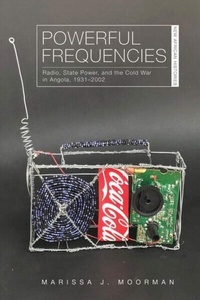
Powerful Frequencies
Radio, State Power, and the Cold War in Angola, 1931-2002
1st Edition
Published on 20. August 2019
277 pages
978-0-8214-4676-8 (ISBN)
Available for download
Description

Powerful Frequencies details the central role that radio technology and broadcasting played in the formation of colonial Portuguese Southern Africa and the postcolonial nation-state, Angola. In Intonations, Marissa J. Moorman examined the crucial relationship between music and Angolan independence during the 1960s and '70s. Now, Moorman turns to the history of Angolan radio as an instrument for Portuguese settlers, the colonial state, African nationalists, and the postcolonial state. They all used radio to project power, while the latter employed it to challenge empire.
From the 1930s introduction of radio by settlers, to the clandestine broadcasts of guerrilla groups, to radio's use in the Portuguese counterinsurgency strategy during the Cold War era and in developing the independent state's national and regional voice, Powerful Frequencies narrates a history of canny listeners, committed professionals, and dissenting political movements. All of these employed radio's peculiarities-invisibility, ephemerality, and its material effects-to transgress social, political, "physical," and intellectual borders. Powerful Frequencies follows radio's traces in film, literature, and music to illustrate how the technology's sonic power-even when it made some listeners anxious and frightened-created and transformed the late colonial and independent Angolan soundscape.
From the 1930s introduction of radio by settlers, to the clandestine broadcasts of guerrilla groups, to radio's use in the Portuguese counterinsurgency strategy during the Cold War era and in developing the independent state's national and regional voice, Powerful Frequencies narrates a history of canny listeners, committed professionals, and dissenting political movements. All of these employed radio's peculiarities-invisibility, ephemerality, and its material effects-to transgress social, political, "physical," and intellectual borders. Powerful Frequencies follows radio's traces in film, literature, and music to illustrate how the technology's sonic power-even when it made some listeners anxious and frightened-created and transformed the late colonial and independent Angolan soundscape.
Reviews / Votes
"This is an outstanding book. Moorman, already the author of a superb and influential social history of Angolan music, writes the definitive work on Angolan radio during the colonial and post-independence periods. It not only unearths new knowledge about Angolan history, but places Angolan developments in the wider canvas of the Cold war. That Moorman has achieved this through a book that is elegantly written and compellingly argued are but two of its many qualities. This will be a must read not only to those focused on modern Africa, but to anyone interested in the workings of state propaganda and the global Cold War." - Ricardo Soares de Oliveira, University of Oxford "Moorman's incisive study argues that the medium of radio is central to the history of human actors, political movements, wars, as well as the struggle for and the exercise of power in southern Africa. Yet radio has not heretofore been an object of systematic analysis in connection to Angola. Following her groundbreaking Intonations, Moorman once again proves herself to be one of the leading scholars on this key southern African nation." - Fernando Arenas, author of Lusophone Africa: Beyond Independence "A gripping modern history of Angola that engages recent work reconfiguring the place of technology in everyday folks' ability to --experience, make, and make sense of politics as well as the place of the state in the history of settler --colonialism, national liberation, decolonization, the Cold War, and postcolonial governance in the wider region." - Kathryn M. de Luna (American Historical Review) "Marissa Moorman's new book aptly captures the multiple dimensions of the enduring power of radio in mediating different historical moments in Angola. It is an excellent book that draws on multiple texts to narrate the role of radio both in Angola's independence struggle and in the post-war of era of nation building." - Dumisani Moyo, author of Radio in Africa: Publics, Cultures, Communities "Moorman's skilled narrative style allows her to move easily in her analysis between scales ranging from the global to the densely and vividly local. At moments the text reads like a thriller, one that informs and enlightens, and also complicates how we think about radio." (Kronos) "In Moorman's analysis, radio does not just exist for its content, it exists as a particular type of modern technology whose very power stems from its capacity to act (and be acted on) by its audiences.... Powerful Frequencies tells us how and why we need to finely tune our receivers, to attend to these ranging forms of power, and to hopefully-like the Angolans that have listened so carefully-find new ways to innovate and protest." (Africa Is a Country)More details
Series
Language
English
Place of publication
Athens
United States
Target group
Professional and scholarly
ISBN-13
978-0-8214-4676-8 (9780821446768)
Copyright in bibliographic data and cover images is held by Nielsen Book Services Limited or by the publishers or by their respective licensors: all rights reserved.
Schweitzer Classification
Other editions
Additional editions
Book
08/2019
Ohio University Press
€35.00
Shipment within 10-20 days
Person
Marissa J. Moorman is a professor in the Department of African Cultural Studies at the University of Wisconsin-Madison. She is the author of Intonations: A Social History of Music and Nation in Luanda, Angola, 1945 to Recent Times and Powerful Frequencies: Radio, State Power, and the Cold War in Angola, 1931-2002. She is on the editorial board of Africa Is a Country, where she regularly writes about politics and culture.
Content
- Intro
- Series Page
- Title Page
- Copyright
- Dedication
- Contents
- List of Illustrations
- Acknowledgments
- Abbreviations
- Chronology
- Introduction
- 1: Sonic Colony: Whiteness, Fast Cars, and Modernity, 1931-74
- 2: Guerrilla Broadcasters and the Unnerved Colonial State in Angola, 1961-74
- 3: Electronic Warfare: Radio and Counterinsurgency, 1961-74
- 4: Nationalizing Radio: Socialism and Sound at Rádio Nacional de Angola, 1974-92
- 5: "Angola: The Firm Trench of the Revolution in Africa!": Our Anti-Imperialism, Your Cold War, 1975-92
- 6: Radio Vorgan: A Rival Voice from Jamba, 1979-98
- Epilogue Jamming
- Notes
- Bibliography
- Index

