

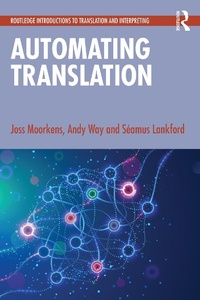
Automating Translation
1st Edition
Published on 29. August 2024
270 pages
978-1-040-10393-7 (ISBN)
Description

Translation technology is essential for translation students, practising translators, and those working as part of the language services industry, but looming above others are the tools for automating translation: machine translation and, more recently, generative AI based on large language models (LLMs).
This book, authored by leading experts, demystifies machine translation, explaining its origins, its training data, how neural machine translation and LLMs work, how to measure their quality, how translators interact with contemporary systems for automating translation, and how readers can build their own machine translation or LLM. In later chapters, the scope of the book expands to look more broadly at translation automation in audiovisual translation and localisation. Importantly, the book also examines the sociotechnical context, focusing on ethics and sustainability. Enhanced with activities, further reading and resource links, including online support material on the Routledge Translation studies portal, this is an essential textbook for students of translation studies, trainee and practising translators, and users of MT and multilingual LLMs.
Additional resources are available on the Routledge Translation Studies Portal.
This book, authored by leading experts, demystifies machine translation, explaining its origins, its training data, how neural machine translation and LLMs work, how to measure their quality, how translators interact with contemporary systems for automating translation, and how readers can build their own machine translation or LLM. In later chapters, the scope of the book expands to look more broadly at translation automation in audiovisual translation and localisation. Importantly, the book also examines the sociotechnical context, focusing on ethics and sustainability. Enhanced with activities, further reading and resource links, including online support material on the Routledge Translation studies portal, this is an essential textbook for students of translation studies, trainee and practising translators, and users of MT and multilingual LLMs.
Additional resources are available on the Routledge Translation Studies Portal.
Reviews / Votes
This is an indispensable textbook for any translation students and professionals working in the translation industry who want to learn about the recent developments in the field of machine translation. Written in a clear and engaging style, it accommodates readers of all levels, benefiting from the authors' extensive experience in the field. Its comprehensive scope and insightful perspective make this book an invaluable resource for anyone who wants to learn about the modern machine translation approaches. Readers without a computational background but who want to learn more about how machine translation works will appreciate the technical details provided in text boxes and extra reading materials. I will definitely recommend this book to my students.- Professor Constantin Orasan, University of Surrey
Tailored for translation students and language professionals, this textbook offers a comprehensive and accessible exploration of all aspects of machine translation. From data and the inner workings of MT to evaluation and the customisation of your own LLM, every topic is covered. With its clear explanations, valuable pointers to open-source tools and recommended additional readings, this book empowers readers to engage in informed discussions about the appropriate use of MT.
- Professor Lieve Macken, Ghent University, Belgium
Automating Translation is a valuable and forward-looking academic work that offers a systematic, innovative, and practical exploration of translation technology. The book constructs a comprehensive knowledge framework that spans from the historical evolution and theoretical foundations of machine translation to its core technologies, real-world applications, evaluation methods, and broader sociotechnical implications.
-Journal Across Languages and Culture
More details
Series
Edition
1. Auflage
Language
English
Place of publication
London
United Kingdom
Publishing group
Taylor & Francis Ltd
Target group
College/higher education
Professional and scholarly
Illustrations
8 Tables, black and white; 45 Halftones, black and white; 45 Illustrations, black and white
ISBN-13
978-1-040-10393-7 (9781040103937)
Copyright in bibliographic data and cover images is held by Nielsen Book Services Limited or by the publishers or by their respective licensors: all rights reserved.
Schweitzer Classification
Other editions
Additional editions
Joss Moorkens | Andy Way | Seamus Lankford
Automating Translation
Book
08/2024
1st Edition
Routledge
€206.60
Shipment within 10-20 days
Joss Moorkens | Andy Way | Seamus Lankford
Automating Translation
Book
08/2024
1st Edition
Routledge
€60.40
Shipment within 10-20 days

Joss Moorkens
Automating Translation
Book
08/2024
Routldege Taylor & Francis Group
Unfortunately, price unknown
Available (delivery time upon request)
Persons
Joss Moorkens is Associate Professor at the School of Applied Language and Intercultural Studies and Science Lead at the ADAPT Centre at Dublin City University, Ireland. He is General Co- Editor of the journal Translation Spaces, author and editor of several books, articles, chapters, and special issues on translation technology, and sits on the board of the European Masters in Translation network.
Andy Way is Professor of Computing and Co- Founder of the ADAPT Centre at Dublin City University, Ireland. He was previously editor of the Machine Translation journal for 15 years, and president of both the European and International Associations for Machine Translation. He has over 450 publications, including five books on machine translation.
Seamus Lankford is a Computer Science lecturer with over 25 years' experience at the Munster Technological University, Ireland. He has published extensively on the topic of machine translation. The focus of his doctoral thesis was the enhancement of NMT of low- resource languages through corpus development, human evaluation, and explainable AI architectures.
Andy Way is Professor of Computing and Co- Founder of the ADAPT Centre at Dublin City University, Ireland. He was previously editor of the Machine Translation journal for 15 years, and president of both the European and International Associations for Machine Translation. He has over 450 publications, including five books on machine translation.
Seamus Lankford is a Computer Science lecturer with over 25 years' experience at the Munster Technological University, Ireland. He has published extensively on the topic of machine translation. The focus of his doctoral thesis was the enhancement of NMT of low- resource languages through corpus development, human evaluation, and explainable AI architectures.
Content
Contents
Series Editor's Foreword
Preface
Abbreviations and Acronyms
Chapter 1 - The Roots of Machine Translation
Chapter 2 - Data for Machine Translation
Chapter 3 - Translation Memory and Computer-Assisted Translation tools
Chapter 4 - Neural Networks and Neural Machine Translation
Chapter 5 - Machine Translation Evaluation
Chapter 6 - Neural Machine Translation: Build or Buy?
Chapter 7 - Building Machine Translation Models with Colab
Chapter 8 - Machine Translation Post-Editing
Chapter 9 - Machine Translation in Multimedia Translation and Localisation
Chapter 10 - Large Language Models and Multilingual Language Models: The Future of Machine Translation?
Chapter 11 - Sociotechnical Effects of Machine Translation
Afterword
Glossary
Series Editor's Foreword
Preface
Abbreviations and Acronyms
Chapter 1 - The Roots of Machine Translation
Chapter 2 - Data for Machine Translation
Chapter 3 - Translation Memory and Computer-Assisted Translation tools
Chapter 4 - Neural Networks and Neural Machine Translation
Chapter 5 - Machine Translation Evaluation
Chapter 6 - Neural Machine Translation: Build or Buy?
Chapter 7 - Building Machine Translation Models with Colab
Chapter 8 - Machine Translation Post-Editing
Chapter 9 - Machine Translation in Multimedia Translation and Localisation
Chapter 10 - Large Language Models and Multilingual Language Models: The Future of Machine Translation?
Chapter 11 - Sociotechnical Effects of Machine Translation
Afterword
Glossary
