
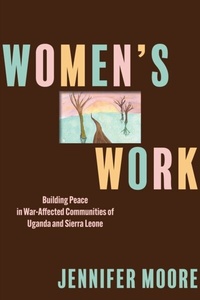
Women's Work
Description
Alles über E-Books | Antworten auf Fragen rund um E-Books, Kopierschutz und Dateiformate finden Sie in unserem Info- & Hilfebereich.
When women have full socioeconomic citizenship as well as equitable and respectful partnerships with men, transformative justice can be sustained in postconflict societies
In Women's Work, Jennifer Moore presents a reimagined theory of peacebuilding and transformative justice based on the experiences and insights of women farmers and microentrepreneurs who lived through protracted civil conflicts, drawing on seven years of interviews with women activists across ten communities-five in the Acholi region of Northern Uganda and five in the Moyamba and Koinadugu Districts of Sierra Leone. Despite the important differences between the preconflict and conflict histories and demographics of the two countries, Moore finds commonalities in the practical, yet visionary, approaches to community life emerging from the core values, daily activities, and long-range goals shared by rural cooperative members in both regions.
Collective survival, communal healing, and conflict resolution define the rhythm of these women's daily lives as they go about building peace, piecemeal. They reject punitive retribution models and demand, instead, a peacebuilding model that advocates for advances in material well-being, the acknowledgment of state accountability for community suffering, and reconciliation and restoration of community networks. But most important, Moore amplifies these women's voices when they insist that legal equality for women and healthy partnerships between women and men are also essential components to enduring transformation of their societies.
Moore theorizes what peacebuilding look like if it were modeled on these women-led, matriarchically structured communities that proved not only to be effective at holding governments accountable but also to have the capacity to feed their people and revitalize their local economies. Women's Work shows that when women have full socioeconomic citizenship as well as equitable and respectful partnerships with men, transformative justice can be sustained through the arts of collective livelihood, violence-free conflict management, and celebration.
All prices
More details
Other editions
Additional editions

Person
System requirements
File format: ePUB
Copy protection: Adobe-DRM (Digital Rights Management)
System requirements:
- Computer (Windows; MacOS X; Linux): Install the free reader Adobe Digital Editions prior to download (see eBook Help).
- Tablet/smartphone (Android; iOS): Install the free app Adobe Digital Editions or the app PocketBook before downloading (see eBook Help).
- E-reader: Bookeen, Kobo, Pocketbook, Sony, Tolino and many more (not Kindle).
The file format ePub works well for novels and non-fiction books – i.e., „flowing” text without complex layout. On an e-reader or smartphone, line and page breaks automatically adjust to fit the small displays.
This eBook uses Adobe-DRM, a „hard” copy protection. If the necessary requirements are not met, unfortunately you will not be able to open the eBook. You will therefore need to prepare your reading hardware before downloading.
Please note: We strongly recommend that you authorise using your personal Adobe ID after installation of any reading software.
For more information, see our ebook Help page.
File format: PDF
Copy-Protection: Adobe-DRM (Digital Rights Management)
System requirements:
- Computer (Windows; MacOS X; Linux): Install the free reader Adobe Digital Editions prior to download (see eBook Help).
- Tablet/smartphone (Android; iOS): Install the free app Adobe Digital Editions or the app PocketBook before downloading (see eBook Help).
- E-reader: Bookeen, Kobo, Pocketbook, Sony, Tolino and many more (only limited: Kindle).
The file format PDF always displays a book page identically on any hardware. This makes PDF suitable for complex layouts such as those used in textbooks and reference books (images, tables, columns, footnotes). Unfortunately, on the small screens of e-readers or smartphones, PDFs are rather annoying, requiring too much scrolling.
This eBook uses Adobe-DRM, a „hard” copy protection. If the necessary requirements are not met, unfortunately you will not be able to open the eBook. You will therefore need to prepare your reading hardware before downloading.
Please note: We strongly recommend that you authorise using your personal Adobe ID after installation of any reading software.
For more information, see our eBook Help page.
File format: ePUB
Copy protection: Watermark-DRM (Digital Rights Management)
System requirements:
- Computer (Windows; MacOS X; Linux): Use a reading software that can process the file format ePUB: e.g., Adobe Digital Editions or FBReader – both free (see eBook Help).
- Tablet/Smartphone (Android; iOS): Before downloading, install the free app Adobe Digital Editions (see eBook Help).
- E-reader: Bookeen, Kobo, Pocketbook, Sony, Tolino and many more (not Kindle).
The file format ePUB works well for novels and non-fiction books – i.e., „flowing” text without complex layout. On an e-reader or smartphone, line and page breaks automatically adjust to fit the small displays.
This eBook uses Watermark-DRM, a „soft” copy protection. This means that there are no technical restrictions to prevent illegal distribution. However, there is a personalised watermark embedded in the eBook that can be used to identify the purchaser of the eBook in the event of misuse and to provide evidence for legal purposes.
For more information, see our eBook Help page.
