

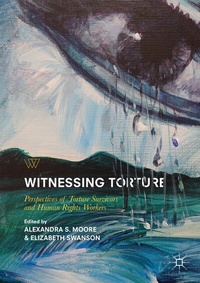
Witnessing Torture
Description

This book demonstrates a new, interdisciplinary approach to life writing about torture that situates torture firmly within its socio-political context, as opposed to extending the long line of representations written in the idiom of the proverbial dark chamber . By dismantling the rhetorical divide that typically separates survivors' suffering from human rights workers' expertise, contributors engage with the personal, professional, and institutional dimensions of torture and redress. Essays in this volume consider torture from diverse locations - the Philippines, Argentina, Sudan, and Guantánamo, among others. From across the globe, contributors witness both individual pain and institutional complicity; the challenges of building communities of healing across linguistic and national divides; and the role of the law, art, writing, and teaching in representing and responding to torture.
Reviews / Votes
"I would strongly recommend this book to anyone working in the field of life narrative. . I am very glad that I did, because it forced me to shift my understanding of the work that I do-for the better, I hope." (Annie Pohlman, Biography, Vol. 42 (4), 2019)
More details
Other editions
Additional editions
Persons
Alexandra S. Moore is Professor of English and Associate Director of the Human Rights Institute at Binghamton University, USA. Her publications include Vulnerability and Security in Human Rights Literature and Visual Culture (2015) and Regenerative Fictions: Postcolonialism, Psychoanalysis, and the Nation as Family (2004). She has also co-edited several volumes and a special journal issue: The Routledge Companion to Literature and Human Rights (with Sophia A. McClennen, 2015); Teaching Human Rights in Literary and Cultural Studies (with Elizabeth Swanson Goldberg, 2015); Globally Networked Teaching in the Humanities (with Sunka Simon, 2015); Theoretical Perspectives on Human Rights and Literature (with Goldberg, 2011), and Human Rights and Cultural Forms, special issue of College Literature (with Goldberg and Greg Mullins, 2013).
Elizabeth Swanson is Professor of English at Babson College, USA, and has published widely on the subject of literature and human rights. Author of Beyond Terror: Gender, Narrative, Human Rights (2007), she is co-editor, with Alexandra Schultheis Moore, of Theoretical Perspectives on Literature and Human Rights (2011) and Options for Teaching Human Rights in Literary and Cultural Studies (2015), and with James Brewer Stewart of Human Bondage and Abolition: New Histories of Slavery Past and Present (2018). She has been a human rights activist since age 14, when she wrote her first letter for Amnesty International, and has for the past ten years worked with survivors of sex trafficking and gender-based violence in southeast Asia to create dignified, sustainable, life and livelihood solutions.
Content
Part I Torture in Context and Translation .-1 Torture: The Catastrophe of a Bond.-2 Torture in an Historical Context: Notes from Sudan.-3 The Unspeakable Agony of Inflicted Pain: Torture,.-4 Translating Trauma, Witnessing Survival.-Part II Witnessing Torture and Recovery: Survivors, HealthProfessionals, Institutions.-5 The Role of Health Professionals in Torture Treatment.-6 Assessing the Treatment of Torture: Balancing.-Quantifiable with Intangible Metrics 7 The Little Red Cabinet of Tears: The Impact upon.-Treatment Providers of Bearing Witness to Torture Judy B. Okawa.-8 Beyond Institutional Betrayal: When the Professional Is Personal.-Part III Disappearance and Torture, Redress and Representation.-9 Everardo and the CIA's Long-Term Torture Practices.-10 Survivors and the Origin of the Convention for the Protection of All Persons from Enforced Disappearance.-11 The Tenacity of Memory: Art in the Aftermath of Atrocity 12 Teaching about Torture, or, Reading between the Lines in the Humanities.-13 Legal Appeal: Habeas Lawyers Narrate Guantánamo Life.-14 Did We Survive Torture?.-Epilogue: From Solitude to Solidarity.-Index
