

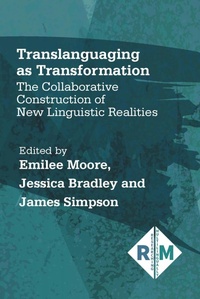
Translanguaging as Transformation
The Collaborative Construction of New Linguistic Realities
Published on 12. May 2020
232 pages
978-1-78892-806-9 (ISBN)
Description

This book examines translanguaging as a resource which can disrupt the privileging of particular voices, and a social practice which enables collaboration within and across groups of people. Addressing the themes of collaboration and transformation, the chapters critically examine how people work together to catalyse change in diverse global contexts, experiences and traditions. The authors suggest an epistemological and methodological turn to the study of translanguaging, which is particularly reflected in the collaborative, arts-based and action research/activist approaches followed in the chapters. The book will be of particular interest to scholars using ethnographic, critical and collaborative action and activist research approaches to the study of multilingualism in educational and creative arts contexts.
Reviews / Votes
This collection of studies constitutes a ground-breaking move towards a much better understanding of translanguaging and its transformative potential in education. The highly creative collaborative projects reported provide a sound empirical basis and clear models for pedagogic intervention that challenge traditional ideas about language and communication. * Josep M. Cots, University of Lleida, Catalonia, Spain * This illuminating and ground-breaking volume sets out to critically advance the paradigm of translanguaging as a collaborative and transformative resource and practice for generating a social justice activism agenda across different communities and contexts. This rich and remarkable collection of detailed empirical studies will give fresh impetus to translanguaging and multilingualism studies. * Gerardo Mazzaferro, University of Turin, Italy * This is a well-crafted and critically astute book that brings together a range of voices in the field of translanguaging. It raises vital questions about how we perceive and work in, with and through languages, providing critical insights into ways people collaborate to bring about new linguistic realities. A powerful book that will have an impact on how we understand, learn and experience languages. * Vicky Macleroy, Goldsmiths, University of London, UK * This new publication by Multilingual Matters provides a rich selection of essays that reveal how the transformative potential of translanguaging is inextricably linked with participatory collaborative practice. The editors, who have been involved in exploring translanguaging practices for a number of years, have brought to us a very timely, exciting and wellbalanced collection presenting projects that span geographical locations, spaces of engagement and scholarly traditions. -- Dobrochna Futro, University of Glasgow, UK * Language Issues 31.2 * ...a core strength of this book is not only the sheer diversity of context and projects represented, but the impressive degree of innovation and creativity that underpin design and implementation. That the research is also co-designed with 'participants', in a critical endeavour to redress multiple inequalities, makes the undertaking(s) ground-breaking: social justice is clearly at its core. -- Emma Brooks, UCL Institute of Education, UK * ELT Journal, November 2021 *More details
Series
Language
English
Place of publication
Bristol
United Kingdom
Target group
College/higher education
Product notice
Reflowable
Dimensions
Height: 234 mm
Width: 156 mm
ISBN-13
978-1-78892-806-9 (9781788928069)
Copyright in bibliographic data and cover images is held by Nielsen Book Services Limited or by the publishers or by their respective licensors: all rights reserved.
Schweitzer Classification
Other editions
Additional editions
Emilee Moore | Jessica Bradley | James Simpson
Translanguaging as Transformation
The Collaborative Construction of New Linguistic Realities
Book
05/2020
Multilingual Matters
€56.30
Shipment within 3-4 weeks
Persons
Emilee Moore is a Serra Hunter Fellow (Assistant Professor) at the Universitat Autonoma de Barcelona, Spain. She co-convenes the AILA Research Network on Creative Inquiry in Applied Linguistics.
Jessica Bradley is a Lecturer in Literacies in the School of Education, University of Sheffield, UK. She co-convenes the AILA Research Network on Creative Inquiry in Applied Linguistics.
James Simpson lectures in Language Education at the School of Education, University of Leeds, UK. He is the co-author of ESOL: A Critical Guide (OUP, 2008, with Melanie Cooke), the editor of The Routledge Handbook of Applied Linguistics (2011), and the co-editor of three further books.
Jessica Bradley is a Lecturer in Literacies in the School of Education, University of Sheffield, UK. She co-convenes the AILA Research Network on Creative Inquiry in Applied Linguistics.
James Simpson lectures in Language Education at the School of Education, University of Leeds, UK. He is the co-author of ESOL: A Critical Guide (OUP, 2008, with Melanie Cooke), the editor of The Routledge Handbook of Applied Linguistics (2011), and the co-editor of three further books.
Content
Ofelia Garcia: Foreword: Co-labor and Re-Performances
Jessica Bradley, Emilee Moore and James Simpson: Translanguaging as Transformation: The Collaborative Construction of New Linguistic Realities
Part I: Collaborative Relationships
Mike Baynham: Comment on Part I: Collaborative Relationships
Chapter 1. Margaret R. Hawkins: Toward Critical Cosmopolitanism: Transmodal Transnational Engagements of Youth
Chapter 2. James Simpson: Translanguaging in ESOL: Competing Positions and Collaborative Relationships
Chapter 3. Sari Poeyhoenen, Lotta Kokkonen, Mirja Tarnanen and Maija Lappalainen: Belonging, Trust and Relationships: Collaborative Photography with Unaccompanied Minors
Chapter 4. Camilo Ballena, Dolors Masats and Virginia Unamuno: The Transformation of Language Practices: Notes from the Wichi Community of Los Lotes (Chaco, Argentina)
Part II: Collaborative Processes
Adrian Blackledge: Comment on Part II: Collaborative Processes
Chapter 5. Joelle Aden and Sandrine Eschenauer: Translanguaging: An Enactive-Performative Approach to Language Education
Chapter 6. Jane Andrews, Richard Fay, Katja Frimberger, Gameli Tordzro and Tawona Sithole: Theorising Arts-Based Collaborative Research Processes
Chapter Seven. Jessica Bradley and Louise Atkinson: Translanguaging as Bricolage: Meaning Making and Collaborative Ethnography in Community Arts
Chapter 8. Emilee Moore and Ginalda Tavares: Telling the Stories of Youth: Co-Producing Knowledge across Social Worlds
Part III: Collaborative Outcomes
Zhu Hua and Li Wei: Comment on Part III: Collaborative Outcomes
Chapter 9. Lou Harvey: Entangled Trans-ing: Co-Creating a Performance of Language and Intercultural Research
Chapter 10. Kendall A. King and Martha Bigelow: The Hyper-Local Development of Translanguaging Pedagogies
Chapter 11. Julia Llompart-Esbert and Luci Nussbaum: Collaborative and Participatory Research for Plurilingual Language Learning
Chapter 12. Claudia Vallejo Rubinstein: Translanguaging as Practice and as Outcome: Bridging across Educational Milieus through a Collaborative Service-Learning Project
Angela Creese: Afterword: Starting from the Other End
?
Jessica Bradley, Emilee Moore and James Simpson: Translanguaging as Transformation: The Collaborative Construction of New Linguistic Realities
Part I: Collaborative Relationships
Mike Baynham: Comment on Part I: Collaborative Relationships
Chapter 1. Margaret R. Hawkins: Toward Critical Cosmopolitanism: Transmodal Transnational Engagements of Youth
Chapter 2. James Simpson: Translanguaging in ESOL: Competing Positions and Collaborative Relationships
Chapter 3. Sari Poeyhoenen, Lotta Kokkonen, Mirja Tarnanen and Maija Lappalainen: Belonging, Trust and Relationships: Collaborative Photography with Unaccompanied Minors
Chapter 4. Camilo Ballena, Dolors Masats and Virginia Unamuno: The Transformation of Language Practices: Notes from the Wichi Community of Los Lotes (Chaco, Argentina)
Part II: Collaborative Processes
Adrian Blackledge: Comment on Part II: Collaborative Processes
Chapter 5. Joelle Aden and Sandrine Eschenauer: Translanguaging: An Enactive-Performative Approach to Language Education
Chapter 6. Jane Andrews, Richard Fay, Katja Frimberger, Gameli Tordzro and Tawona Sithole: Theorising Arts-Based Collaborative Research Processes
Chapter Seven. Jessica Bradley and Louise Atkinson: Translanguaging as Bricolage: Meaning Making and Collaborative Ethnography in Community Arts
Chapter 8. Emilee Moore and Ginalda Tavares: Telling the Stories of Youth: Co-Producing Knowledge across Social Worlds
Part III: Collaborative Outcomes
Zhu Hua and Li Wei: Comment on Part III: Collaborative Outcomes
Chapter 9. Lou Harvey: Entangled Trans-ing: Co-Creating a Performance of Language and Intercultural Research
Chapter 10. Kendall A. King and Martha Bigelow: The Hyper-Local Development of Translanguaging Pedagogies
Chapter 11. Julia Llompart-Esbert and Luci Nussbaum: Collaborative and Participatory Research for Plurilingual Language Learning
Chapter 12. Claudia Vallejo Rubinstein: Translanguaging as Practice and as Outcome: Bridging across Educational Milieus through a Collaborative Service-Learning Project
Angela Creese: Afterword: Starting from the Other End
?
