

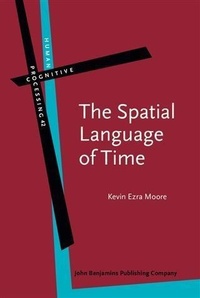
The Spatial Language of Time
Metaphor, metonymy, and frames of reference
1st Edition
Published on 16. May 2014
XXV, 340 pages
978-90-272-7065-8 (ISBN)
Description

The Spatial Language of Time presents a crosslinguistically valid state-of-the-art analysis of space-to-time metaphors, using data mostly from English and Wolof (Africa) but additionally from Japanese and other languages. Metaphors are analyzed in terms of their most direct motivation by basic human experiences (Grady 1997a; Lakoff & Johnson 1980). This motivation explains the crosslinguistic appearance of certain metaphors, but does not say anything about temporal metaphor systems that deviate from the types documented here. Indeed, we observe interesting culture- and language-specific metaphor phenomena. Refining earlier treatments of temporal metaphor and adapting to temporal experience Levinson's (2003) idea of frames of reference, the author proposes a contrast between perspective-neutral and perspective-specific frames of reference in temporal metaphor that has important crosslinguistic ramifications for the temporal semantics of FRONT/BEHIND expressions. This book refines the cognitive-linguistic approach to temporal metaphor by analyzing the extensive temporal structure in what has been considered the source domain of space, and showing how temporal metaphors can be better understood by downplaying the space-time dichotomy and analyzing metaphor structure in terms of conceptual frames. This book is of interest to linguists, psychologists, anthropologists, philosophers, and others who may have wondered about relationships between space and time.
More details
Other editions
Additional editions
Book
05/2014
John Benjamins Publishing Co
€100.70
Shipment within 10-15 days
Person
Content
- The Spatial Language of Time
- Editorial page
- Title page
- LCC data
- Epigraph
- Dedication page
- Table of contents
- List of diagrams
- List of tables
- Abbreviations and special symbols
- Transcription conventions
- Acknowledgments
- I. Temporal metaphor and ego's perspective
- 1. Introduction: Talking about time as if it were space
- 2. The deictic nature of Moving Ego and Ego-centered Moving Time expressions
- 3. The experiential bases (grounding, motivation) of Moving Ego and Ego-centered Moving Time
- 4. From earlier to later
- 5. Frame of reference and alternate construals of ego-centered time
- II. Perspectival neutrality
- 6. A field-based frame of reference
- 7. The psychological reality of sequence is relative position on a path
- 8. Illustrating the field-based/ego-perspective contrast: The case of sequence is relative position
- 9. Space-to-time metonymy
- III. The temporal semantics of IN-FRONT and BEHIND
- 10. The contrasting front/behind schemas of sequence is relative position on a path and Moving Ego
- 11. The crosslinguistic pairing of in-front and behind with 'earlier' and 'later'
- 12. The alignment of ego with a field-based frame of reference
- 13. When back is not the opposite of front: A temporal relative frame of reference in Wolof
- 14. The Ego-opposed temporal metaphor and contexts of shared perspective
- 15. Modes of construal of front and behind
- 16. In search of primary metaphors of time
- IV. Location without translational motion
- 17. Expressions of static temporal "location"
- 18. Beyond metaphor and metonymy: Mental spaces and conceptual integration
- 19. Other-centered Moving Time and Wolof fekk 'become co-located with'
- 20. Times as bounded regions
- V. Fundamentally different temporal concepts
- 21. Having and wasting Wolof counterparts of time
- 22. Conclusions
- References
- Name index
- Subject index
