

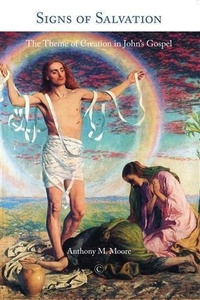
Signs of Salvation
The Theme of Creation in John's Gospel
Published on 26. September 2013
216 pages
978-0-227-90177-9 (ISBN)
Description

Was Mary Magdalene really mistaken when she took the Risen Lord to be a 'gardener' working near the tomb where Christ was laid after the crucifixion? In this compelling volume, Anthony M. Moore persuasively argues that Jesus must be recognised, at a theological level, as the Gardener: the Creator-God Himself.
The author skilfully examines the strong evidence available to the reader that the narrative material of the Book of Signs (John 2-12), together with the 'High Priestly Prayer' of John 17, is deliberately infused with the fundamental theme of creation. The first sentence of the Gospel, 'in the beginning', meaningfully echoes the start of Genesis, and sets the tone for what is to come. 'Creation indicators', or leitmotifs, which link the signs narratives in the Fourth Gospel to the sequence of the days of creation, are unpicked in this volume in a careful survey of the placement of particular nouns and verbs within the narratives and how often they occur. Upon these foundations, the author builds his strikingly original thesis: that each miraculous 'sign' of John 2-12 corresponds to a day of creation, and that, subtly but unmistakably, John intends to reveal Jesus as the Creator in all His glory.
A book that offers a novel and enlightening way of reading John's Gospel, 'Signs of Salvation' will interest any reader seeking a deeper understanding of a fundamental truth about Christ's nature: He is the God of creation, at one with and participating in the creative work of the Father.
The author skilfully examines the strong evidence available to the reader that the narrative material of the Book of Signs (John 2-12), together with the 'High Priestly Prayer' of John 17, is deliberately infused with the fundamental theme of creation. The first sentence of the Gospel, 'in the beginning', meaningfully echoes the start of Genesis, and sets the tone for what is to come. 'Creation indicators', or leitmotifs, which link the signs narratives in the Fourth Gospel to the sequence of the days of creation, are unpicked in this volume in a careful survey of the placement of particular nouns and verbs within the narratives and how often they occur. Upon these foundations, the author builds his strikingly original thesis: that each miraculous 'sign' of John 2-12 corresponds to a day of creation, and that, subtly but unmistakably, John intends to reveal Jesus as the Creator in all His glory.
A book that offers a novel and enlightening way of reading John's Gospel, 'Signs of Salvation' will interest any reader seeking a deeper understanding of a fundamental truth about Christ's nature: He is the God of creation, at one with and participating in the creative work of the Father.
Reviews / Votes
'Anthony Moore has woven together a fascinating series of observations on the structure and vocabulary of John's gospel into a compelling exploration of creation themes in the fourth gospel. An enjoyable read with plenty of food for reflection.'-Dr Hilary Marlow, Course Director of the Faraday Institute for Science and Religion, Cambridge
"Moore has touched upon an important and somewhat neglected aspect of Johannine Christology, and his book could stimulate thinking about the Johannine view of Jesus' role in creation and re-creation." Maarten -J.J. Menken, Novum Testamentum Volume 57.3
"This is a wonderful book and although it might seem initially daunting with tables of Greek and Hebrew ... everything is well explained and no assumption is made that the reader will automatically be able to decipher the Greek and Hebrew scripts."
-Joseph Emmanuel SSF, Franciscan, Vol.28 No.1, 2016
More details
Language
English
Place of publication
Cambridge
United Kingdom
File size
1,49 MB
ISBN-13
978-0-227-90177-9 (9780227901779)
Copyright in bibliographic data and cover images is held by Nielsen Book Services Limited or by the publishers or by their respective licensors: all rights reserved.
Schweitzer Classification
Other editions
Additional editions
Book
09/2013
James Clarke & Co Ltd
€58.41
Shipment within 10-20 days
Person
Dr Anthony M. Moore is Canon Chancellor of Lichfield Cathedral. Previously he was Dean of Chapel, Chaplain and a Fellow of St Catharine's College, Cambridge. He has taught at the College of the Resurrection, Mirfield and has served in parishes in Lancashire and Central London where he was also Chaplain to the Royal Academy of Music. He has lectured and led study days on his research in the Dioceses of Ely, London, Winchester, Lichfield, Wakefield and St Edmundsbury & Ipswich.
Content
Introduction
Chapter 1 'Now a discussion arose' - a review of the literature
Chapter 2 'Supposing him to be the gardener' - a case study in John's compositional methodology
Chapter 3 "Come and see" - discerning the way [without the tables]
Chapter 4 "The Father and I are one" - Jesus as Creator
Chapter 5 "That they may all be one" - the call to be 'gardeners' today
Chapter 1 'Now a discussion arose' - a review of the literature
Chapter 2 'Supposing him to be the gardener' - a case study in John's compositional methodology
Chapter 3 "Come and see" - discerning the way [without the tables]
Chapter 4 "The Father and I are one" - Jesus as Creator
Chapter 5 "That they may all be one" - the call to be 'gardeners' today
