

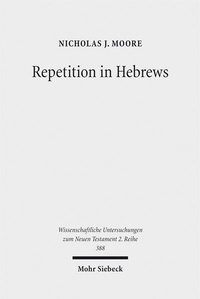
Repetition in Hebrews
Plurality and Singularity in the Letter to the Hebrews, Its Ancient Context, and the Early Church
1st Edition
Published on 17. March 2015
291 pages
978-3-16-153855-1 (ISBN)
Description

Wiederholung hat in der Geschichte des Christentums eine kontroverse und oftmals negative Rezeption erfahren, vor allem in Verbindung mit Ritualen und Liturgie, und der Hebräerbrief liegt diesem strittigen Verständnis zugrunde. Nicholas Moore zeigt, dass die Wiederholungen im Brief an die Hebräer nicht im einheitlichen Kontrast zum einmaligen Tode Jesu für die Menschheit stehen, sondern eher auf verschiedene Art und Weisen fungieren, viele davon konstruktiv. Die Einzigartigkeit des Christusereignisses wird mit Bezug auf den jährlich stattfindenden Versöhnungstag erläutert, um die alles übertreffende theologische Erfüllung auszudrücken, wobei Wiederholungen mit diesem einzigartigen Ereignis kontrastieren oder koexistieren können. Moore zeigt im Einzelnen auf, dass die täglichen levitischen Opfer den fortwährenden christlichen Zugang zu und die Anbetung von Gott andeuten. Diese Neubewertung des Phänomens der Wiederholung im Hebräerbrief bildet die Basis einer erneuerten Wertschätzung ihrer Bedeutung für den theologischen Diskurs und das religiöse Leben.
More details
Other editions
Additional editions
Nicholas J. Moore
Repetition in Hebrews
Plurality and Singularity in the Letter to the Hebrews, Its Ancient Context, and the Early Church
Book
03/2015
1st Edition
Mohr Siebeck
€109.00
Article exhausted; check different version
Person
Content
- Cover
- Preface
- Table of Contents
- Note
- Part One: Hebrews and Repetition
- Chapter 1: Hebrews and the Problem of Repetition
- 1.1 Introduction
- 1.2 Repetition in Hebrews Scholarship
- 1.2.1 Repetition as Self-Evidently Ineffective
- 1.2.2 Repetition as a Uniform Phenomenon
- 1.2.3 Repetition-Singularity and Platonic Earth-Heaven Dualism
- 1.2.4 Repetition-Singularity and the Transition from Old Covenant to New
- 1.3 Approaching Repetition
- 1.3.1 Definition
- 1.3.2 Hebrews' Portrayal of Repetition
- 1.3.3 The Relationship of Repetition to Ritual
- 1.3.4 Approaching the Relationship of Repetition to Effect
- 1.3.5 Charting Repetition and Effect
- 1.4 Argument of this Study
- Chapter 2: Repetition in the Historical Settings of Hebrews
- 2.1 Introduction
- 2.2 Locating Hebrews
- 2.3 Old Testament
- 2.3.1 Repetition in the Old Testament Prophetic 'Critique' of Sacrifice
- 2.3.2 Uniqueness in the Old Testament (1): The Shema
- 2.3.3 Uniqueness in the Old Testament (2): The Day of Atonement
- 2.3.4 Conclusion: Hebrews and the Old Testament
- 2.4 Jubilees and Qumran
- 2.4.1 Repetition in Jubilees (1): Calendar
- 2.4.2 Repetition in Jubilees (2): Chronology
- 2.4.3 Repetition, Worship, and Liturgy in the Qumran Texts
- 2.4.4 Conclusion: Hebrews and Qumran
- 2.5 Middle Platonism (1): Philo of Alexandria
- 2.5.1 Plurality in Philo (1): The Earthly Realm
- 2.5.2 Plurality in Philo (2): Sacrifices
- 2.5.3 Plurality in Philo (3): Recollection and Repentance
- 2.5.4 Singularity in Philo: God and the Jerusalem Cult
- 2.6 Middle Platonism (2): Plutarch
- 2.6.1 Plurality in Plutarch
- 2.6.2 Singularity in Plutarch
- 2.6.3 Conclusion: Hebrews and Middle Platonism
- 2.7 Early Christianity
- 2.7.1 Plurality and Repetition in the New Testament
- 2.7.2 Uniqueness in the New Testament (1): The Shema
- 2.7.3 Uniqueness in the New Testament (2): Jesus' Death
- 2.7.4 Conclusion: Hebrews and Early Christianity
- 2.8 Conclusion
- Chapter 3. Repetition in the Early Church
- 3.1 Introduction
- 3.2 Repeating Repentance
- 3.2.1 The Unrepeatability of Christian Baptism
- 3.2.2 The Shepherd of Hermas on Postbaptismal Repentance
- 3.2.3 Clement of Alexandria on Postbaptismal Repentance
- 3.2.4 Origen on the Means of Postbaptismal Forgiveness
- 3.3 Repeating Baptisms
- 3.3.1 Controversies over 'Rebaptism'
- 3.3.2 Jewish and Jewish-Christian Baptismal Groups
- 3.3.3 Critiques of Repeated Baptisms
- 3.3.4 Epiphanius against Baptistic Sects
- 3.4 Repeating Sacrifices
- 3.4.1 First Clement and Barnabas on Old Covenant Sacrifices
- 3.4.2 Emperor Julian on the Christians' Failure to Repeat Sacrifices
- 3.4.3 Chrysostom on Repetition and Uniqueness in the Eucharist
- 3.5 Conclusion
- Part Two: Repetition in Hebrews
- Chapter 4: Repetition and Revelation
- 4.1 Introduction
- 4.2 A Plurality of Prophets - the Exordium (Hebrews 1.1-4)
- 4.2.1 ????µe??? ?a? p???t??p?? in the Context of Hebrews
- 4.2.2 ????µe??? ?a? p???t??p?? in Wider Context
- 4.3 Repetition of Divine Speech in 'These Last Days'
- 4.3.1 Repetition of Divine Speech in the New Covenant: Heb 2.1-4
- 4.3.2 Repetition of Divine Speech in the Rest of Hebrews
- 4.4 Plurality and Hebrews' Interpretation of the Old Testament
- 4.4.1 The Uses of Plurality in Hebrews: Previous Scholarship
- 4.4.2 The Creation and Use of Plurality: Psalm 8
- 4.4.3 Exploiting Textual and Temporal Plurality: Psalm 95
- 4.5 Conclusion
- Chapter 5. Repetition and Repentance
- 5.1 Introduction
- 5.2 Repeated and Unrepeatable Acts in Hebrews 5.11-6.12
- 5.3 Repentance in Hebrews
- 5.3.1 ?et????a in Wider Context
- 5.3.2 ?et????a in Hebrews
- 5.4 Why is Repentance Unrepeatable?
- 5.4.1 'Impossible' vs 'Very Difficult'
- 5.4.2 The Nature of 'Falling Away'
- 5.4.3 'Crucifying' vs 'Recrucifying'
- 5.4.4 Early Evidence for the Recrucifixion Motif in the Acts of Peter
- 5.4.5 The Increased Gravity of New Covenant Apostasy
- 5.4.6 ?pa?: Atonement and Repentance as 'Once-for-All'
- 5.5 The Relationship between Repeated and Unrepeatable Acts
- 5.6 Conclusion
- Chapter 6. Repetition and Ritual
- 6.1 Introduction
- 6.2 The Cultus in Hebrews
- 6.2.1 The Relationship between the Heavenly and the Earthly Cult
- 6.2.2 The Nature of Cultic Language in Hebrews
- 6.3 Priesthood
- 6.3.1 Hebrews 2.10-3.6 and 4.14-5.10: A Perfect Priest
- 6.3.2 Hebrews 7.1-22: Melchizedek Made Like the Son
- 6.3.3 Hebrews 7.23-24: Mortals and the Immortal One
- 6.4 Sacrifice
- 6.4.1 Hebrews 7.26-28: Sinners and the Sinless One
- 6.4.2 Hebrews 9.23-28: Dying Once
- 6.4.3 Hebrews 10.1-4: The Inadequacy of Animal Sacrifices
- 6.4.4 Hebrews 10.5-10: Christ's Obedient Sacrifice
- 6.4.5 Hebrews 10.11-18: Singular, Seated, and Perfect
- 6.4.6 Hebrews 9.6: The Tamid
- 6.4.7 Hebrews 9.1-14: Typology and the Tabernacle
- 6.5 A Repeated New Covenant Cultus
- 6.5.1 Regular Meetings and their Cultic Context
- 6.5.2 The (Anti-?)Cultic Argument of Hebrews 13
- 6.5.3 The New Covenant Altar
- 6.5.4 New Covenant Sacrifices
- 6.6 Conclusion
- Conclusion
- Chapter 7: Repetition, Redemption, and Eternity
- 7.1 Introduction
- 7.2 Repetition, Singularity, and Effect in Hebrews
- 7.3 Hebrews and Kierkegaardian Repetition
- 7.4 'Let Us Go On': The Implications of this Study
- 7.4.1 Repetition and Hebrews' Historical Context
- 7.4.2 Hebrews and Repetition in Christian Tradition
- Bibliography
- Primary Literature
- Reference Works
- Secondary Literature
- Index of Ancient Sources
- Ancient Near Eastern Literature
- Old Testament
- Old Testament Apocrypha and Pseudepigrapha
- Dead Sea Scrolls
- Greco-Roman Literature
- Philo of Alexandria
- Plutarch
- Josephus
- New Testament
- Apostolic Fathers
- Other Early Christian and Patristic Literature
- Rabbinic Literature
- Index of Modern Authors
- Index of Subjects
