

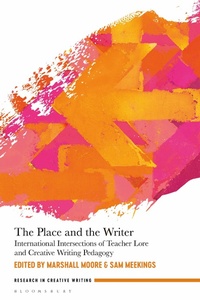
The Place and the Writer
International Intersections of Teacher Lore and Creative Writing Pedagogy
1st Edition
Published on 8. April 2021
272 pages
978-1-350-12716-6 (ISBN)
Description

The combined experience of authors throughout the ages offers a wealth of valuable information about the practice of creative writing. However, such lore can also be problematic for students and practitioners as it can be inherently additive, making it difficult to abandon processes that do not work. This adherence to lore also tends to be a US-centric endeavor. In order to take a nuanced approach to the uses and limitations of lore, The Place and the Writer offers a global perspective on creative writing pedagogy that has yet to be fully explored. Featuring a diverse array of cultural viewpoints from Brazil to Hong Kong, Finland to South Africa, this book explores the ongoing international debate about the best approaches for teaching and practicing creative writing.
Marshall Moore and Sam Meekings challenge areas of perceived wisdom that persist in the field of creative writing, including aesthetics and politics in institutionalized creative writing; the process of workshopping; tuition and talent; anxiety in the classroom; unifying theory and lore; and teaching creative writing in languages other than English.
Marshall Moore and Sam Meekings challenge areas of perceived wisdom that persist in the field of creative writing, including aesthetics and politics in institutionalized creative writing; the process of workshopping; tuition and talent; anxiety in the classroom; unifying theory and lore; and teaching creative writing in languages other than English.
More details
Series
Edition
1. Auflage
Language
English
Place of publication
London
United Kingdom
Publishing group
Bloomsbury Publishing PLC
Target group
College/higher education
ISBN-13
978-1-350-12716-6 (9781350127166)
Copyright in bibliographic data and cover images is held by Nielsen Book Services Limited or by the publishers or by their respective licensors: all rights reserved.
Schweitzer Classification
Other editions
Additional editions
Marshall Moore | Sam Meekings
The Place and the Writer
International Intersections of Teacher Lore and Creative Writing Pedagogy
Book
10/2022
Bloomsbury Academic
€45.10
Shipment within 15-20 days
Marshall Moore | Sam Meekings
The Place and the Writer
International Intersections of Teacher Lore and Creative Writing Pedagogy
Book
04/2021
Bloomsbury Academic
€141.13
Shipment within 15-20 days
Persons
Marshall Moore is Course Leader and Senior Lecturer in the School of Communication at Falmouth University, UK. He is the author of several novels and collections of short fiction, the most recent being Inhospitable (2018). With Xu Xi, he is the co-editor of the anthology The Queen of Statue Square: New Short Fiction from Hong Kong (2015). He holds a PhD in creative writing from Aberystwyth University,
UK, and his current research focuses on the disconnects between the publishing industry and the academy, and on the mythology and lore that surround creative practice and pedagogy.
Sam Meekings is Assistant Professor of Creative Writing at Northwestern University in Qatar. He is the
author of Under Fishbone Clouds (2011, called 'a poetic evocation of the country and its people' by the New York Times), The Book of Crows (2012), and The Afterlives of Dr Gachet (2018). He has a PhD in creative writing from Lancaster University, UK, and has taught writing at NYU (Global Campus) and the University of Chichester, UK. He researches issues of identity in grief narratives, and the practices and processes of digital storytelling.
UK, and his current research focuses on the disconnects between the publishing industry and the academy, and on the mythology and lore that surround creative practice and pedagogy.
Sam Meekings is Assistant Professor of Creative Writing at Northwestern University in Qatar. He is the
author of Under Fishbone Clouds (2011, called 'a poetic evocation of the country and its people' by the New York Times), The Book of Crows (2012), and The Afterlives of Dr Gachet (2018). He has a PhD in creative writing from Lancaster University, UK, and has taught writing at NYU (Global Campus) and the University of Chichester, UK. He researches issues of identity in grief narratives, and the practices and processes of digital storytelling.
Content
1. Foreword by Marshall Moore and Sam Meekings
2. Introduction by Graeme Harper (University of Oakland, USA)
3. Toward a Unified Field: The Complications of Lore and Global Context by Stephanie Vanderslice (University of Central Arkansas, USA)
4. Ukubhukuda: 1 Not Sinking in Language but Swimming by Bronwyn Law-Viljoen and Phillippa Yaa de Villiers (University of the Witwatersrand, South Africa)
5. Workshopping to Better Writing and Understanding by Dai Fan and Li Ling (Sun Yat-Sen University, China)
6. Protagonizing the L2: the Case for "Life Writing" in Creative Writing (SL) Contexts by Dan Disney (Sogang University, Korea)
7. From the Shadow of a Myth to an Academic Subject: Teaching Writing from a Cognitive Base by Nora Ekstrom (University of Jyväskylä, Finland)
8. Scenes of Judgement: Teaching Narrative Form in Literary Memoir by Jonathan Taylor (University of Leicester, UK)
9. Tuition and the Individual Talent by Ross Gibson (University of Canberra, Australia)
10. Creative Portfolios: Adapting AWP Goals for EFL Creative Writing Courses in Japan by Holly Thompson (Yokohama City University, Japan)
11. Through the Looking Glass and Back Again: Writing Reflectively in Creative Writing by Maria Taylor (De Montfort University, UK)
12. Teacher Lore and Pedagogy in Creative Writing Courses in Poland:A Brief History and Practices That Work by Hanna Sieja-Skrzypulec (Jagiellonian University, Poland)
13. Historical and Pedagogical Dimension of Creative Writing in Greece: From Conventional to Open and Distance-Learning Education by Triantafyllos Kotopoulos (University of Western Macedonia), Sophie Iakovidou (Democritus University of Thrace), and Iordanis Koumasidis (Hellenic Open University)
14. An American Walks into a Bar (with her British Creative Writing Students) by Lania Knight (University of Gloucestershire, UK)
15. Teaching Chinese-Language Creative Writing in Hong Kong: Three Case Studies by James Shea (Hong Kong Baptist University)
16. Playing Catch-Up: Finding a Voice for Creative Writing in Brazil by Bernardo Bueno (Pontifical Catholic University of Rio Grande do Sul, Brazil)
17. Teaching Creative Writing in a Threatened Language by Rúnar Vignisson (University of Iceland)
2. Introduction by Graeme Harper (University of Oakland, USA)
3. Toward a Unified Field: The Complications of Lore and Global Context by Stephanie Vanderslice (University of Central Arkansas, USA)
4. Ukubhukuda: 1 Not Sinking in Language but Swimming by Bronwyn Law-Viljoen and Phillippa Yaa de Villiers (University of the Witwatersrand, South Africa)
5. Workshopping to Better Writing and Understanding by Dai Fan and Li Ling (Sun Yat-Sen University, China)
6. Protagonizing the L2: the Case for "Life Writing" in Creative Writing (SL) Contexts by Dan Disney (Sogang University, Korea)
7. From the Shadow of a Myth to an Academic Subject: Teaching Writing from a Cognitive Base by Nora Ekstrom (University of Jyväskylä, Finland)
8. Scenes of Judgement: Teaching Narrative Form in Literary Memoir by Jonathan Taylor (University of Leicester, UK)
9. Tuition and the Individual Talent by Ross Gibson (University of Canberra, Australia)
10. Creative Portfolios: Adapting AWP Goals for EFL Creative Writing Courses in Japan by Holly Thompson (Yokohama City University, Japan)
11. Through the Looking Glass and Back Again: Writing Reflectively in Creative Writing by Maria Taylor (De Montfort University, UK)
12. Teacher Lore and Pedagogy in Creative Writing Courses in Poland:A Brief History and Practices That Work by Hanna Sieja-Skrzypulec (Jagiellonian University, Poland)
13. Historical and Pedagogical Dimension of Creative Writing in Greece: From Conventional to Open and Distance-Learning Education by Triantafyllos Kotopoulos (University of Western Macedonia), Sophie Iakovidou (Democritus University of Thrace), and Iordanis Koumasidis (Hellenic Open University)
14. An American Walks into a Bar (with her British Creative Writing Students) by Lania Knight (University of Gloucestershire, UK)
15. Teaching Chinese-Language Creative Writing in Hong Kong: Three Case Studies by James Shea (Hong Kong Baptist University)
16. Playing Catch-Up: Finding a Voice for Creative Writing in Brazil by Bernardo Bueno (Pontifical Catholic University of Rio Grande do Sul, Brazil)
17. Teaching Creative Writing in a Threatened Language by Rúnar Vignisson (University of Iceland)
