

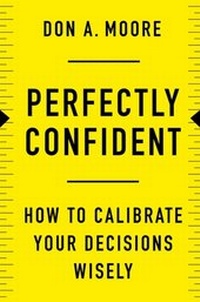
Perfectly Confident
Description

An expert on the psychology of decision making at Berkeley's Haas School of Business helps readers calibrate their confidence, arguing that some confidence is good, but overconfidence can hinder growth.
A surge of confidence can feel fantastic-offering a rush of energy, even a dazzling vision of the future. It can give us courage and bolster our determination when facing adversity. But if that self-assurance leads us to pursue impossible goals, it can waste time, money, and energy. Self-help books and motivational speakers tell us that the more confident we are, the better. But this way of thinking can lead to enormous trouble.
Decades of research demonstrates that we often have an over-inflated sense of self and are rarely as good as we believe. Perfectly Confident is the first book to bring together the best psychological and economic studies to explain exactly what confidence is, when it can be helpful, and when it can be destructive in our lives.
Confidence is an attitude that takes into account both personal feelings and the facts. Don Moore identifies the ways confidence behaves in real life and raises thought-provoking questions. How optimistic should you be about an uncertain future? What justifies your confidence in something amorphous and subjective like your attractiveness or sense of humor?
Moore reminds us that the key to success is to avoid being both over- and under-confident. In this essential guide, he shows how to become perfectly confident-how to strive for and maintain the well-calibrated, adaptive confidence that can elevate all areas of our lives.
This essential guide provides a crucial framework for replacing wishful thinking with actionable, evidence-based strategies.
- Well-Calibrated Confidence: Learn to find the 'just right' zone between the dangerous arrogance of overconfidence and the missed opportunities of underconfidence.
- The Planning Fallacy: Discover why we consistently underestimate how long things will take and learn a simple method for making more realistic forecasts for your projects.
- Smarter Risk Assessment: Move beyond gut feelings and wishful thinking to make better decisions about what paths to take in your career, investments, and life.
- Leadership and Influence: Understand how confidence is perceived by others, when it builds influence, and how to avoid the traps that have humbled even the most successful leaders.
- Evidence-Based Tools: Go beyond vague self-help advice with practical exercises and insights from decades of psychological research you can apply immediately.
All prices
More details
Other editions
Additional editions
Person
Don Moore is a Professor of Management of Organizations at the University of California at Berkeley's Haas School of Business, where he teaches popular courses in leadership, negotiations, and decision-making. He also consults on these topics.
With Max Bazerman, he is the coauthor of Judgment in Managerial Decision Making, one of the bestselling textbooks in the field. Additionally, Moore was one of the principal investigators on the Good Judgment Project, a forecasting tournament sponsored by the U.S. government's Intelligence Advanced Research Projects Activity (IARPA). The forecasters involved established an excellent record predicting the outcomes of major world events, and this project was chronicled by Philip Tetlock and Dan Gardner in their 2015 book, Superforecasting.
Moore has authored or coauthored columns published by The New Yorker, The Wall Street Journal, Businessweek, Fortune, Forbes Leadership Forum, USA Today, San Francisco Chronicle, Harvard Business Review, the Harvard Negotiation Newsletter, and others. His work has been covered in The New York Times, Money, The Wall Street Journal, The Economist, the Financial Times, The New Yorker, Businessweek, Forbes, Kiplinger's Personal Finance, The Washington Post, the Christian Science Monitor, USA Today, Entrepreneur, PBS's Nightly Business Report, CNN, NPR, KCBS, PredictablyIrrational.com, Freakonomics.com, and numerous other media outlets and websites. Moore writes a blog entitled Perfectly Confident for Psychology Today.
