

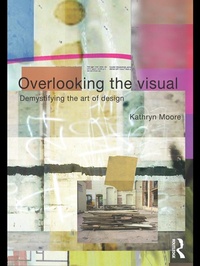
Overlooking the Visual
Demystifying the Art of Design
Published on 1. November 2010
272 pages
978-1-134-39358-9 (ISBN)
Description

Making tangible connections between theory and practice, ideas and form, this book encourages debate about the artistic, conceptual, and cultural significance of the way things look. What are the metaphysical concepts at the heart of design education, theory, and philosophy? Why do we assume that design is impossible to teach?
This book challenges the traditional foundations of perception and takes an imaginative, radical approach, setting itself apart from the traditions of analytical philosophy, evolutionary psychology, and phenomenology which underpin much of current design theory and discourse. The new definition of perception produces startling consequences for conceptions of language, intelligence, meaning, the senses, emotions and subjectivity. This is an innovative, fresh view on design and how we can improve it for both practitioners and students in the architecture and design fields as well as philosophers.
This book challenges the traditional foundations of perception and takes an imaginative, radical approach, setting itself apart from the traditions of analytical philosophy, evolutionary psychology, and phenomenology which underpin much of current design theory and discourse. The new definition of perception produces startling consequences for conceptions of language, intelligence, meaning, the senses, emotions and subjectivity. This is an innovative, fresh view on design and how we can improve it for both practitioners and students in the architecture and design fields as well as philosophers.
Reviews / Votes
"...this is a book designers ought to read, not least because it is a role model of how they could advocate theories in everyday prose that deals both clearly and rigorously with difficult philosophical and design issues." - Times Higher Education"[Overlooking the Visual] is ahead of the curve in the current task of reconnecting theory to application, positioning design knowledge as embodied, accessible, and reproducible." - Philip Plowright, Lawrence Technological University
"The book fills a gap in the literature whereby it makes a very important point from the perspective of landscape. My students so far have mostly all agreed with your argument, and actually found little to quarrel with..." - Gareth Doherty, Harvard University Graduate School of Design "...this is a book designers ought to read, not least because it is a role model of how they could advocate theories in everyday prose that deals both clearly and rigorously with difficult philosophical and design issues." - Times Higher Education
"[Overlooking the Visual] is ahead of the curve in the current task of reconnecting theory to application, positioning design knowledge as embodied, accessible, and reproducible." - Philip Plowright, Lawrence Technological University
"The book fills a gap in the literature whereby it makes a very important point from the perspective of landscape. My students so far have mostly all agreed with your argument, and actually found little to quarrel with..." -Gareth Doherty, Harvard University Graduate School of Design
More details
Language
English
Place of publication
London
United Kingdom
Publishing group
Taylor & Francis Ltd
Target group
College/higher education
Professional and scholarly
Illustrations
120 Farbfotos bzw. farbige Rasterbilder, 100 s/w Zeichnungen
100 Line drawings, black and white; 120 Halftones, color
File size
29,17 MB
ISBN-13
978-1-134-39358-9 (9781134393589)
Copyright in bibliographic data and cover images is held by Nielsen Book Services Limited or by the publishers or by their respective licensors: all rights reserved.
Schweitzer Classification
Other editions
Additional editions
Book
12/2009
1st Edition
Routledge
€282.16
Shipment within 15-20 days
Book
11/2009
1st Edition
Routledge
€80.63
Shipment within 15-20 days
Person
Kathryn Moore has lectured and published extensively on design quality, theory, education and practice. She is past President of the Landscape Institute, UK representative of IFLA, a design consultant, and is Professor at the Birmingham Institute of Art and Design, Birmingham City University, UK.
Content
Foreword Paul Shepheard Preface 1. Introduction 2. The Sensory Interface and Other Myths and Legends 3. Teaching the Unknowable 4. Aesthetics: The Truth, The Whole Truth and Universal Truth 5. Objectivity Without Neutrality 6. Studied Ignorance 7. Seeing is Believing 8. Theory into Practice. Bibliography
