

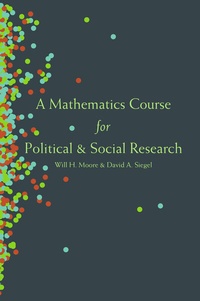
A Mathematics Course for Political and Social Research
Mathematics Course for Political and Social Research
1st Edition
Published on 16. June 2015
456 pages
978-1-4008-4861-4 (ISBN)
Description

Political science and sociology increasingly rely on mathematical modeling and sophisticated data analysis, and many graduate programs in these fields now require students to take a "math camp" or a semester-long or yearlong course to acquire the necessary skills. Available textbooks are written for mathematics or economics majors, and fail to convey to students of political science and sociology the reasons for learning often-abstract mathematical concepts. A Mathematics Course for Political and Social Research fills this gap, providing both a primer for math novices in the social sciences and a handy reference for seasoned researchers.
The book begins with the fundamental building blocks of mathematics and basic algebra, then goes on to cover essential subjects such as calculus in one and more than one variable, including optimization, constrained optimization, and implicit functions; linear algebra, including Markov chains and eigenvectors; and probability. It describes the intermediate steps most other textbooks leave out, features numerous exercises throughout, and grounds all concepts by illustrating their use and importance in political science and sociology.
- Uniquely designed and ideal for students and researchers in political science and sociology
- Uses practical examples from political science and sociology
- Features "Why Do I Care?" sections that explain why concepts are useful
- Includes numerous exercises
- Complete online solutions manual (available only to professors, email david.siegel at duke.edu, subject line "Solution Set")
- Selected solutions available online to students
The book begins with the fundamental building blocks of mathematics and basic algebra, then goes on to cover essential subjects such as calculus in one and more than one variable, including optimization, constrained optimization, and implicit functions; linear algebra, including Markov chains and eigenvectors; and probability. It describes the intermediate steps most other textbooks leave out, features numerous exercises throughout, and grounds all concepts by illustrating their use and importance in political science and sociology.
- Uniquely designed and ideal for students and researchers in political science and sociology
- Uses practical examples from political science and sociology
- Features "Why Do I Care?" sections that explain why concepts are useful
- Includes numerous exercises
- Complete online solutions manual (available only to professors, email david.siegel at duke.edu, subject line "Solution Set")
- Selected solutions available online to students
More details
Edition
Course Book
Language
English
Place of publication
Princeton, NJ
United States
Publishing group
De Gruyter
Target group
Professional and scholarly
Edition type
Digital original
Illustrations
57 line illus. 18 tables.
File size
3,21 MB
ISBN-13
978-1-4008-4861-4 (9781400848614)
Schweitzer Classification
Other editions
Additional editions
Will H. Moore | David A. Siegel
A Mathematics Course for Political and Social Research
Book
08/2013
Princeton University Press
€108.94
Article exhausted; check different version
Will H. Moore | David A. Siegel
A Mathematics Course for Political and Social Research
Book
08/2013
Princeton University Press
€56.00
Shipment within 10-20 days
Persons
Will H. Moore is professor of political science at Florida State University. David A. Siegel is associate professor of political science at Duke University. He is the coauthor of A Behavioral Theory of Elections (Princeton).
Content
List of Figures xi
List of Tables xii
Preface xv
I Building Blocks 1
1 Preliminaries 3
1.1 Variables and Constants 3
1.2 Sets 5
1.3 Operators 9
1.4 Relations 13
1.5 Level of Measurement 14
1.6 Notation 18
1.7 Proofs, or How Do We Know This? 22
1.8 Exercises 26
2 Algebra Review 28
2.1 Basic Properties of Arithmetic 28
2.2 Algebra Review 30
2.3 Computational Aids 40
2.4 Exercises 41
3 Functions, Relations, and Utility 44
3.1 Functions 45
3.2 Examples of Functions of One Variable 53
3.3 Preference Relations and Utility Functions 74
3.4 Exercises 78
4 Limits and Continuity, Sequences and Series, and More on Sets 81
4.1 Sequences and Series 81
4.2 Limits 84
4.3 Open, Closed, Compact, and Convex Sets 92
4.4 Continuous Functions 96
4.5 Exercises 99
II Calculus in One Dimension 101
5 Introduction to Calculus and the Derivative 103
5.1 A Brief Introduction to Calculus 103
5.2 What Is the Derivative? 105
5.3 The Derivative, Formally 109
5.4 Summary 114
5.5 Exercises 115
6 The Rules of Differentiation 117
6.1 Rules for Differentiation 118
6.2 Derivatives of Functions 125
6.3 What the Rules Are, and When to Use Them 130
6.4 Exercises 131
7 The Integral 133
7.1 The Defnite Integral as a Limit of Sums 134
7.2 Indefnite Integrals and the Fundamental Theorem of Calculus 136
7.3 Computing Integrals 140
7.4 Rules of Integration 148
7.5 Summary 149
7.6 Exercises 150
8 Extrema in One Dimension 152
8.1 Extrema 153
8.2 Higher-Order Derivatives, Concavity, and Convexity 157
8.3 Finding Extrema 162
8.4 Two Examples 169
8.5 Exercises 170
III Probability 173
9 An Introduction to Probability 175
9.1 Basic Probability Theory 175
9.2 Computing Probabilities 182
9.3 Some Specifc Measures of Probabilities 192
9.4 Exercises 194
9.5 Appendix 197
10 An Introduction to (Discrete) Distributions 198
10.1 The Distribution of a Single Concept (Variable) 199
10.2 Sample Distributions 202
10.3 Empirical Joint and Marginal Distributions 206
10.4 The Probability Mass Function 209
10.5 The Cumulative Distribution Function 216
10.6 Probability Distributions and Statistical Modeling 218
10.7 Expectations of Random Variables 229
10.8 Summary 239
10.9 Exercises 239
10.10 Appendix 241
11 Continuous Distributions 242
11.1 Continuous Random Variables 242
11.2 Expectations of Continuous Random Variables 249
11.3 Important Continuous Distributions for Statistical Modeling 258
11.4 Exercises 271
11.5 Appendix 272
IV Linear Algebra 273
12 Fun with Vectors and Matrices 275
12.1 Scalars 276
12.2 Vectors 277
12.3 Matrices 282
12.4 Properties of Vectors and Matrices 297
12.5 Matrix Illustration of OLS Estimation 298
12.6 Exercises 300
13 Vector Spaces and Systems of Equations 304
13.1 Vector Spaces 305
13.2 Solving Systems of Equations 310
13.3 Why Should I Care? 320
13.4 Exercises 324
13.5 Appendix 326
14 Eigenvalues and Markov Chains 327
14.1 Eigenvalues, Eigenvectors, and Matrix Decomposition 328
14.2 Markov Chains and Stochastic Processes 340
14.3 Exercises 351
V Multivariate Calculus and Optimization 353
15 Multivariate Calculus 355
15.1 Functions of Several Variables 356
15.2 Calculus in Several Dimensions 359
15.3 Concavity and Convexity Redux 371
15.4 Why Should I Care? 372
15.5 Exercises 374
16 Multivariate Optimization 376
16.1 Unconstrained Optimization 377
16.2 Constrained Optimization: Equality Constraints 383
16.3 Constrained Optimization: Inequality Constraints 391
16.4 Exercises 398
17 Comparative Statics and Implicit Differentiation 400
17.1 Properties of the Maximum and Minimum 401
17.2 Implicit Differentiation 405
17.3 Exercises 411
Bibliography 413
Index 423
List of Tables xii
Preface xv
I Building Blocks 1
1 Preliminaries 3
1.1 Variables and Constants 3
1.2 Sets 5
1.3 Operators 9
1.4 Relations 13
1.5 Level of Measurement 14
1.6 Notation 18
1.7 Proofs, or How Do We Know This? 22
1.8 Exercises 26
2 Algebra Review 28
2.1 Basic Properties of Arithmetic 28
2.2 Algebra Review 30
2.3 Computational Aids 40
2.4 Exercises 41
3 Functions, Relations, and Utility 44
3.1 Functions 45
3.2 Examples of Functions of One Variable 53
3.3 Preference Relations and Utility Functions 74
3.4 Exercises 78
4 Limits and Continuity, Sequences and Series, and More on Sets 81
4.1 Sequences and Series 81
4.2 Limits 84
4.3 Open, Closed, Compact, and Convex Sets 92
4.4 Continuous Functions 96
4.5 Exercises 99
II Calculus in One Dimension 101
5 Introduction to Calculus and the Derivative 103
5.1 A Brief Introduction to Calculus 103
5.2 What Is the Derivative? 105
5.3 The Derivative, Formally 109
5.4 Summary 114
5.5 Exercises 115
6 The Rules of Differentiation 117
6.1 Rules for Differentiation 118
6.2 Derivatives of Functions 125
6.3 What the Rules Are, and When to Use Them 130
6.4 Exercises 131
7 The Integral 133
7.1 The Defnite Integral as a Limit of Sums 134
7.2 Indefnite Integrals and the Fundamental Theorem of Calculus 136
7.3 Computing Integrals 140
7.4 Rules of Integration 148
7.5 Summary 149
7.6 Exercises 150
8 Extrema in One Dimension 152
8.1 Extrema 153
8.2 Higher-Order Derivatives, Concavity, and Convexity 157
8.3 Finding Extrema 162
8.4 Two Examples 169
8.5 Exercises 170
III Probability 173
9 An Introduction to Probability 175
9.1 Basic Probability Theory 175
9.2 Computing Probabilities 182
9.3 Some Specifc Measures of Probabilities 192
9.4 Exercises 194
9.5 Appendix 197
10 An Introduction to (Discrete) Distributions 198
10.1 The Distribution of a Single Concept (Variable) 199
10.2 Sample Distributions 202
10.3 Empirical Joint and Marginal Distributions 206
10.4 The Probability Mass Function 209
10.5 The Cumulative Distribution Function 216
10.6 Probability Distributions and Statistical Modeling 218
10.7 Expectations of Random Variables 229
10.8 Summary 239
10.9 Exercises 239
10.10 Appendix 241
11 Continuous Distributions 242
11.1 Continuous Random Variables 242
11.2 Expectations of Continuous Random Variables 249
11.3 Important Continuous Distributions for Statistical Modeling 258
11.4 Exercises 271
11.5 Appendix 272
IV Linear Algebra 273
12 Fun with Vectors and Matrices 275
12.1 Scalars 276
12.2 Vectors 277
12.3 Matrices 282
12.4 Properties of Vectors and Matrices 297
12.5 Matrix Illustration of OLS Estimation 298
12.6 Exercises 300
13 Vector Spaces and Systems of Equations 304
13.1 Vector Spaces 305
13.2 Solving Systems of Equations 310
13.3 Why Should I Care? 320
13.4 Exercises 324
13.5 Appendix 326
14 Eigenvalues and Markov Chains 327
14.1 Eigenvalues, Eigenvectors, and Matrix Decomposition 328
14.2 Markov Chains and Stochastic Processes 340
14.3 Exercises 351
V Multivariate Calculus and Optimization 353
15 Multivariate Calculus 355
15.1 Functions of Several Variables 356
15.2 Calculus in Several Dimensions 359
15.3 Concavity and Convexity Redux 371
15.4 Why Should I Care? 372
15.5 Exercises 374
16 Multivariate Optimization 376
16.1 Unconstrained Optimization 377
16.2 Constrained Optimization: Equality Constraints 383
16.3 Constrained Optimization: Inequality Constraints 391
16.4 Exercises 398
17 Comparative Statics and Implicit Differentiation 400
17.1 Properties of the Maximum and Minimum 401
17.2 Implicit Differentiation 405
17.3 Exercises 411
Bibliography 413
Index 423
