

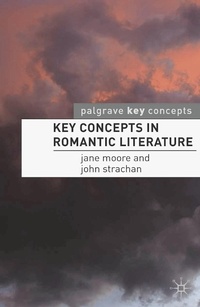
Key Concepts in Romantic Literature
1st Edition
Published on 10. September 2010
224 pages
978-1-350-31037-7 (ISBN)
Description

Key Concepts in Romantic Literature is an accessible and easy-to-use scholarly guide to the literature, criticism and history of the culturally rich and politically turbulent Romantic era (1789-1832). The book offers a comprehensive and critically up-to-date account of the fascinating poetry, novels and drama which characterized the Romantic period alongside an historically-informed account of the important social, political and aesthetic contexts which shaped that body of writing.
The epochal poetry of William Wordsworth, William Blake, Mary Robinson, S. T. Coleridge, Charlotte Smith, P. B. Shelley, Lord Byron, John Keats, Felicia Hemans and Letitia Elizabeth Landon; the drama of Joanna Baillie and Charles Robert Maturin; the novels of Jane Austen and Mary Shelley; all of these figures and many more are insightfully discussed here, together with clear and helpful accounts of the key contexts of the age's literature (including the French Revolution, slavery, industrialisation, empire and the rise of feminism) as well as accounts of perhaps less familiar aspects of late Georgian culture (such as visionary spirituality, atheism, gambling, fashion, music and sport). This is the broadest guide available to late eighteenth and early 19th century British and Irish literature, history and culture.
The epochal poetry of William Wordsworth, William Blake, Mary Robinson, S. T. Coleridge, Charlotte Smith, P. B. Shelley, Lord Byron, John Keats, Felicia Hemans and Letitia Elizabeth Landon; the drama of Joanna Baillie and Charles Robert Maturin; the novels of Jane Austen and Mary Shelley; all of these figures and many more are insightfully discussed here, together with clear and helpful accounts of the key contexts of the age's literature (including the French Revolution, slavery, industrialisation, empire and the rise of feminism) as well as accounts of perhaps less familiar aspects of late Georgian culture (such as visionary spirituality, atheism, gambling, fashion, music and sport). This is the broadest guide available to late eighteenth and early 19th century British and Irish literature, history and culture.
More details
Series
Edition
1. Auflage
Language
English
Place of publication
London
United Kingdom
Publishing group
Bloomsbury Publishing PLC
Target group
College/higher education
ISBN-13
978-1-350-31037-7 (9781350310377)
Copyright in bibliographic data and cover images is held by Nielsen Book Services Limited or by the publishers or by their respective licensors: all rights reserved.
Schweitzer Classification
Other editions
Additional editions
Jane Moore | John Strachan
Key Concepts in Romantic Literature
Book
09/2010
Red Globe Press
€41.50
Shipment within 10-20 days
Persons
JANE MOORE is Reader in English Literature and Critical and Cultural Theory at Cardiff University, UK. She is an experienced teacher of Romantic women's writing and Romantic poetry and has published widely in these fields, most particularly, Mary Wollstonecraft (1999) and, more recently, The Satires of Thomas Moore (2003). She is co-editor (with Catherine Belsey) of The Feminist Reader: Essays in Gender and the Politics of Literary Criticism, (2nd Edition, 1997).
JOHN STRACHAN is Professor of Romantic Literature at the University of Sunderland, UK. He is the author of Advertising and Satirical Culture in the Romantic Period (2007) and the editor of many editions of Romantic poetry including British Satire 1785-1840 (2003), the Poems of John Keats: A Sourcebook (2003) and Leigh Hunt's Poetical Works (2003). He is Associate Editor for Romanticism for the Oxford Companion to English Literature (7th edition, 2009).
JOHN STRACHAN is Professor of Romantic Literature at the University of Sunderland, UK. He is the author of Advertising and Satirical Culture in the Romantic Period (2007) and the editor of many editions of Romantic poetry including British Satire 1785-1840 (2003), the Poems of John Keats: A Sourcebook (2003) and Leigh Hunt's Poetical Works (2003). He is Associate Editor for Romanticism for the Oxford Companion to English Literature (7th edition, 2009).
Content
What is Romanticism?'
An introductory discussion which clearly addresses the vexed critical question of the nature of Romanticism
'Historical Definitions and Conceptualizations of Romanticism'?
Discusses the changing manner in which Romanticism has been understood from the late eighteenth century to the present day
'CONTEXTS: History, Politics, Culture'
Detailed and clearly written accounts of the momentous historical, political and social issues and events which shaped the Romantic period from the French Revolution onwards. After an account of British Politics from 1789 to 1832, subsequent chapters here include 'Empire and Travel', 'Feminism and the Position of Women', 'Industry and Economics', 'Ireland and the 'Catholic Question', 'Medicine and Science', 'Religion and Atheism', 'Sexualities' and 'Slavery, Abolition and African-British Literature'
'TEXTS: Themes, Issues, Concepts?
This section addresses the key themes of Romantic literature, beginning with an account of the poetry of Wordsworth, Coleridge, Blake, Smith, and Robinson, and a discussion of their successors Byron, Shelley, Keats, Hemans, and Landon. Other chapters include 'Joanna Baillie and Romantic-Era Drama', 'Irish, Scottish and Welsh Poetry', 'Medievalism, the Sublime and the Gothic', 'The Novel' and 'Satire'
'CRITICISM: Approaches, Theory, Practice'?
Discusses criticism of the Romantics from the early nineteenth century to the present day. Chapters include 'Contemporary and Victorian Reception', 'Twentieth
Century Criticism from Modernism to the New Criticism', and 'Modern Critical Approaches'. This last section offers a guide to the critical movements which have transformed Romantic studies from the 1980s in accounts of criticism 'From Deconstruction to Post
Colonial and Psychoanalytical Criticism', 'From Historicism to Ecological Criticism' and 'Gender Criticism'.
An introductory discussion which clearly addresses the vexed critical question of the nature of Romanticism
'Historical Definitions and Conceptualizations of Romanticism'?
Discusses the changing manner in which Romanticism has been understood from the late eighteenth century to the present day
'CONTEXTS: History, Politics, Culture'
Detailed and clearly written accounts of the momentous historical, political and social issues and events which shaped the Romantic period from the French Revolution onwards. After an account of British Politics from 1789 to 1832, subsequent chapters here include 'Empire and Travel', 'Feminism and the Position of Women', 'Industry and Economics', 'Ireland and the 'Catholic Question', 'Medicine and Science', 'Religion and Atheism', 'Sexualities' and 'Slavery, Abolition and African-British Literature'
'TEXTS: Themes, Issues, Concepts?
This section addresses the key themes of Romantic literature, beginning with an account of the poetry of Wordsworth, Coleridge, Blake, Smith, and Robinson, and a discussion of their successors Byron, Shelley, Keats, Hemans, and Landon. Other chapters include 'Joanna Baillie and Romantic-Era Drama', 'Irish, Scottish and Welsh Poetry', 'Medievalism, the Sublime and the Gothic', 'The Novel' and 'Satire'
'CRITICISM: Approaches, Theory, Practice'?
Discusses criticism of the Romantics from the early nineteenth century to the present day. Chapters include 'Contemporary and Victorian Reception', 'Twentieth
Century Criticism from Modernism to the New Criticism', and 'Modern Critical Approaches'. This last section offers a guide to the critical movements which have transformed Romantic studies from the 1980s in accounts of criticism 'From Deconstruction to Post
Colonial and Psychoanalytical Criticism', 'From Historicism to Ecological Criticism' and 'Gender Criticism'.
