

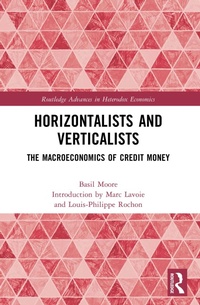
Horizontalists and Verticalists
The Macroeconomics of Credit Money
Published on 7. November 2025
404 pages
978-1-040-43714-8 (ISBN)
Description

This anniversary edition of Basil Moore's classic work features the original text along with an extensive new introduction and foreword. Providing much of the theoretical foundation on which post-Keynesian endogenous money and Modern Monetary Theory were subsequently developed, this seminal work continues to challenge the validity of much of mainstream monetary macroeconomics.
Basil Moore argues that the money supply in modern economies is not under the control of central banks, but is determined by borrower demand for bank credit. In his analysis, Moore distinguishes sharply between commodity, fiat, and credit money, arguing that much of mainstream macroeconomic theory is not appropriate to contemporary credit money economies. Mainstream analysis takes the view that central banks have it in their power to initiate exogenous changes in the nominal supply of money. This 'Verticalist' view maintains that monetary change originates from the changes in the high-powered base, which allegedly are under the control of the central bank. Moore, in contrast, contends that the supply of credit money is endogenous and responds to changes in the demand for bank credit. Central bank open-market operations affect how required reserves are supplied between borrowed and nonborrowed reserves, rather than the total volume of reserves that is endogenously determined. This 'Horizontalist' view holds that central banks have the ability to set exogenously the supply price of the money market, but not the quantity of credit money. It follows that all models that treat the supply of credit as exogenous are fundamentally misspecified and conventional views about the forces determining the money supply, national income, interest rates, exchange rates, inflation, and the role of saving are fundamentally in error.
This book remains required reading for anyone interested in macroeconomics, central banking, and monetary theory.
Basil Moore argues that the money supply in modern economies is not under the control of central banks, but is determined by borrower demand for bank credit. In his analysis, Moore distinguishes sharply between commodity, fiat, and credit money, arguing that much of mainstream macroeconomic theory is not appropriate to contemporary credit money economies. Mainstream analysis takes the view that central banks have it in their power to initiate exogenous changes in the nominal supply of money. This 'Verticalist' view maintains that monetary change originates from the changes in the high-powered base, which allegedly are under the control of the central bank. Moore, in contrast, contends that the supply of credit money is endogenous and responds to changes in the demand for bank credit. Central bank open-market operations affect how required reserves are supplied between borrowed and nonborrowed reserves, rather than the total volume of reserves that is endogenously determined. This 'Horizontalist' view holds that central banks have the ability to set exogenously the supply price of the money market, but not the quantity of credit money. It follows that all models that treat the supply of credit as exogenous are fundamentally misspecified and conventional views about the forces determining the money supply, national income, interest rates, exchange rates, inflation, and the role of saving are fundamentally in error.
This book remains required reading for anyone interested in macroeconomics, central banking, and monetary theory.
Reviews / Votes
"Basil Moore was the pioneer of realistic, and empirically grounded, analysis of banking. To the myth of Loanable Funds, he simply said 'Loans Create Deposits', 45 years before the Bank of England conceded the same point. He was a pioneer in recognising that the economy is a complex system, not an evolutionary one. This book defined the foundations of post-Keynesian thought in endogenous money and complexity theory."Steve Keen, Independent economist
"Basil's book is a timeless classic for young scholars, shaping generations of post-Keynesians in their understanding of endogenous money and the flaws of monetarism - which, unfortunately, still persist in mainstream economics, albeit in subtler forms. This new edition will surely renew its influence among young economists - hopefully, going beyond heterodox circles."
Sylvio Kappes, Assistant Professor of Macroeconomics, Federal University of Alagoas, Brazil. Co-editor, Review of Political Economy
More details
Series
Language
English
Place of publication
London
United Kingdom
Publishing group
Taylor & Francis Ltd
Target group
College/higher education
Illustrations
35 Tables, black and white; 11 Halftones, black and white; 11 Illustrations, black and white
File size
3,98 MB
ISBN-13
978-1-040-43714-8 (9781040437148)
Copyright in bibliographic data and cover images is held by Nielsen Book Services Limited or by the publishers or by their respective licensors: all rights reserved.
Schweitzer Classification
Other editions
Additional editions
Book
11/2025
1st Edition
Routledge
€207.50
Shipment within 10-20 days
Person
Basil Moore was a leading Post-Keynesian Economist and a main Advocate of the Horizontalist view of endogenous money. Born in Canada, Moore pursued his studies at the University of Toronto as well as at Johns Hopkins University. In 1958, Moore started a long and distinguished career, first as a member of the faculty at Wesleyan University, and then, starting in 1993, he joined the University of Stellenbosch, in South Africa, until he passed away, in 2018.
Introduction by:
Louis-Philippe Rochon is Full Professor of Economics at Laurentian University, Canada, where he has been teaching since 2004.
Marc Lavoie is Professor Emeritus at both the University of Ottawa and the University of Sorbonne Paris Nord (Paris 13).
Introduction by:
Louis-Philippe Rochon is Full Professor of Economics at Laurentian University, Canada, where he has been teaching since 2004.
Marc Lavoie is Professor Emeritus at both the University of Ottawa and the University of Sorbonne Paris Nord (Paris 13).
Content
Part I The endogeneity of credit money 1 The differences between commodity, fiat, and credit money 2 Contemporary commercial banking 3 A simple model of bank intermediation 4 The money "multiplier" 5 The endogeneity of the high-powered base 6 The U.S. money supply process 7 A causality analysis of the determinants of money growth 8 Keynes and the endogeneity of credit money Part II The macroeconomic implications of monetary endogeneity 9 The determination of the nominal money supply 10 Interest rates: a real or monetary phenomenon? 11 Interest rates: an exogenous policy variable 12 Monetary change, deficit spending, and the growth of aggregate demand 13 The determination of the real money supply 14 Inflation and velocity 15 The dynamics of disequilibrium: toward a new macroeconomic paradigm Bibliography Index
