

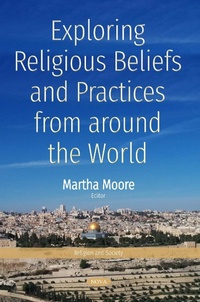
Exploring Religious Beliefs and Practices from around the World
Published on 1. May 2018
177 pages
978-1-5361-3867-2 (ISBN)
Description

Exploring Religious Beliefs and Practices from around the World sets out to identify the languages that the Catholic Church uses for its religious rites in the highly multilingual setting of the Southwest Region of Cameroon on the one hand, and to work out the reasons that determine the choice of these languages out of the many available codes on the other hand. The data were collected in the main church of the following eight localities: Bangem, Buea, Kumba, Limbe, Mamfe, Mundemba, Tiko and Tombel. Next, the authors discuss how Jerusalem has served as a magnet for devout pilgrims who wished to visit the New Testament sites. This pilgrim movement required the development of support systems to accommodate these travellers and their needs. In the 12th century, these support structures translated into the various Crusader Monastic Orders that had separate establishments in Jerusalem and eventually in Acre after the Christian forces were expelled from the city by Salah al-Din in 1187. Continuing, a paper is included which investigates language practice by Moslem faithfuls in multilingual settings of Northern Cameroon. It focuses on the Friday prayer, the most important of all the statutory prayers. The data were collected through participant observation, a nineteen-item questionnaire (administered in the main three towns of this half of the country, namely Maroua, Garoua and Ngaoundere), library and internet search and personal communication with worshipers. Lastly, this book aims to decipher how participants manage multilingualism in religious settings, through the functional structural framework (Kouega, 2008) which consists of breaking up a church service into its constituent parts and sorting out language use for each part. The data were collected in eight Protestant churches through participant observation and a questionnaire. The analysis of the data revealed that multilingualism is addressed in socio-religious multilingual settings through eight main communication strategies, namely code-switching, borrowing, random alternation, chorus recitation, summarizing, paraphrasing, repetition, and translation.
More details
Other editions
Additional editions
Book
07/2018
Nova Science Publishers Inc
€172.60
Shipment within 15-20 days
Content
- Intro
- Contents
- Preface
- Chapter 1
- Language Use and Religious Rites in the Catholic Church in Multilingual Settings: The Case of the Southwest Region of Cameroon
- Abstract
- Introduction
- Background to the Study
- Review of Past Works
- Methodology
- Data Analysis and Discussion
- Structure of a Catholic Church Mass
- Languages Used by the Participants
- The Celebrant or Priest
- Languages Used by the Congregation in the Southwest Region
- Languages Used by the Choirs
- Languages Used for Certain Activities
- Languages Used to do the First Reading
- Languages Used to do the Second Reading
- Languages Used to Make Announcements
- Other Activities Carried Out in Church
- Uses of Languages in the Southwest Region
- Akoose (203)
- Bamileke
- Duala (215)
- Ejagham (174)
- English
- French
- Igbo
- Kenyang (175)
- Kom (127)
- Lamnso (137)
- Latin
- Lingala
- Mungaka (185)
- Oroko (206)
- Pidgin English
- Others
- Factors Motivating Language Choice
- Bangem
- Buea
- Kumba
- Limbe
- Mamfe
- Mundemba
- Tiko
- Tombel
- Congregants' Attitude to the Selected Languages
- Conclusion
- Appendix
- Questionnaire
- References
- Biographical Sketch
- Chapter 2
- Pilgrim Services in Jerusalem during the Early Medieval Period
- Abstract
- Introduction
- Xenodocheum Services
- Leprosarium Sancti Lazari
- Pilgrim Protection
- Conclusion
- References
- Chapter 3
- Language Practice in Multilingual Islamic Northern Cameroon
- Abstract
- 1. Introduction
- 1.1. Islam in Far North Cameroon
- 1.2. Islam in North Cameroon
- 1.3. Islam in the Adamawa Region
- 2. Review of Literature
- 2.1. The Sociolinguistic Approach
- 2.2. The Applied Linguistic Approach
- 2.3. The Structural-Functional Approach
- 3. Methodology
- 3.1. Informants
- 3.2. Instruments
- 3.2.1. The Questionnaire
- 3.2.1.1. Format of the Questionnaire
- 3.2.1.2. The Administration of the Questionnaire
- 3.2.2. Interviews
- 3.2.3. Participant Observation
- 4. Data Analysis
- 4.1. Language Use in the Mosque of the Three Regions
- 4.2. The Sociolinguistic Features of the Languages Identified
- 4.2.1. Arabic
- 4.2.2. French
- 4.2.3. Fulfulde
- 4.2.4. Hausa
- 4.2.5. Kanuri
- 4.2.6. Shuwa Arabic
- 4.2.7. Wandala
- Conclusion
- Research Question 1
- Research Question 2
- Research Question 3
- Research Question 4
- Research Question 5
- Research Question 6
- Research Question 7
- Appendix: Sample Questionnaire Used for Data Collection
- References
- Biographical Sketch
- Chapter 4
- Communication Strategies in Socio-Religious Multilingual Settings: The Case of Some Protestant Churches in Cameroon
- Abstract
- 1. Introduction
- 2. Methodology
- 3. Language Use Scenarios
- 3.1. The Cameroon Baptist Convention (CBC), Etoug-Ebe Church
- 3.2. Eglise Baptiste Camerounaise (EBC), Ebénézer Church
- 3.3. Eglise Protestante Africaine (EPA), Yaoundé-Melen-Philadelphie Parish
- 3.4. Eglise Presbytérienne Camerounaise (EPC), Oyom-Abang Parish
- 3.5. Eglise Evangélique du Cameroun (EEC), Maroua-Hardé Parish
- 3.6. Eglise Evangélique Luthérienne Camerounaise (EELC), Djoungolo Parish
- 3.7. Eglise Fraternelle Luthérienne Camerounaise (EFLSC), Mimboman Parish
- 3.8. The Presbyterian Church Nsimeyong
- 4. Communication Strategies
- 4.1. Code-Switching
- 4.2. Borrowing
- 4.3. Random Alternation
- 4.4. Chorus Recitation
- 4.5. Summarising
- 4.6. Paraphrasing
- 4.7. Repetition or Duplication
- 4.8. Translation
- 5. Communication Strategies and Patterns of Religious Practices
- 5.1. Pattern 1 Religious Practices
- 5.2. Pattern 2 Religious Practices
- 5.3. Pattern 3 Religious Practices
- 5.4. Pattern 4 Religious Practices
- 5.5. Pattern 5 Religious Practices
- Conclusion
- References
- Biographical Sketch
- Index
- Blank Page
