

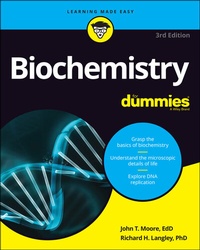
Biochemistry For Dummies
Description

It's alive! It's alive! (Thanks to biochemistry, that is.)
Biochemistry is the science of the chemical processes that allow for...well...life. If it moves, breathes, eats, or sleeps, biochemistry can probably explain how. So, it stands to reason that the fundamentals of biochemistry can get a little complicated.
In Biochemistry For Dummies, you'll explore the carbons, proteins, and cellular systems that make up the biochemical processes that create and sustain life of all kinds. Perfect for students majoring in biology, chemistry, pre-med, health-services, and other science-related fields, this book tracks a typical college-level biochemistry class. It simplifies and clarifies the subject with easy-to-follow diagrams and real-world examples. You'll also get:
- Explorations of cell biology, carbohydrates, proteins, lipids, and other fundamental building blocks of life
- Discussions of the basic structures common to all living organisms
- Treatments of the microscopic details of life that make us all tick
If you're looking for a hand with some of the trickier parts of biochemistry-or you just need an accessible overview of the subject-check out Biochemistry For Dummies today!
More details
Other editions
Additional editions
Content
- Intro
- Title Page
- Copyright Page
- Table of Contents
- Introduction
- About This Book
- Foolish Assumptions
- Icons Used in This Book
- Beyond the Book
- Where to Go from Here
- Part 1 Setting the Stage: Basic Biochemistry Concepts
- Chapter 1 Biochemistry: What You Need to Know and Why
- Why Biochemistry?
- What Is Biochemistry and Where Does It Take Place?
- Types of Living Cells
- Prokaryotes
- Eukaryotes
- Animal Cells and How They Work
- A Brief Look at Plant Cells
- Chapter 2 Seems So Basic: Water Chemistry and pH
- The Fundamentals of H2O
- Let's get wet! The physical properties of water
- Water's most important biochemical role: The solvent
- Hydrogen Ion Concentration: Acids and Bases
- Achieving equilibrium
- Understanding the pH scale
- Calculating pOH
- Applying the Brønsted-Lowry theory
- Buffers and pH Control
- Chapter 3 Fun with Carbon: Organic Chemistry
- The Role of Carbon in the Study of Life
- It's All in the Numbers: Carbon Bonds
- When Forces Attract: Bond Strengths
- Everybody has 'em: Intermolecular forces
- Water-related interactions: Both the lovers and the haters
- How bond strengths affect physical properties of substances
- Getting a Reaction out of a Molecule: Functional Groups
- Hydrocarbons
- Functional groups with oxygen and sulfur
- Functional groups containing nitrogen
- Functional groups containing phosphorus
- Reactions of functional groups
- pH and functional groups
- Same Content, Different Structure: Isomerism
- Cis-trans isomers
- Chiral carbons
- Part 2 The Meat of Biochemistry: Proteins
- Chapter 4 Amino Acids: The Building Blocks of Protein
- General Properties of Amino Acids
- Amino acids are positive and negative: The zwitterion formation
- Protonated? pH and the isoelectric point
- Asymmetry: Chiral amino acids
- The Magic 20 Amino Acids
- Nonpolar (hydrophobic) and uncharged amino acids
- Polar (hydrophilic) and uncharged amino acids
- Acidic amino acids
- Basic amino acids
- Lest We Forget: Rarer Amino Acids
- Rudiments of Amino Acid Interactions
- Intermolecular forces: How an amino acid interacts with other molecules
- Altering interactions by changing the pH
- Combining Amino Acids: How It Works
- The peptide bond and the dipeptide
- Tripeptide: Adding an amino acid to a dipeptide
- Chapter 5 Protein Structure and Function
- Proteins: Not Just for Dinner
- Primary Structure: The Structure Level All Proteins Have
- Building a protein: Outlining the process
- Organizing the amino acids
- Example: The primary structure of insulin
- Secondary Structure: A Structure Level Most Proteins Have
- The -helix
- The -pleated sheet
- -turns and the -loops
- Tertiary Structure: A Structure Level Many Proteins Have
- Quaternary Structure: A Structure Level Some Proteins Have
- Dissecting a Protein for Study
- Separating proteins within a cell and purifying them
- Digging into the details: Uncovering a protein's amino acid sequence
- Chapter 6 Enzyme Kinetics: Getting There Faster
- Enzyme Classification: The Best Catalyst for the Job
- Up one, down one: Oxidoreductases
- You don't belong here: Transferases
- Water does it again: Hydrolases
- Taking it apart: Lyases
- Shuffling the deck: Isomerases
- Putting it together: Ligases
- Enzymes as Catalysts: When Fast Is Not Fast Enough
- All about Kinetics
- Enzyme assays: Fixed time and kinetics
- Rate determination: How fast is fast?
- Measuring Enzyme Behavior: The Michaelis-Menten Equation
- Ideal applications
- Realistic applications
- Here we go again: Lineweaver-Burk plots
- Graphing kinetics data
- Enzyme Inhibition: Slowing It Down
- Competitive inhibition
- Noncompetitive inhibition
- Graphing inhibition
- Enzyme Regulation
- Part 3 Carbohydrates, Lipids, Nucleic Acids, and More, Oh My!
- Chapter 7 What We Crave: Carbohydrates
- Properties of Carbohydrates
- They contain one or more chiral carbons
- They have multiple chiral centers
- A Sweet Topic: Monosaccharides
- The most stable monosaccharide structures: Pyranose and furanose forms
- Chemical properties of monosaccharides
- Derivatives of monosaccharides
- The most common monosaccharides
- The beginning of life: Ribose and deoxyribose
- Sugars Joining Hands: Oligosaccharides
- Keeping it simple: Disaccharides
- Starch and cellulose: Polysaccharides
- The Aldose Family of Sugars
- Chapter 8 Lipids and Membranes
- Lovely Lipids: An Overview
- Behavior of lipids
- Fatty acids in lipids
- A Fatty Subject: Triglycerides
- Properties and structures of fats
- Cleaning up: Breaking down a triglyceride
- No Simpletons Here: Complex Lipids
- Phosphoglycerides
- Sphingolipids
- Sphingophospholipids
- Membranes: The Bipolar and the Bilayer
- Crossing the wall: Membrane transport
- Steroids: Pumping up
- Prostaglandins, Thromboxanes, and Leukotrienes: Mopping Up
- Chapter 9 Nucleic Acids and the Code of Life
- Nucleotides: The Guts of DNA and RNA
- Reservoir of genetic info: Nitrogen bases
- The sweet side of life: The sugars
- The sour side of life: Phosphoric acid
- Tracing the Process: From Nucleoside to Nucleotide to Nucleic Acid
- First reaction: Nitrogen base + 5-carbon sugar = nucleoside
- Second reaction: Phosphoric acid + nucleoside = nucleotide
- Third reaction: Nucleotide becomes nucleic acid
- A Primer on Nucleic Acids
- DNA and RNA in the grand scheme of life
- Nucleic acid structure
- Chapter 10 Vitamins: Both Simple and Complex
- More than One-a-Day: Basics of Vitamins
- To B or Not to B: B Complex Vitamins
- Vitamin B1 (thiamine)
- Vitamin B2 (riboflavin)
- Vitamin B3 (niacin)
- Vitamin B6 (pyridoxine)
- Biotin
- Folic acid
- Pantothenic acid
- The wonders of vitamin B12
- Vitamin A
- Vitamin C
- Vitamin D
- Vitamin E
- Vitamin K
- Chapter 11 Hormones: The Body's Messengers
- Structures of Some Key Hormones
- Proteins
- Steroids
- Amines
- Now and Later: Prohormones
- Proinsulin
- Angiotensinogen
- Fight or Flight: Hormone Function
- Opening the letter: Hormonal action
- Models of hormonal action
- Part 4 Bioenergetics and Pathways
- Chapter 12 Life and Energy
- ATP: The Energy Pony Express
- ATP and free energy
- ATP as an energy transporter
- It's Relative: Molecules Related to ATP
- The nucleoside triphosphate family
- As easy as 1, 2, 3: AMP, ADP, and ATP
- Where It All Comes From
- Chapter 13 ATP: The Body's Monetary System
- Metabolism I: Glycolysis
- Glycolysis: Phase I
- Glycolysis: Phase II
- Releasing the power: Energy efficiency
- Going in reverse: Gluconeogenesis
- Alcoholic fermentation: We'll drink to that
- Metabolism II: Citric Acid (Krebs) Cycle
- Let's get started: Synthesis of acetyl-CoA
- Three's a crowd: Tricarboxylic acids
- Oxidative decarboxylation
- Production of succinate and GTP
- Oxaloacetate regeneration
- Amino acids as energy sources
- Electron Transport and Oxidative Phosphorylation
- The electron transport system
- Oxidative phosphorylation
- Proposed mechanisms
- ATP production
- Involving the fats: ß-oxidation cycle
- Not so heavenly bodies: Ketone bodies
- Investing in the Future: Biosynthesis
- Fatty acids
- Membrane lipids
- Amino acids
- Chapter 14 Smelly Biochemistry: Nitrogen in Biological Systems
- Ring in the Nitrogen: Purine
- Biosynthesis of purine
- How much will it cost?
- Pyrimidine Synthesis
- First step: Carbamoyl phosphate
- Next step: Orotate
- Last step: Cytidine
- Back to the Beginning: Catabolism
- Nucleotide catabolism
- Amino acid catabolism
- Heme catabolism
- Process of Elimination: The Urea Cycle
- Amino Acids Once Again
- Metabolic Disorders
- Gout
- Lesch-Nyhan syndrome
- Albinism
- Alkaptonuria
- Phenylketonuria
- Part 5 Genetics: Why We Are What We Are
- Chapter 15 Photocopying DNA
- Let's Do It Again: Replication
- DNA polymerases
- The current model of DNA replication
- Mechanisms of DNA repair
- Mutation: The good, the bad, and the ugly
- Restriction enzymes
- Mendel Rolling Over: Recombinant DNA
- Patterns: Determining DNA Sequences
- Getting charged up about gel electrophoresis
- Determining the base sequence
- The butler did it: Forensic applications
- Genetic Diseases and Other DNA Testing Applications
- Sickle cell anemia
- Hemochromatosis
- Cystic fibrosis
- Hemophilia
- Tay-Sachs disease
- Chapter 16 Transcribe This! RNA Transcription
- Types of RNA
- RNA Polymerase Requirements
- Making RNA: The Basics
- Promoting transcription of RNA
- Prokaryotic cells
- Eukaryotic cells
- Not a Secret Any Longer: The Genetic Code
- Codons
- Alpha and omega
- Models of Gene Regulation
- The Jacob-Monod (operon) model
- Regulation of eukaryotic genes
- Chapter 17 Translation: Protein Synthesis
- Hopefully Not Lost in Translation
- Who needs translation, anyway?
- Home, home in the ribosome
- The Translation Team
- The team captain: rRNA
- Here's the snap: mRNA
- Carrying the ball: tRNA
- Charging up the middle: Amino acid activation
- Hooking Up: Protein Synthesis
- Activation
- Initiation
- Elongation
- Termination
- The wobble hypothesis
- Variation in Eukaryotic Cells
- Ribosomes
- Initiator-tRNA
- Initiation
- Elongation and termination
- Part 6 The Part of Tens
- Chapter 18 Ten Great Applications of Biochemistry
- Ames Test
- Pregnancy Testing
- HIV Testing
- Breast Cancer Testing
- Prenatal Genetic Testing
- PKU Screening
- Genetically Modified Foods
- Genetic Engineering
- Cloning
- Gene-Replacement Therapy
- Chapter 19 Ten Biochemistry Careers
- Research Assistant
- Nanotechnologist
- Quality Control Analyst
- Clinical Research Associate
- Technical Writer
- Biochemical Development Engineer
- Forensic Scientist
- Patent Attorney
- Pharmaceutical Sales Representative
- Biostatistician
- Index
- EULA
